This year, Han Kuang Exercise 42 adopted the U.S. military model for the first time by introducing an embedded journalist system. Civilian reporters are allowed to follow military units 24/7 up close, enabling strategic communication through real-time reporting. Storm Media accompanied the Second Operational Area for on-site coverage. Given that the Hualien region hosts the Jiashan Base and Hualien Airport, the Second Operational Area assumes that the enemy may conduct anti-airborne operations and infiltrate large numbers of special agents and mainland-affiliated personnel into the operational zone. These infiltrators could use handguns or chemical substances to sabotage key positions, weaken military combat effectiveness, and prevent reinforcements from moving northward.
To counter potential enemy actions, Storm Media directly observed the Second Operational Area simulating an enemy special agent releasing toxic gas at a military position, aiming to incapacitate troops and destroy their combat will. Nearby, reserve soldiers simulated being victims of a chemical attack during wartime, with other soldiers conducting combat casualty care procedures. After completing the mission to eliminate enemy forces, chemical troops first applied decontamination agents to personnel to reduce toxic contamination before transferring them to armored vehicles.
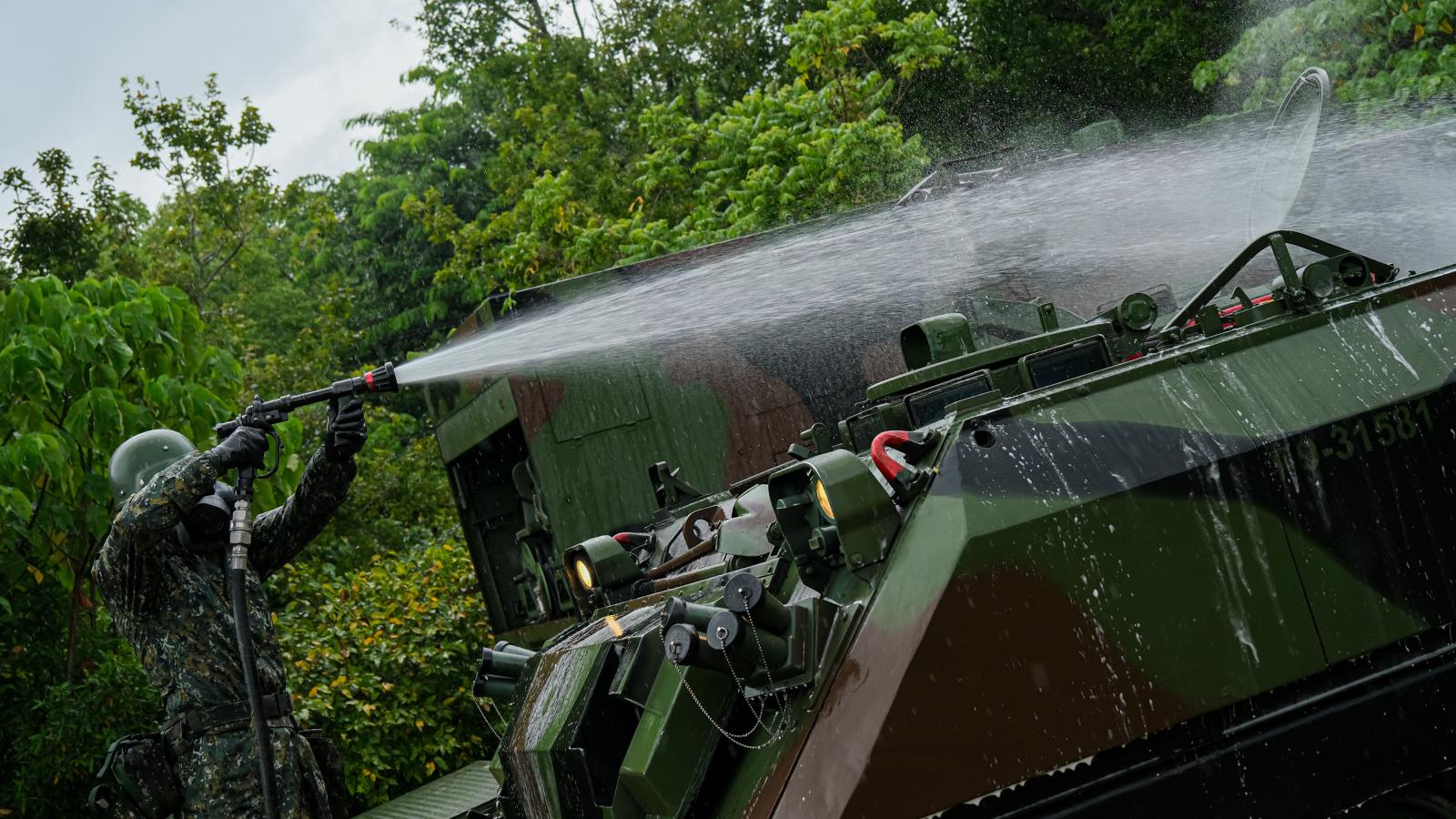
Upon arriving at another position, decontamination operations were conducted on contaminated armored vehicles. Regarding vehicle decontamination, Major Chang Chih-yuan, commander of the chemical company, explained in an interview: 'The primary purpose of decontamination is to assist allied units in cleaning vital mobile assets such as armored vehicles and tanks. The main goal is to ensure that all vehicles can quickly regain combat capability if contaminated during operations, while also ensuring personnel safety and vehicle mobility.'
Major Chang detailed the decontamination process, which involves several steps. For vehicles, seven stations are established. The first is the preparation zone, where detection paper or instruments are used to check the vehicle's exterior for contamination. If contamination is detected, it is marked with chalk. The vehicle then passes through a disinfection station to clean the undercarriage and tires. Next, it enters a hot water decontamination station, where high-pressure water jets remove oil and mud. Afterward, it proceeds to a chemical spray zone, where decontamination agents are fully applied to contaminated areas to neutralize toxins. After a waiting period, the vehicle moves to a rinse zone, where all foam and residue are washed off with clean water. Finally, it enters a re-inspection zone, where detection paper or instruments are used again to ensure no contamination remains.
How long does the decontamination process take? Major Chang stated that the standard time is 30 minutes. Both personnel and vehicle decontamination stations operate simultaneously, ensuring that combat capability is restored and units can re-engage in operations as quickly as possible.
Notably, in addition to regular troops, reserve soldiers (jiao zhao yuan) also participated in the drill. Reserve soldier Lin Bing-hsuan shared in an interview: 'This is my fourth time being recalled. We had to undergo refresher training for our specialties. By about the fifth day, I started to regain the feel of driving armored vehicles. Unlike the previous three recalls, which were relatively relaxed and mostly involved indoor drills, this time we conducted outdoor tactical maneuvers, loaded and unloaded from transport vehicles, and truly regained the feeling of being in active service—it was very rigorous and realistic.'
FACT BOX
- Source: PR Times
- Category: Event