In coordination with the progress of the 'Han Kuang 42' live-fire exercise, the Fourth作战区 of the Eighth Corps, Republic of China Army, conducted a series of operational drills today (April 9) at a port, encompassing harbor defense, unmanned aerial vehicle (UAV) operations, forward casualty pickup and rearward evacuation, and emergency equipment repair during enemy fire intervals. From frontline intelligence gathering and defensive deployment to combat medical care and logistical support, the exercise comprehensively validated the unit’s command coordination, adaptability, and sustained combat capability when facing enemy threats.
The drill unfolded according to a pre-established combat scenario. Participating units first deployed forces to protect critical port facilities and anticipated enemy approach routes. Based on the terrain and mission requirements, they erected obstacle systems, established defensive depth, and reinforced protective measures through optimized firepower positioning—validating their ability to rapidly deploy and defend the port against sudden threats.
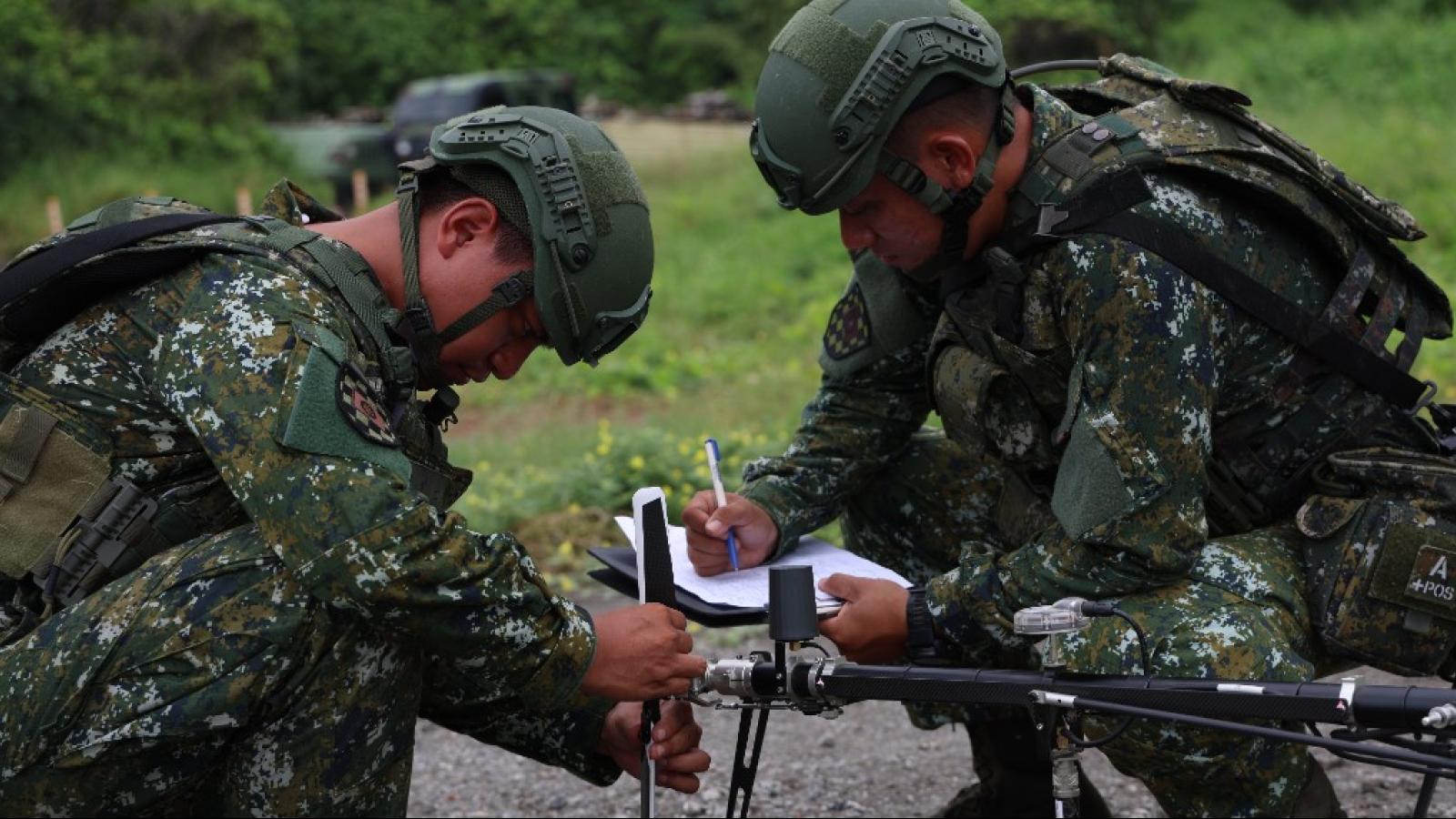
For intelligence, surveillance, and reconnaissance (ISR), troops simultaneously employed the Army’s tactical short-range UAVs to conduct aerial monitoring missions. Prior to takeoff, standard equipment checks were completed. After launch, the drones monitored surrounding terrain and enemy movements, transmitting real-time reconnaissance data back to the command center. This enabled commanders to maintain situational awareness and significantly enhanced the unit’s ISR and battlefield monitoring capabilities.
To simulate potential mass casualties on the battlefield, the exercise further modeled a scenario in which the unit came under enemy fire. Personnel sequentially executed battlefield first aid, triage classification, casualty stabilization, and forward pickup and rearward evacuation, swiftly transferring the injured to rear medical facilities. This verified the mechanism for handling mass casualties and medical evacuation, ensuring robust battlefield medical support.
Additionally, the drill included an emergency equipment repair component conducted during lulls in enemy fire. Simulating weapon systems damaged by enemy attacks, maintenance personnel seized brief windows between enemy volleys to initiate repairs. Following standardized procedures—including fault diagnosis, parts replacement, and performance testing—they rapidly restored equipment readiness, maintaining uninterrupted combat strength and validating logistical support and rapid repair capabilities.
The Fourth作战区 emphasized that this exercise adopted a 'live-troops, live-site, real-time, live-equipment, hands-on' approach, integrating multiple tasks such as harbor defense, drone reconnaissance, casualty care, and equipment repair. By linking front-end ISR and force deployment with backend medical and logistical support, the drill strengthened inter-unit command coordination and real-time adaptability.
The Fourth作战区 stated that through realistic training, it continues to enhance personnel’s rapid response, immediate action, and sustained combat capabilities under diverse threats. This ensures that, even in complex battlefield environments, the unit can swiftly detect enemy movements, complete defensive deployments, and maintain both personnel care and equipment readiness—significantly improving overall defensive operational effectiveness.
Photo: Fourth作战区 personnel conducting mass casualty forward pickup and rearward evacuation drills. (Photo courtesy of the Fourth作战区)
FACT BOX
- Source: PR Times
- Category: Event