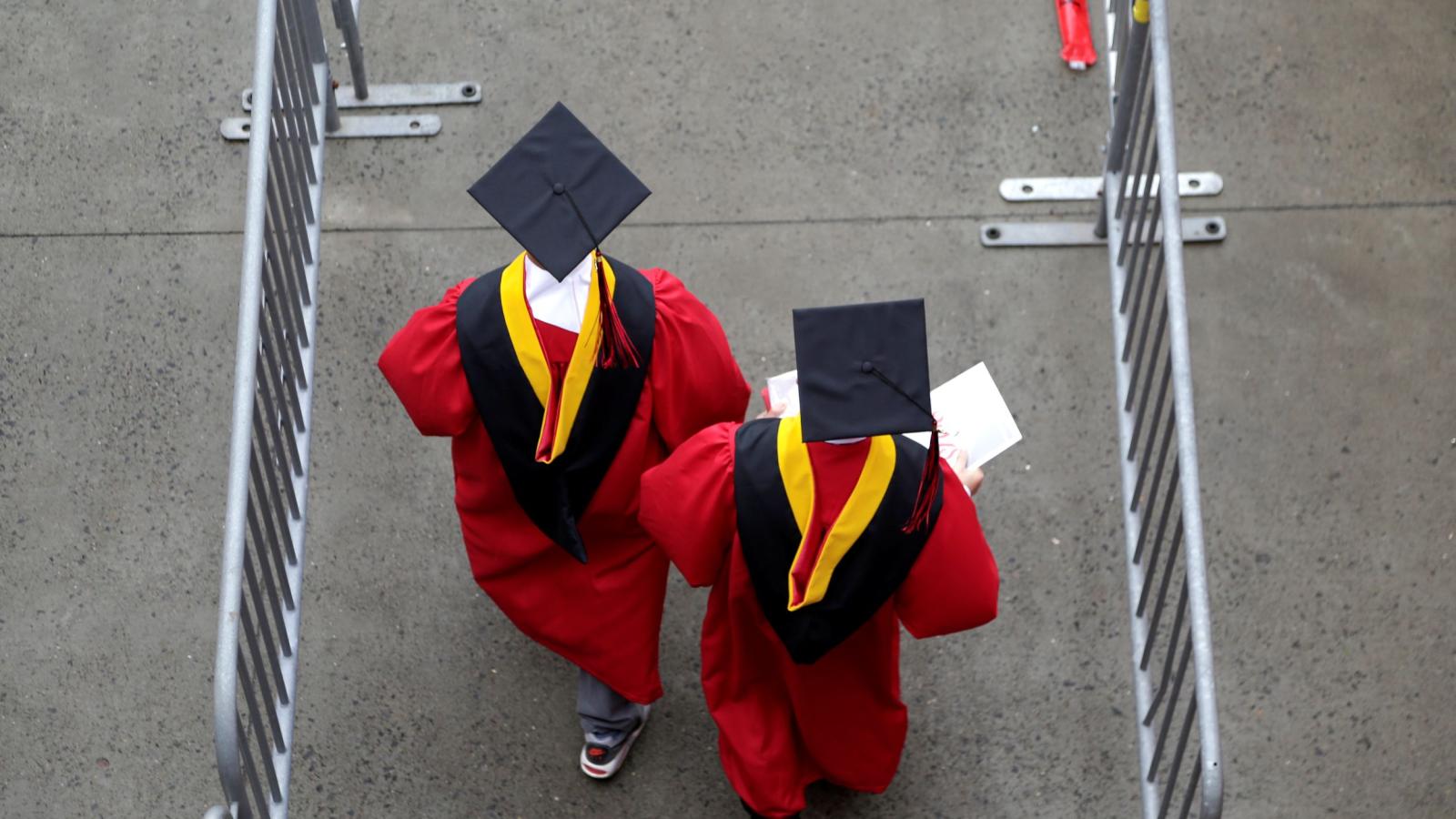
For decades, financially capable Chinese families have viewed sending their children to study in the West as a shortcut to social mobility and high-paying jobs. However, The Economist reported on June 6 that this 'overseas study boom,' which has lasted over two decades, is rapidly cooling. The number of Chinese students studying abroad has significantly declined due to rising education costs, a grim youth job market in China, and escalating geopolitical tensions. At the same time, the prestige of returning graduates—known as 'returnees' or 'haigui'—has sharply faded.
Yang Fan, an education consultant based in Beijing, observed that when she entered the industry 15 years ago, students studying abroad were highly respected, and parents universally hoped their children would broaden their horizons and gain international experience. Today, parents are increasingly questioning: 'Domestic universities aren't bad—why spend so much money sending our children overseas?'
The Economist cited official data showing that the number of Chinese students studying abroad dropped to around 570,000 in 2025, a sharp decline from the historical peak of 700,000 in 2019, and the lowest since 2016.
The publication analyzed that tightened policies in Western countries hosting Chinese students are one of the main reasons for the cooling trend. In 2025, the Trump administration announced plans to actively revoke visas for Chinese students not enrolled in unspecified 'critical fields.' Additionally, the U.S. linked the H-1B high-skilled work visa lottery system to salary thresholds, a change that severely disadvantages entry-level job seekers with lower starting salaries, making it difficult for many Chinese graduates to remain in the country after graduation.
Ms. Hao, a 25-year-old who previously worked at a U.S. startup, admitted that visa restrictions made it nearly impossible for her to switch employers, ultimately forcing her to return to China.
In an era of inflation, the soaring cost of studying abroad has further deterred many families. A survey by the major education provider New Oriental Education Group revealed that the average cost of overseas study in 2025 reached 605,000 RMB (approximately 2.89 million TWD), a nearly 20% increase from 2023. Against the backdrop of China's slowing economy and more conservative household spending, many students are shifting toward more 'value-for-money' destinations.
While Chinese authorities have not disclosed specific student destinations, official data from various countries show a significant drop in Chinese students heading to the U.S., U.K., and Canada, with increasing flows to Hong Kong, Japan, and Australia. Yang Fan noted that Hong Kong, with its strong global university rankings and geographical proximity, has become the top choice—up to 80% of her clients inquire about studying there. Affordable options like Malaysia, where total tuition can be as low as 100,000 RMB (approximately 480,000 TWD), are also gaining popularity.
The 'Returnee' Halo Fades: Disappointing Starting Salaries
Even more concerning than the decline in outbound students is the post-graduation trajectory of these students. Data shows that in 2025, as high as 94% of overseas students returned to China—setting a new historical high. Between 2015 and 2025, a cumulative 5.2 million returnee graduates came back to China. This massive return wave has drastically reduced the appeal of overseas degrees in both the job market and the marriage market.
New Oriental's data indicates that the average starting salary for returnee graduates is now around 12,800 RMB per month (approximately 61,000 TWD), only slightly higher than the 10,700 RMB (approximately 51,000 TWD) earned by domestic graduates. Many returnees end up in low-wage jobs such as food delivery.
On a Chinese television program, a young woman lamented that her parents spent over 2 million RMB to send her abroad, yet her post-return job pays only 4,000 RMB per month (approximately 19,000 TWD), saying, 'I’d have to work a century to save back my tuition.'
Ms. Zou, pursuing a master's in chemistry at University College London (UCL), admitted that while a U.K. master's takes only one year compared to three years in China, overseas degrees offer no advantage when applying for jobs in high-tech industries like semiconductors. She added that Chinese students make up 40% of her class, and in some programs, as high as 90%, saying, 'It feels just like studying in China.'
Moreover, Chinese employers' attitudes toward overseas degrees are shifting. Due to the short duration and relatively flexible admission standards of one-year master's programs, employers are increasingly questioning the value of foreign degrees. Ms. Zou noted that some HR departments even believe domestic graduates are 'more obedient' and less influenced by Western liberal ideologies. Some provinces have even restricted overseas graduates from applying for civil service positions.
In 2025, Dong Mingzhu, chairwoman of Gree Electric, China's leading home appliance company, publicly stated she would not hire returnees, citing concerns that 'they might be spies.'
China's Declining Student Outflow Triggers Crisis in UK Universities
Meanwhile, the competitiveness of Chinese domestic universities continues to rise. In the latest QS World University Rankings, Peking University and Tsinghua University have climbed to 13th and 14th globally. Beyond the elite institutions of China's '985 Project' (a higher education initiative launched in May 1998, with only 39 top universities selected nationwide) and the '211 Project' (a 1995 initiative to build around 100 key universities and disciplines for the 21st century), public universities charge only a few thousand RMB annually, making them highly attractive.
Notably, the sharp decline in Chinese outbound students is severely impacting Western universities that heavily rely on international tuition fees. In the 2024–25 academic year, Chinese students accounted for over 40% of international students in the U.K.'s elite Russell Group of 24 universities. Many institutions expanded master's programs to attract Chinese students, charging significantly higher tuition than for domestic students.
Filippo Boeri, a scholar at City, University of London, warned that Western universities had long been immersed in a 'financial stability illusion.' With the sudden drop in Chinese enrollment, several U.K. universities have already begun closing programs, cutting faculty, or encouraging voluntary retirements.
The Economist emphasized that the decline in Chinese students is not only a loss of high-level talent for the West but also detrimental to China itself. Throughout China's reform and opening-up, returnee talent brought overseas technology and knowledge, playing a crucial role in modernization and economic catch-up. Among the 21 members of the current Politburo of the Chinese Communist Party, eight have overseas study backgrounds. As 'sea turtles' stop swimming abroad, the connection between China and the world shrinks—ultimately harming both China and the West.
FACT BOX
- Source: PR Times
- Category: Survey