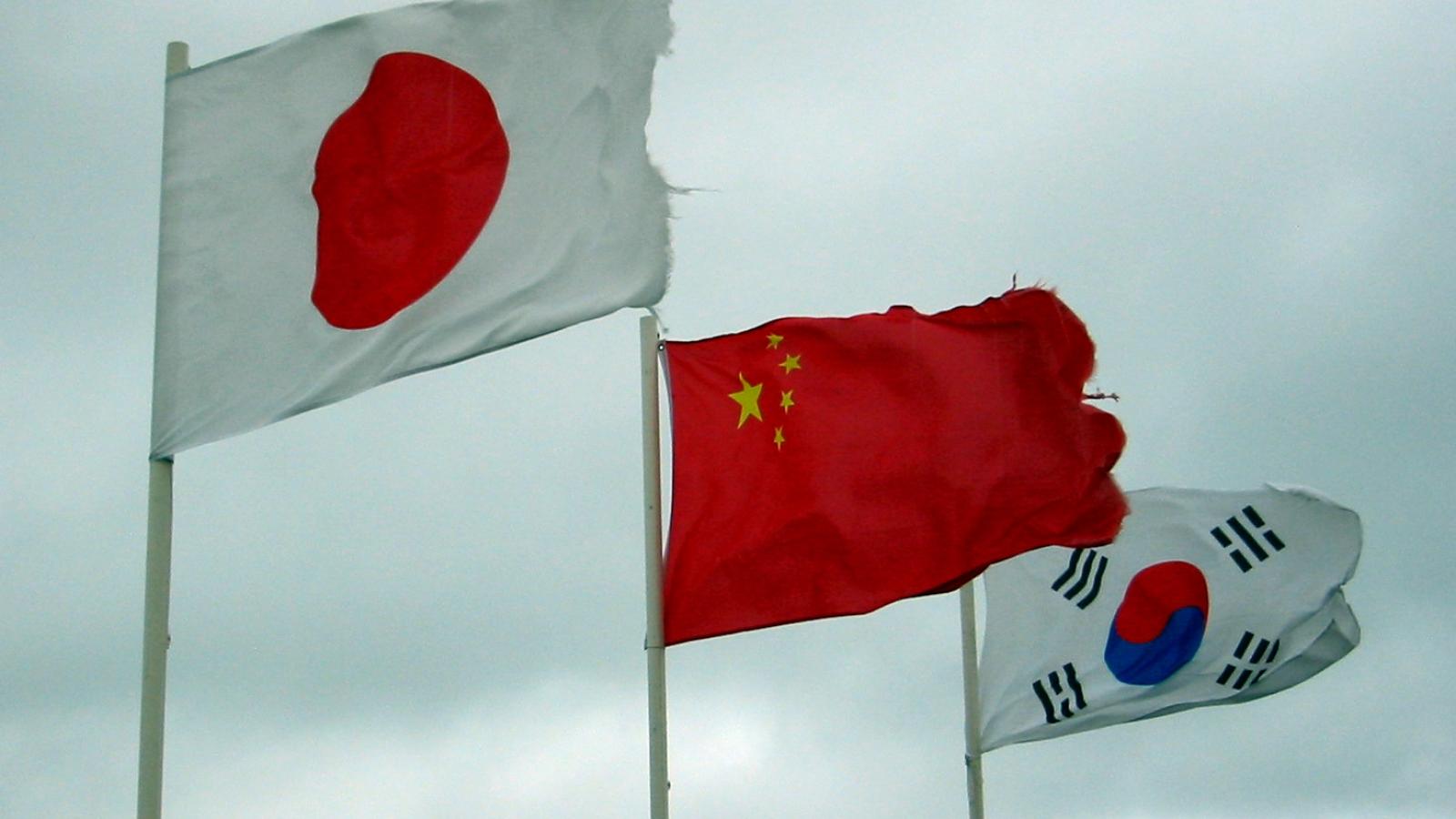
The sudden surge in historical perception conflicts among South Korea, China, and Japan in the post–Cold War era stems from the emergence of suppressed imperial consciousness. In this context, the official statements made at the trilateral summit held in Beijing in October 2009—announcing the joint compilation of a shared history textbook among the three nations and supporting the formation of an East Asian community—are particularly noteworthy. Preceding this, the collaborative effort by civil society figures from the three countries to produce 'History to Open the Future' (2005) laid the foundation for this textbook initiative. Notably, unlike former empires such as China, Japan, and Vietnam, South Korea has never been an empire, making it the least historically obstructive to regional peace within East Asia’s shared historical projects. Thus, South Korea’s decision in November 2006 to introduce 'East Asian History' as a high school subject, implemented in 2012, was no coincidence.
Some may criticize the claim that South Korea poses the fewest historical barriers to regional history as merely 'Korea-centered.' However, this is not the case. Observers outside East Asia also recognize that the real key lies in the postures of the two major powers, Japan and China. One American scholar stated that the greatest threat to a shared historical consciousness in East Asia comes from Japan’s continued refusal to acknowledge its imperial colonialism and the recent resurgence of Sinocentrism. Although Japan began discussing East Asian history earlier than South Korea, it simultaneously bears the heavier burden of overcoming its imperial legacy. China, with its vast territory, has an even broader and longer imperial history than Japan. For both China and Japan, writing a regional history means severing ties with their nations’ 'glorious pasts,' making the task exceptionally difficult. Yet, precisely because of this, if both nations courageously confront and challenge their imperial traditions to produce Japanese- and Chinese-authored versions of East Asian history, it would carry exceptional significance.
In every society, there are those who, intoxicated solely by national glory and victory, shout loudly and wave lofty banners, unable to distinguish self-reflection from self-abasement. But they are merely twenty-first-century Don Quixotes. Starting from a perspective of self-reflection, even across borders, we can gradually approach a mutually communicable East Asian regional history. Of course, this goal cannot be achieved overnight. Through the efforts of many, we are slowly working toward a future that can be shared by all.
East Asia’s Regions, Nations, and Peoples
People typically divide Asia into East Asia, West Asia (Islamic and Arab), South Asia (Indian), and Inner Asia (nomadic regions), based on historical development and cultural similarities. These four regions are separated by deserts or mountains, making travel difficult. Yet, over long periods, people have crossed borders despite dangers to exchange with one another. Broadly speaking, East Asia refers to the area east of the Bay of Bengal, including Southeast Asia. Narrowly, it often refers only to Northeast Asia.
The East Asia discussed here reflects cultural regional divisions but is also a relatively fluid concept shaped by the perspectives and needs of different actors. Historically, it is difficult to find examples of broad East Asia being treated as a single unit. Especially after the Ming Dynasty first implemented maritime bans in the 17th century, mutual exchanges and trade among Northeast Asian nations were greatly restricted, a trend that continued afterward. By then, many Southeast Asian nations had already become European colonies. Under European Christian dominance, cultural differences between these two regions became even more pronounced. The Opium War (1840–1842) marked a turning point where European powers based in Southeast Asia gradually moved northward, imposing colonial pressure on Northeast Asian nations. During this period, Russia advanced eastward overland, triggering crises among northern nations like the Qing Dynasty, Korea, and Japan.
This external colonial force significantly impacted mutual relations and perceptions among East Asian nations. Had South Korea, China, and Japan, feeling threatened by Russia’s southward expansion in the 1880s–1890s, actively formed a 'trilateral East Asian' or 'trilateral Eastern' community before becoming Western colonies, they might have resisted Western powers. However, due to internal imperialization driven by colonial forces—particularly Japan’s annexation of Korea in 1910—this community-based conception of East Asia disappeared, leaving only an East Asia divided between imperialism (including Japan) and anti-imperialism. At the time, many individuals and groups in Ryukyu, Korea, Taiwan, and China assisted or collaborated with Japan’s imperialization, benefiting personally. Therefore, to realize the self-reflective East Asia we speak of today, these internal and external hierarchies must first be dismantled.
After World War II, the hierarchies formed by imperialization collapsed. Yet, the ensuing Cold War system re-divided nations in another form. Coupled with the intensification of hot wars like the Korean and Vietnam Wars, the idea of East Asia as a unified entity was delayed once again. This differs from European imperialism, which expanded outward rather than inward. Thus, comparing East Asia to Europe—which achieved regional integration during the Cold War—is difficult. Ultimately, with the U.S.-Japan alliance and China establishing diplomatic relations, and China launching its reform and opening-up policy from 1978–1979, Cold War tensions gradually eased. Then, in 1991, the collapse of the Soviet Union dismantled one major Cold War bloc, finally creating objective conditions for treating East Asia as a single conceptual unit. Today, for South Koreans in northern East Asia, connections with Southeast Asia have grown close not only through flows of goods, labor, and capital but also through students, international marriages, and television dramas.
Only in the past two decades has the idea of treating East Asia as a regional historical unit emerged. This reflects post–Cold War efforts toward peaceful coexistence within the region. Of course, North Koreans still live in a land lacking resources and freedom. To advance toward a truly peaceful East Asia, competition among nations must replace Japan’s monopoly, the tension and division of the Korean Peninsula must be resolved, and reunification must be achieved.
The nations and peoples forming East Asia in each era possess unique characteristics and influence one another. As powerful nations rise and fall, when a strong state becomes an empire, weaker neighboring states are conquered and absorbed. When the empire declines, many royal lineages separate or gain independence. Throughout these historical processes, peoples who could not form their own states or whose states were taken remain active as part of East Asia alongside those with sovereign nations. Today, East Asian nations include six in Northeast Asia (South Korea, North Korea, China, Japan, Mongolia, Taiwan) and eleven in Southeast Asia (Vietnam, Laos, Cambodia, Thailand, Myanmar, Philippines, Indonesia, Malaysia, Singapore, Brunei, East Timor). Regarding Taiwan’s sovereignty, China long views Taiwan as one of its provinces, yet Taiwan continues to function as a state recognized by over twenty countries worldwide. The number of East Asian nations was only three (Korea, China, Japan) in the 1880s, then reduced to two (China, Japan), and now totals seventeen in the 21st century. This signifies the end of the imperial era and the liberation of nations and peoples from imperialist oppression, allowing them to assert their uniqueness and autonomy.
Yet, examining East Asia’s de-imperialization process reveals that many nations and peoples absorbed through 'internal imperialization'—as opposed to 'external imperialization' by European powers—remain under imperial oppression. Recognizing this, we must examine the internalized imperial consciousness hindering the construction of East Asian regional history. To identify the sources of this oppression, let us briefly revisit the process of internal imperialization that gradually formed within East Asia after the maritime ban era.
After the failure of the Liaodong recovery movement in early Joseon, Korea expanded its territory in the 15th century by establishing the Four Commanderies and Six Garrisons, setting the Yalu and Tumen Rivers as borders, achieving a territory comparable to today’s North and South Korea. While generally seen as a territorial reduction compared to ancient Gojoseon, Goguryeo, and Balhae, a minority view considers this northern expansion a form of growth for the southern-based Samhan. Regardless, Korea did not forcibly conquer or annex foreign lands and peoples in an imperial posture.
Unlike Korea, the Qing Dynasty, Vietnam, and Japan clearly ruled foreign lands and peoples as empires. In China, after the Manchus conquered the Central Plains, they expanded in the 18th century to incorporate Uyghurs, Mongols, Tibetans, and Taiwan, forming the Qing Empire’s territory. Only Primorsky Krai was ceded to Russia; subsequent Republic of China and People’s Republic of China largely maintained this territory. In Vietnam, the Lê Dynasty, based in present-day northern Hanoi, conquered the Champa Kingdom in central Annam in the late 15th century and continued southward. By 1757, it had conquered the Mekong Delta and annexed southern Nam Kỳ. At this point, the Vietnamese southward expansion was formally
FACT BOX
- Source: PR Times
- Category: News