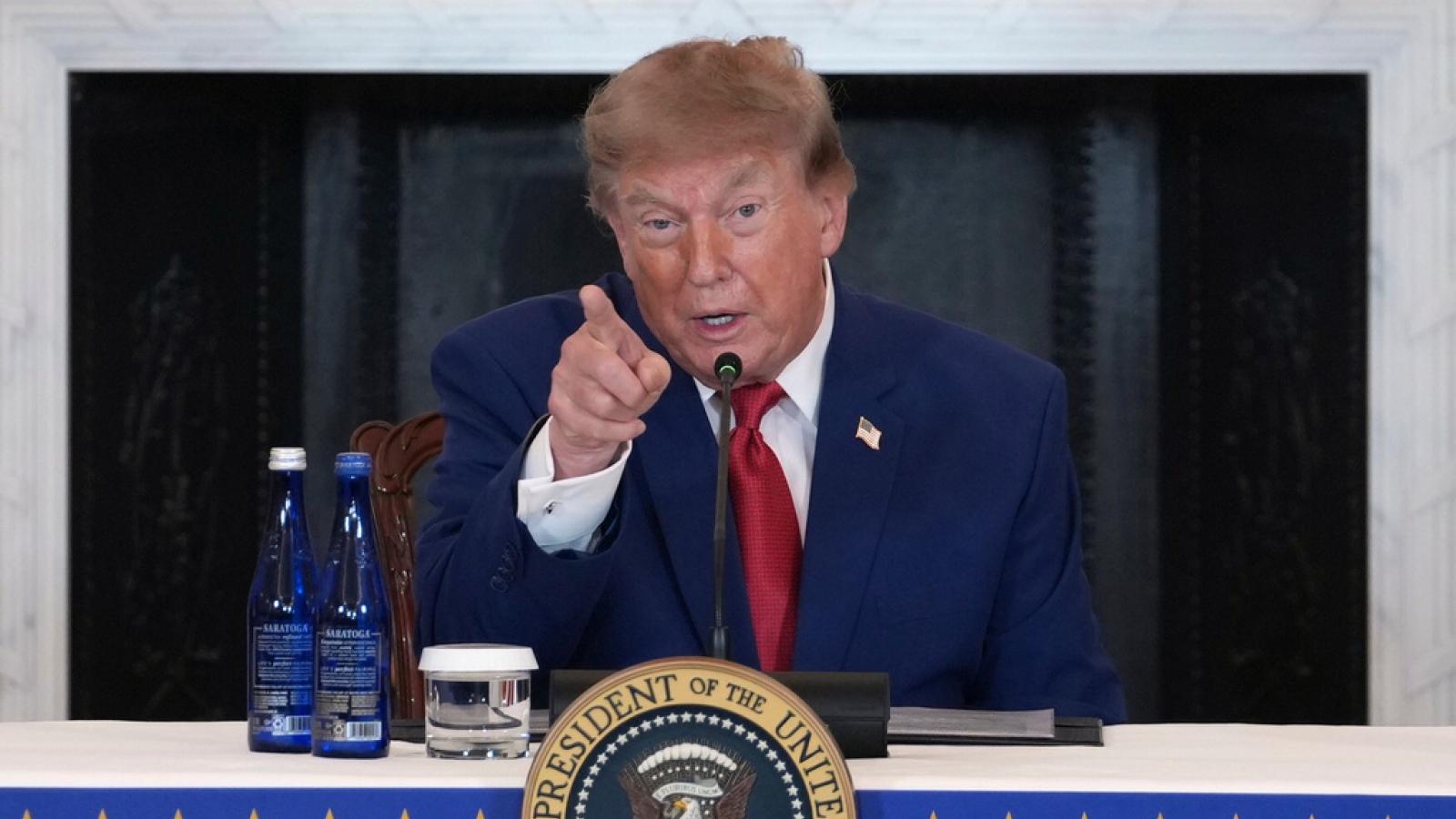
U.S. President Donald Trump stated on August 9, Eastern Time, that the United States is taking a 'low-key approach' toward Iran, signaling Washington’s preference for escalating economic pressure to force Tehran into compliance, rather than launching a new large-scale military operation. In a brief phone interview with Axios, Trump said, 'We're handling this thing very quietly now.' He elaborated, 'We're in a semi-negotiation state, mainly watching Iran's high inflation and the fact that they simply have no money.'
Trump emphasized that Iran's economic situation is 'very bad,' to the point where it lacks funds to pay its military salaries. He believes the U.S.-imposed naval blockade has further intensified the financial crisis facing the Iranian regime. These remarks come roughly a week after U.S. officials revealed that Trump had previously leaned toward resuming large-scale military operations against Iran but ultimately decided to de-escalate temporarily.
Trump also noted that falling oil prices are helping to mitigate the conflict's impact on American citizens. He pointed out that crude oil prices have dropped to just above $75 per barrel. Regarding the ongoing standoff with Tehran, Trump described it as 'like a game of chess. It will eventually be resolved, it always gets resolved.'
During the interview, Trump did not issue new military threats nor express dissatisfaction over Iran's delay in resuming negotiations with Oman and the U.S. on reopening the Strait of Hormuz. That agreement, which has been stalled for several days, would grant Iran partial control over the strategic waterway—a power it did not hold before the conflict.
Qatari and Pakistani mediators had initially been confident the agreement could be announced by August 12, but recent developments suggest the chances of reaching a deal are fading. On August 8, Iran presented a new set of demands for reopening the Strait of Hormuz, going beyond the conditions previously discussed in Oman.
Mohammad Bagher Zolghadr, Secretary of Iran's Supreme National Security Council, stated that the U.S. must 'never threaten or insult Iran in any language' and must 'permanently end its war against Iran and its allies in Lebanon, Gaza, Yemen, and Iraq.' He also demanded the lifting of the naval blockade, withdrawal of U.S. military forces from around Iran, compensation for war damages, full removal of sanctions, and the release of frozen Iranian assets.
Until recently, such demands were framed by Iran as conditions for reviving the nuclear deal; now, Tehran is positioning them as prerequisites for reopening the Strait of Hormuz. A diplomat involved in the mediation noted that Zolghadr’s demands reflect growing political divisions within the Iranian government.
U.S. officials also report increasing internal disagreements within the Iranian regime on how to respond to the economic crisis. One faction, led by President Pezeshkian, is deeply concerned about economic collapse and believes Tehran must reach an agreement with Washington. The other, represented by Islamic Revolutionary Guard Corps commander Vahidi, opposes any concessions.
U.S. officials revealed that about a week ago, Trump had leaned toward resuming large-scale military operations but was later persuaded to hold back. One official argued that ongoing conflict allows Iran’s leadership to avoid confronting the consequences of war, including infrastructure damage and worsening economic crisis. Without active hostilities, Tehran would be forced to directly face these issues—problems for which there appears to be no clear solution.
Meanwhile, according to a U.S. official, approximately 8 million barrels of oil are currently being transported nightly through the southern route of the Strait of Hormuz, coordinated with U.S. military forces. Washington intends to maximize this flow as much as possible if negotiations fail.
On August 8, U.S. Vice President Vance stated that the government continues to apply diplomatic, economic, and military pressure on Tehran. In an interview with Fox News, he said, 'This isn’t over. It’s clearly not the beginning. We’re in the middle phase, using a full suite of tools—diplomatic, economic, military—to secure the best possible outcome for the American people.'
FACT BOX
- Source: PR Times
- Category: News