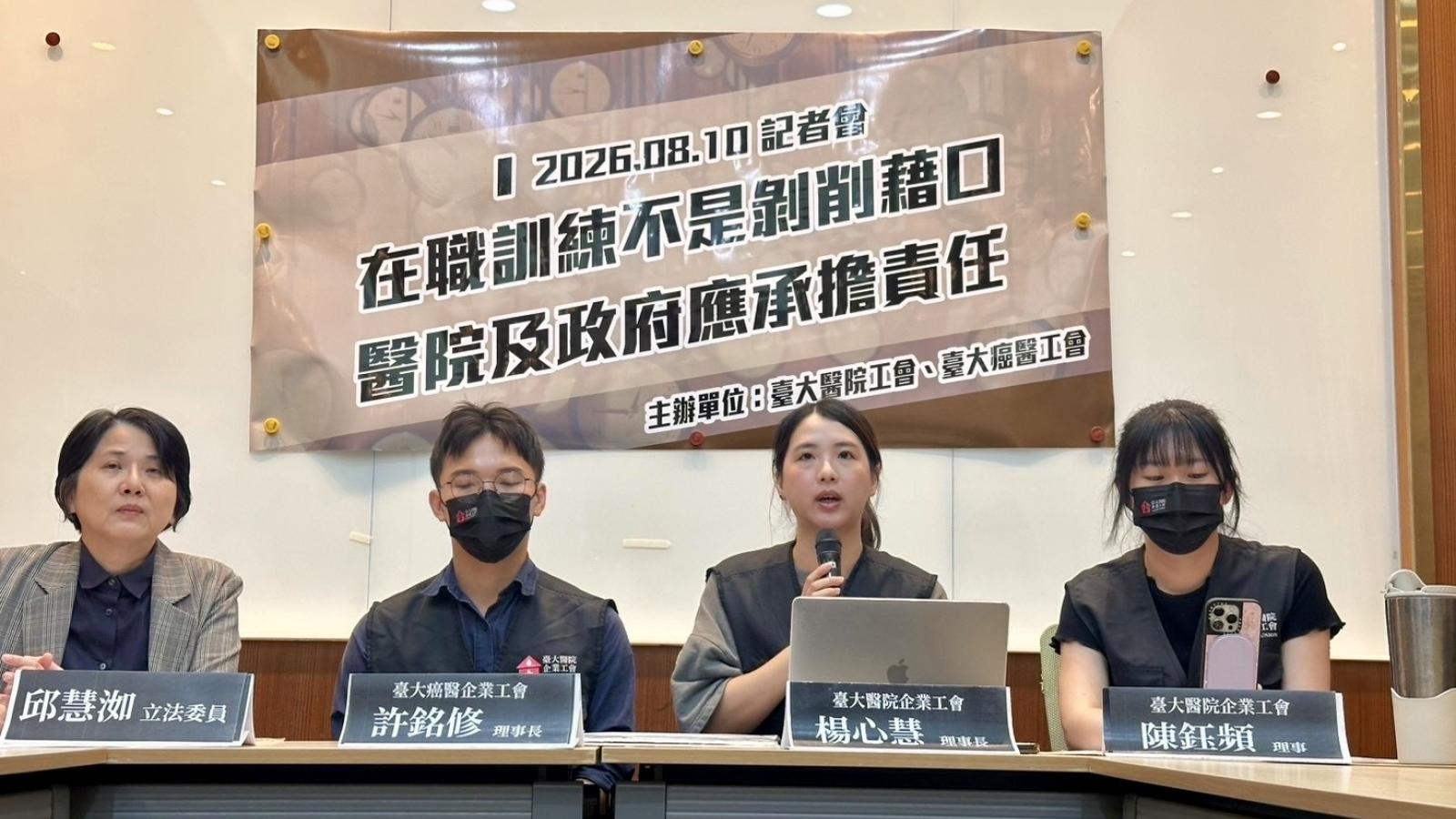
Medical personnel at hospitals are often required to attend continuing education courses necessary for license renewal, in addition to their regular duties, as well as additional mandatory training sessions unilaterally set by individual hospitals. Despite official directives from both the Ministry of Labor and the Ministry of Health and Welfare clearly stating that time spent on 'job-related in-service training' must be counted as working hours or compensated with paid leave, hospitals—including National Taiwan University Hospital (NTUH)—continue to ignore these administrative orders in practice. On the 10th, the NTU Hospital Workers' Union and the NTU Cancer Center Workers' Union held a press conference, condemning such practices as the root cause of overwork among medical staff. In response, NTU spokesperson Chen Yen-yuan stated that the hospital is still internally reviewing the matter.
Medical personnel must complete education credits—MOHW directive mandates inclusion in working hours and paid leave
Yang Hsin-hui, chair of the NTU Hospital Workers' Union, emphasized that physicians, nurses, pharmacists, and other medical professionals are legally required to complete 120 continuing education credits every six years to renew their licenses. This is not a personal interest but a legal obligation. Despite directives issued by the Ministry of Labor in October last year and the Ministry of Health and Welfare (MOHW) in February this year, hospital administrations have made no changes.
Yang stressed that frontline staff at NTU Hospital must complete not only the legally mandated 120 credits every six years but also a large volume of mandatory online courses annually set by the hospital itself—covering fire safety, information security, and infection control. Although the union has successfully negotiated for some internal courses to be recognized as continuing education credits, the scope remains extremely limited.
Is paid leave protection just empty talk? Union: Leave applications rejected, forcing staff to use private rest time
Chen Yu-pin, a union councilor at NTU Hospital, stated that the MOHW's guarantee of paid leave has become meaningless in practice. As a pediatric hematology-oncology nurse, she once applied for paid leave to attend an 'Advanced Oncology Nursing Training Program' but was denied. In practice, the hospital applies extremely narrow and stringent criteria, excluding the vast majority of clinical professional development courses. As a result, nurses are forced to spend at least 20 hours of their personal rest time each year to fulfill credit requirements.
Chen analyzed that while the shift to online continuing education in recent years offers convenience, the refusal of hospitals to grant paid leave forces nurses to 'work overtime' after shifts, clicking through courses, or even rushing through training during high-pressure clinical care breaks. This form-over-substance learning fails to achieve its original goals of enhancing professional competence and ensuring patient safety, and may instead become a tool for employers to evade responsibility during occupational injury investigations or labor inspections.
Hsu Ming-hsiu, chair of the NTU Cancer Center Workers' Union, pointed out that the MOHW's official document explicitly states: 'Time spent by medical personnel completing continuing education credits is part of working hours and should be granted paid leave accordingly.' Yet hospital employers play word games, responding that paid leave mechanisms should 'return to unit autonomy' or require 'mutual agreement.' Under a system where supervisors control performance evaluations and shift scheduling, frontline healthcare workers have no equal bargaining power. In practice, this becomes a cover for hospitals to continuously deny leave and exploit基层 staff.
Accusing hospitals nationwide of 'consuming staff leave'—NTU Hospital responds
Hsu revealed that frontline staff face two major obstacles when applying for paid leave: first, being forced to submit reports, which effectively raises the barrier to discourage applications; second, supervisors overstepping their authority by repeatedly rejecting applications on grounds of 'not required by the unit.' Hsu questioned: continuing education credits are a national legal requirement for license renewal, including universal courses such as infection control and gender equality—unit supervisors have no authority to substitute for the state in reviewing these. Who will bear responsibility if a license expires due to insufficient credits?
Hsu emphasized that since the MOHW has already recognized continuing education training time as working hours, hospitals must no longer shirk responsibility, cut working hours, shift costs, or deprive medical staff of their scarce rest time. Frontline medical personnel across Taiwan are suffering from the same abusive 'leave consumption' practice. The union solemnly urges hospital operators and regulatory authorities nationwide to stop this systemic exploitation. Without healthy medical staff, the vision of a 'Healthy Taiwan' will ultimately become an illusion.
In response to the sharp accusations from the NTU Hospital Workers' Union and the NTU Cancer Center Workers' Union, NTU spokesperson Chen Yen-yuan emphasized that if one carefully reads the union leaders' statements, they themselves acknowledge this is 'the practice of hospitals including NTU Hospital.' In other words, due to staffing shortages, most hospitals adopt the same approach. However, as Taiwan's leading hospital, NTU bears an inescapable responsibility, and the matter is currently under internal review.
FACT BOX
- Source: PR Times
- Category: News