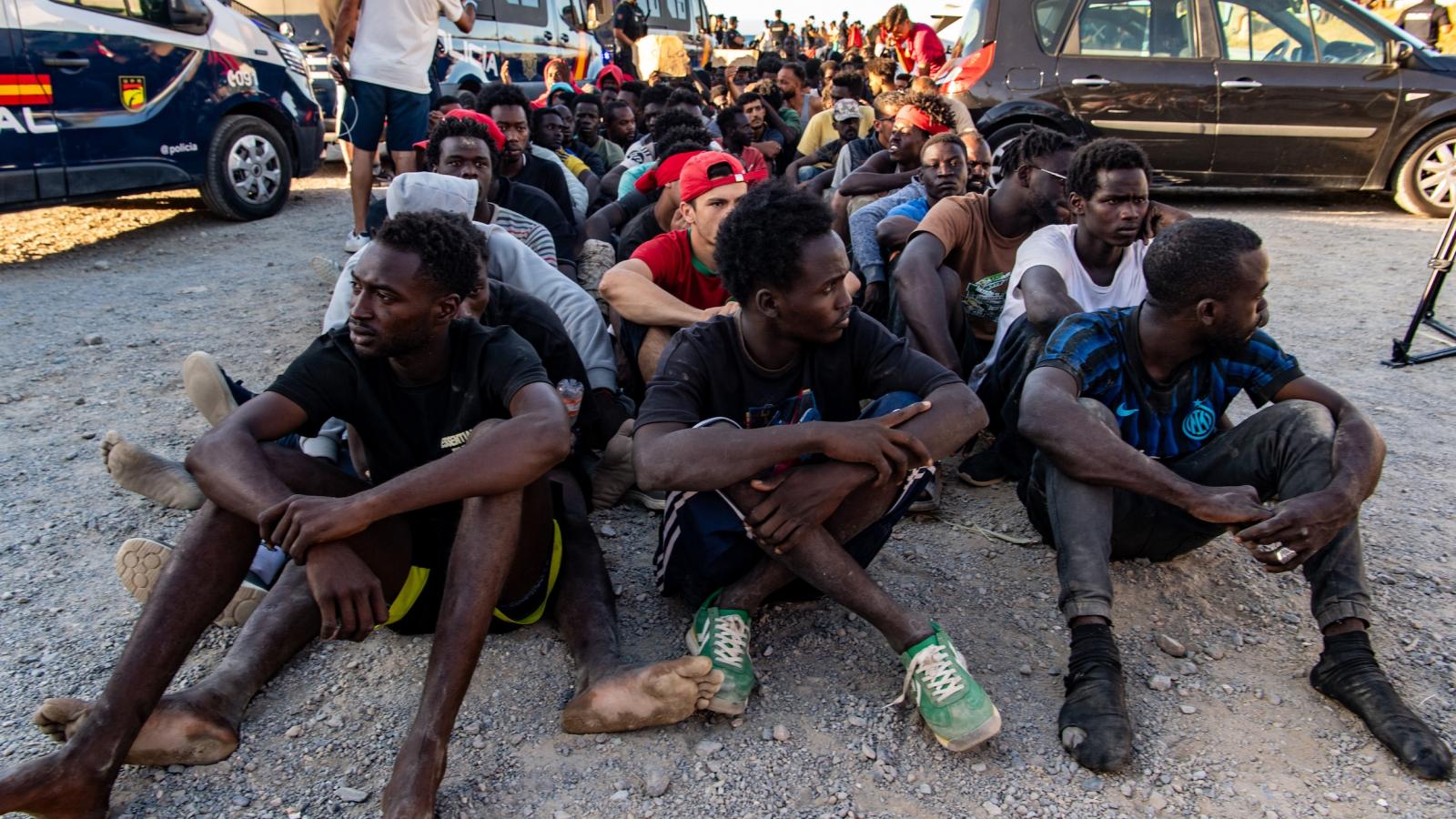
Recently, a large number of Moroccan migrants suddenly flooded into Ceuta, Spain's North African enclave, once again placing Europe's immigration issues under the spotlight. I have introduced Ceuta—the Spanish African enclave—on multiple occasions before, and such crises are not unprecedented. Yet each recurrence highlights the same fundamental question: Can Europe's humanitarian values coexist with effective border control? To answer this, we must recognize that the crisis is not caused by a single factor.
Ceuta's geographical position is highly unique. Along with Melilla, it constitutes the European Union's only land borders located on the African continent. Once entered, EU laws, human rights conventions, and asylum systems apply, making it one of the most valuable smuggling routes for human trafficking networks. Simultaneously, it serves as a key geopolitical lever between Morocco and the EU. This enclave structure itself represents a systemic loophole.
Moreover, the policy signals sent by Spain's recent left-leaning government have been easily exploited. Although the Spanish government has never stated that illegal entrants can remain, its long-standing emphasis on humanitarianism, immigrant integration, and cautious deportation practices has objectively created the external perception that 'once you set foot on Spanish soil, you may have a chance to stay.' In illegal entry cases, it is often not the legal text itself but the public's expectations of the law that influence behavior.
A recent Spanish court ruling on procedural safeguards for sea-based migrants to Ceuta and Melilla has been deliberately distorted by human traffickers. They are telling North African residents that if they successfully swim to Ceuta, they cannot be immediately deported. The law does not actually state this, but smugglers do not need truth—they need a compelling story that convinces more people to pay for illegal passage.
This narrative naturally appeals to Moroccans. While Morocco is relatively developed compared to other African nations, North Africa has long faced economic and demographic pressures, with high youth unemployment and a vast income gap compared to Europe. Additionally, continuous northward movement from sub-Saharan Africa places Morocco under constant migratory pressure. However, these factors have existed for years and are insufficient to explain why the crisis erupted so suddenly.
Thus, it is widely believed that the key lies in a sudden shift in Morocco's border enforcement. Historically, whenever diplomatic tensions arise between Morocco and Spain or the EU, border controls at Ceuta and Melilla 'coincidentally' become relatively relaxed. For example, in 2021, thousands of migrants entered Ceuta within a short period. While there is no evidence that the Moroccan government deliberately allowed entry this time, such a large-scale influx would be nearly impossible without a noticeable loosening of border enforcement. Morocco's foreign policy has recently been active in several areas, including its refusal to issue visas to Taiwan passport holders—an issue we discussed recently—suggesting a potential diplomatic realignment.
Today's scenes in Ceuta recall another Spanish enclave, Melilla. The parents of Spanish footballers Nico Williams and his brother Iñaki Williams entered Spain via Melilla and eventually successfully integrated into society, raising two world-class athletes. This illustrates that migration itself is not the problem—successful integration can become a national asset. The issue lies in the system. Successful integration can produce talents like Nico Williams; uncontrolled borders, however, erode public trust in government, fuel the rise of right-wing parties, and deepen social divisions.
What is happening in Ceuta is not just Spain's crisis—it is a stress test for all of Europe.
*The author is an international relations scholar and currently serves as an Associate Professor at the Center for Taiwan-Hong Kong International Studies, National Sun Yat-sen University.
FACT BOX
- Source: PR Times
- Category: News