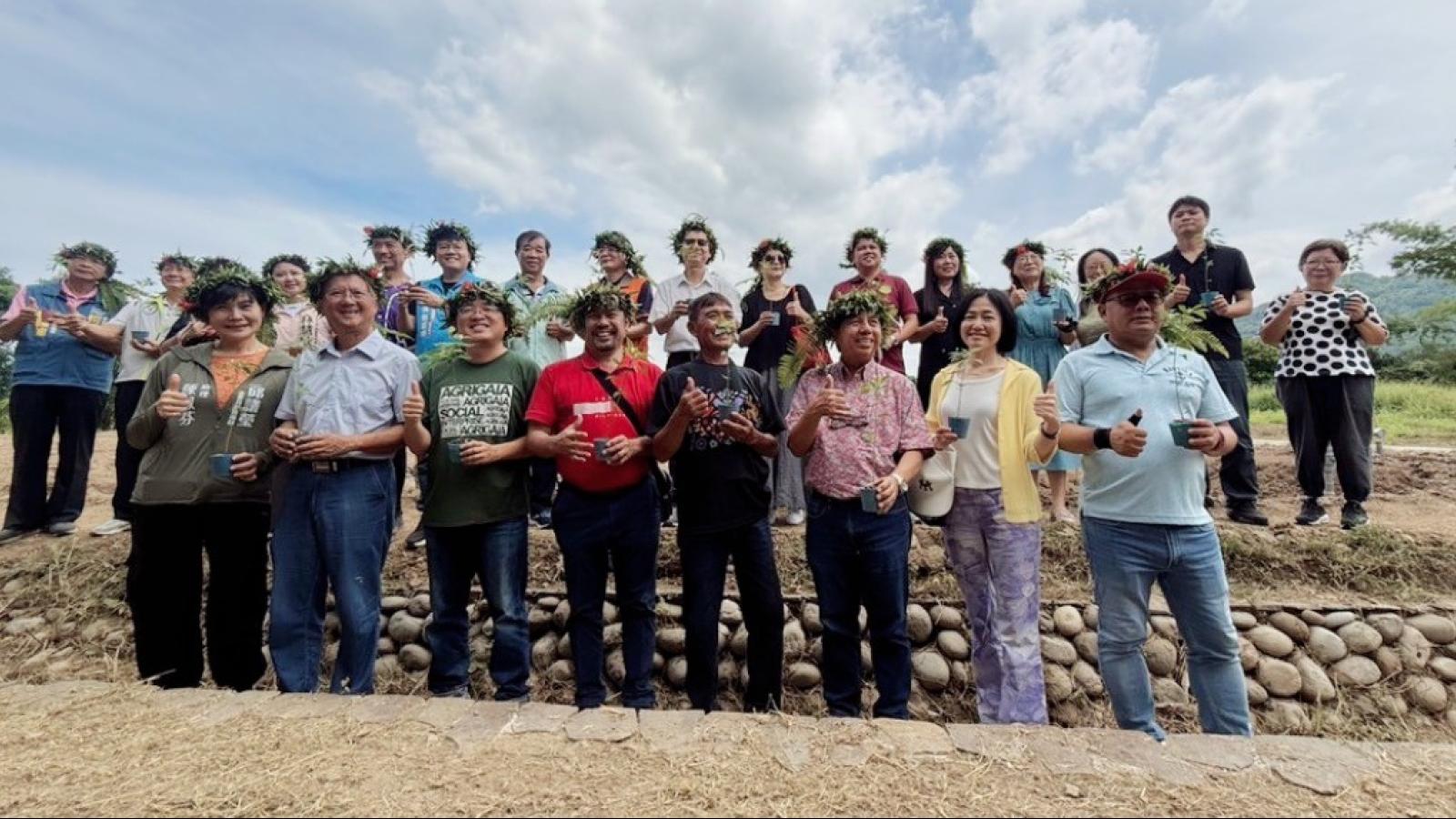
"Please allow me to remember once more—how are you? I am doing well..." Seventeen years after Typhoon Morakot, the Hikari Xiaolin community in Kaohsiung’s Shanlin District is not letting memories be defined by disaster, but is gradually restoring the land into daily life. On the 8th, marking the 17th anniversary of the typhoon, Hikari Xiaolin held the "Xu Su – Morakot 17th Anniversary and Inauguration Ceremony," officially launching a new chapter with Taiwan’s first community-based low-carbon farm, signaling a shift from post-disaster recovery to sustainable agriculture and climate resilience.
"Reviving a handful of old soil, awakening a touch of new green"—Hikari Xiaolin is moving from post-disaster reconstruction toward becoming an international demonstration site for resilient agriculture.
The ceremony began with traditional Dawulang songs performed by community members, blessing this significant and hopeful day. (Photo: Hikari Xiaolin Community)
The establishment of this low-carbon farm was not achieved overnight. Facing multiple challenges such as extreme weather, difficult terrain, and agricultural production constraints, the Hikari Xiaolin community has continuously advanced efforts to create a livable and economically viable environment. With support from the Council of Agriculture’s Soil and Water Conservation Bureau Tainan Branch and the Kaohsiung City Government’s Agriculture Bureau, and in collaboration with Gaia Smart Soil Technology, the community has introduced the "Resilient Low-Carbon Farm System" to gradually build a new agricultural model integrating disaster prevention, low emissions, productivity, and community well-being.
The Agriculture Bureau emphasized that for Hikari Xiaolin, this is more than just the completion of a farm—it symbolizes the community’s progression from "rebuilding homes" to "rebuilding the future" after a major disaster. Through technological integration and collective participation by local residents, agriculture has evolved beyond mere production to become a vital force in confronting climate change, protecting the land, and preserving cultural heritage.
Moreover, as global climate risks escalate, tropical and subtropical regions face direct threats from extreme heat, heavy rainfall, droughts, and compound disasters. Hikari Xiaolin’s collaboration with Gaia Smart Soil Technology integrates three core concepts—extreme weather resilience, low-carbon production, and community co-benefits—to develop a resilient agricultural model suitable for community-level development.
Unlike conventional agriculture focused solely on yield, resilient agriculture emphasizes maintaining basic production capacity under increasing climate and environmental uncertainty. It reduces resource consumption and carbon emissions while fostering community participation to build self-sustaining local lifestyles.
This integrated practice—combining post-disaster recovery, indigenous culture, low-carbon farming, and climate adaptation—has begun attracting international attention. During the ceremony, a delegation of agricultural experts and officials from the Philippines traveled to Taiwan to attend the inauguration and exchange insights on Taiwan’s experience in climate-resilient agriculture and community rebuilding.
For countries like the Philippines, which also face severe climate threats, Hikari Xiaolin’s journey of recovery offers more than just a story of local reconstruction—it provides a valuable reference for green transformation and resilient agriculture across Southeast Asia.
The ceremony concluded with a symbolic "planting a seedling" activity. Due to adverse weather, the ritual was adapted: community members, the Gaia team, and the visiting Philippine delegation each selected a young sapling and handwrote a message of renewal and blessing. Once the weather clears, residents will personally plant these saplings into the soil, transforming each young plant into a living link between memory and the future.
The Agriculture Bureau stressed that for the Hikari Xiaolin people, this land once bore the pain of losing loved ones, but has also witnessed every step of their recovery. Seventeen years later, replanting life into the soil is not only a tribute to the departed but also a declaration that the community chooses to move forward, carrying their memories with them.
From a handful of old soil to a touch of new green; from post-disaster recovery to resilient agriculture—Hikari Xiaolin proves in its own way that true rebirth is not about forgetting past pain, but about transforming memory into momentum for the future.
Going forward, the Hikari Xiaolin community will continue to focus on low-carbon agriculture, climate adaptation, cultural preservation, and community well-being. This community-based low-carbon farm will not only stand as a symbol of post-disaster recovery but also serve as a vital platform for Taiwan and Southeast Asia to exchange knowledge on climate resilience, sustainable agriculture, and community development—carrying the story of land regeneration from Kaohsiung to the world.
FACT BOX
- Source: PR Times
- Category: Event