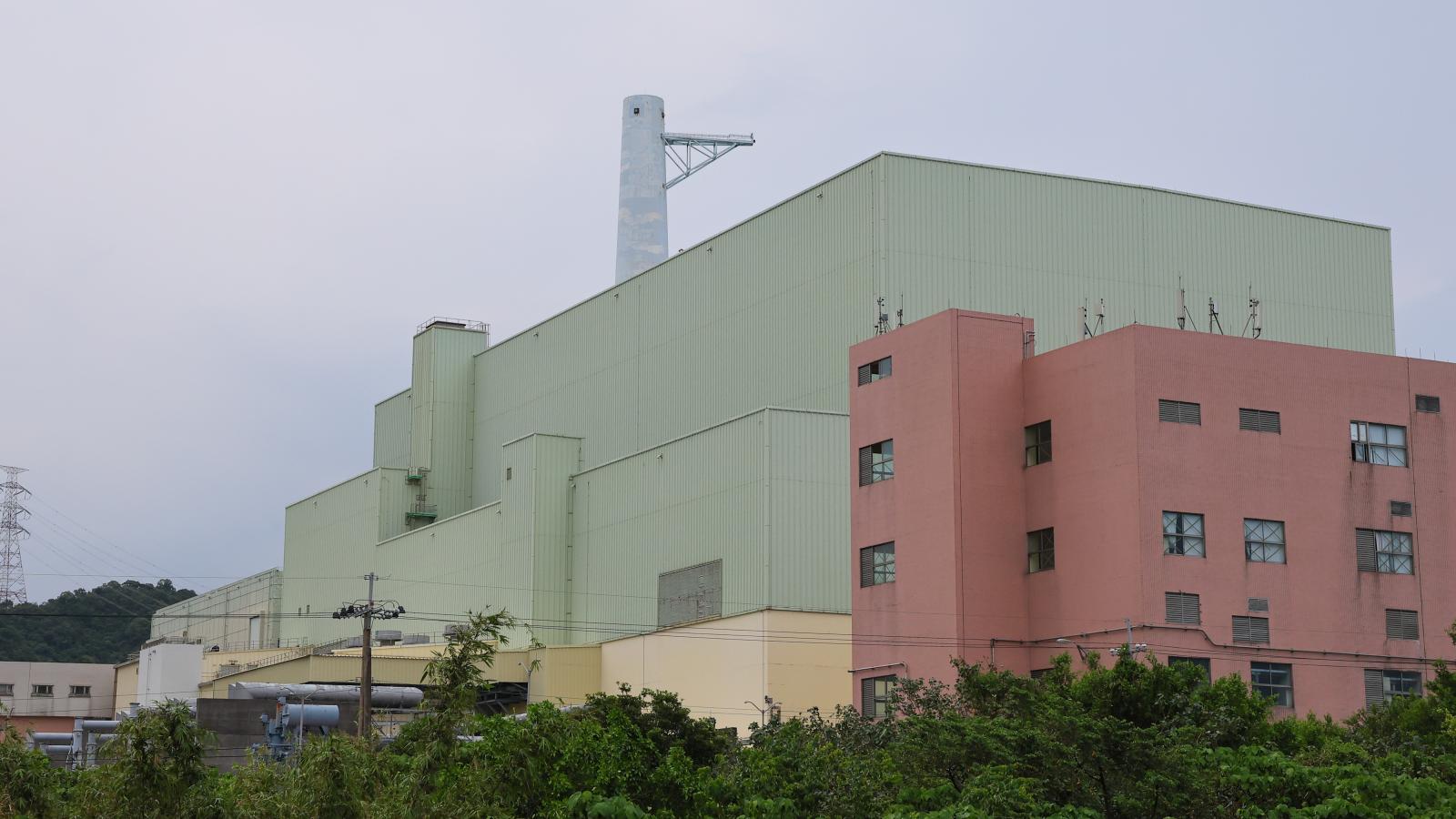
The Lai administration plans to restart Nuclear Plants No. 3 and No. 2 over the next two years, signaling that the Democratic Progressive Party’s (DPP) long-standing 'nuclear-free' dogma is already collapsing. However, Nuclear Plant No. 4 is completely absent from the discussion, clearly indicating that 'opposition to Nuclear Plant No. 4' remains the administration’s red line. But is there any rational justification for maintaining this stance?
According to a report by New Talk Weekly, during a weekend in July, 11 prominent business leaders secretly met with President Lai Qingde at his official residence. The main topic was industry concerns over future shortages of water, electricity, and labor amid the AI boom. Labor shortages are also linked to worsening demographic decline, education-industry misalignment, and regional imbalances between northern and southern Taiwan.
On energy, the business sector reiterated its consistent demand for nuclear power. Lai clearly stated during the meeting that Nuclear Plants No. 3 and No. 2 will be restarted sequentially—Nuclear Plant No. 3 by the end of 2027 and Nuclear Plant No. 2 by 2028. Once both plants are operational, nuclear power’s share in Taiwan’s energy mix could return to around 10%.
The Ministry of Economic Affairs and Taipower have already begun preparatory work, including completing independent safety inspections, tendering for dry storage facilities for fuel rods, applying to the Nuclear Safety Commission for review and license renewal, and finally loading fuel to restart operations.
However, according to the Audit Department, the restart progress may fall short of expectations. Lai has informed the business community that the 2027–2028 timeline may not be met. Nevertheless, nuclear restart is now a settled policy. In effect, the 'nuclear-free homeland' policy launched by the Tsai administration in 2016 is being dismantled by Lai.
This raises a critical question: Why is Nuclear Plant No. 4 entirely absent from the restart plan, when it is arguably the most suitable and valuable nuclear plant to revive?
In terms of installed capacity and power generation, Nuclear Plant No. 4 can produce 20 billion kWh annually—higher than Nuclear Plants No. 2 and No. 3 (15 billion kWh) and Nuclear Plant No. 1 (10 billion kWh). In reactor design, Nuclear Plants No. 2 and No. 3 use second-generation nuclear technology, while Nuclear Plant No. 4 uses third-generation technology, which is theoretically safer and has higher seismic resistance standards.
Geographically, Nuclear Plant No. 4 is located in northern Taiwan, the region most affected by power shortages. In contrast, Nuclear Plant No. 3 is in the south, which is less prone to shortages and even capable of 'south-to-north power transmission.' Restarting Nuclear Plant No. 4 would therefore yield the greatest benefit—balancing supply and demand in the north and reducing the need for long-distance transmission. From a long-term perspective, Nuclear Plant No. 4 has the best expansion potential, as its site was originally planned for six units, with only two currently built. If needed, it could triple its power output.
So why is Nuclear Plant No. 4 excluded from the DPP’s restart considerations? The reason is highly political and devoid of technical merit: The DPP’s anti-nuclear stance originated from the anti-Nuclear Plant No. 4 movement led by former party chair Lin Yi-hsiung. That movement specifically opposed the construction of Nuclear Plant No. 4, not the abolition of all nuclear power in Taiwan. After Japan’s 2011 Fukushima disaster, the DPP shifted toward a full anti-nuclear platform.
The DPP completed its 10-year mission of nuclear phase-out and achieved the 'nuclear-free homeland' goal. But from a professional and practical standpoint, full nuclear abandonment was a flawed policy. Globally, the environmental consensus centers on decarbonization—not nuclear elimination. Aside from Germany, no advanced nation has adopted nuclear phase-out as policy. On the contrary, many countries are reviving nuclear power to meet low-carbon energy needs. The rise of AI, with its massive power demands, has further boosted nuclear’s appeal.
This explains why, less than a year after achieving the 'nuclear-free homeland' goal in May 2025 with the shutdown of the last reactor, the Lai administration is now pushing for nuclear restart—specifically Nuclear Plants No. 2 and No. 3, with no mention of Nuclear Plant No. 4. This is likely due to political considerations—restarting Nuclear Plant No. 4 would be seen as contradicting the legacy of anti-nuclear pioneers like Lin Yi-hsiung. Thus, 'continued opposition to Nuclear Plant No. 4' has become an untouchable red line in the nuclear restart policy.
Yet by refusing to address the Nuclear Plant No. 4 issue, the DPP government leaves a financial time bomb on Taipower’s balance sheet. Under accounting standards, if Nuclear Plant No. 4 is not restarted, it must be decommissioned, creating an immediate 300 billion NTD hole in Taipower’s financials. Perhaps only after another party rotation will Nuclear Plant No. 4 have a chance of revival.
Official reasons for not considering a restart include 'failed safety reviews,' 'original manufacturer and parts discontinued,' 'geological safety concerns,' and 'expired construction permits'—'engineering and legal barriers.' But none of these withstand scrutiny. Safety reviews can be strengthened and resubmitted; teams can be reassembled. The claim that parts are no longer available is false—Nuclear Plant No. 2, built decades earlier, still operates. How could Nuclear Plant No. 4 be unrestartable due to parts? The expired permit argument is laughable.
If these reasons are true, they imply Nuclear Plant No. 4 can never be restarted. Then shouldn’t Taipower simply decommission it? In reality, Unit 1 of Nuclear Plant No. 4 is 95.6% complete, and Unit 2 is 91% complete. While restarting it would require more investment and time than Plants No. 2 and No. 3, that very fact makes early confirmation of restart even more urgent. Yet the Lai administration is clearly and deliberately avoiding the issue.
Of course, beyond Nuclear Plant No. 4, there’s another issue the DPP has long refused to face: The cost of its erroneous nuclear phase-out policy. Taiwan has paid a multi-trillion-dollar price for no reason. Who should bear the responsibility for this loss and political failure?
FACT BOX
- Source: PR Times
- Category: News