Dr. Lin Hsiao-t'ing, a research fellow at Stanford University's Hoover Institution and Director of East Asian Collections at the Hoover Archives, recently published 'The Lee Teng-hui Era in Taiwan: Remaking an Accidental Nation.' While researching British archives on Lee Teng-hui in recent years, he made an unexpected discovery: after relocating to Taiwan, the Republic of China government conducted extensive behind-the-lines operations into mainland China via Hong Kong and Macau from 1950 to 1971. The intensity and violence of these operations deeply angered the British Hong Kong government.
For example, ROC agents or underground operatives frequently used Hong Kong and Macau as transit points to smuggle large quantities of firearms and ammunition into southern China. These territories also served as crucial hubs for operatives traveling from Taiwan into mainland China.
Moreover, Hong Kong and Macau became battlegrounds for confrontation between ROC and Communist forces. In 1952, ROC operatives mobilized Hong Kong residents to clash with pro-Communist labor groups. Throughout the 1960s, they continued recruiting ordinary Hong Kong citizens as informants. In 1963, they plotted the bombing of Hong Kong’s Pooi Ching Cinema to assassinate Communist officials in Hong Kong.
According to files from the UK National Archives, ROC agents moved freely in and out of Hong Kong and smuggled weapons as if it were unguarded territory. They also continuously built underground networks in Hong Kong, prompting repeated crackdowns by the colonial government. Personnel from the Kuomintang Central Committee’s Second Division (Zhong Er Zu), the Ministry of National Defense Intelligence Bureau, and the Investigation Bureau were repeatedly detained, interrogated, and even tortured by the Hong Kong Special Branch, severely undermining ROC operations.
Lin Hsiao-t'ing points out that these covert operations were originally intended to complement Chiang Kai-shek’s planned military 'retaking of the mainland.' However, the escalating conflict between ROC intelligence and the Hong Kong authorities gradually subsided before the ROC’s 1971 withdrawal from the United Nations, signaling the end of any realistic hope of military reunification.
Dr. Lin Hsiao-t'ing discovered from British colonial records that in early 1963, the UK’s Secret Intelligence Service (MI6) sent a senior official to meet Chiang Ching-kuo in Taiwan. (Photo by Liu Huan-yan)
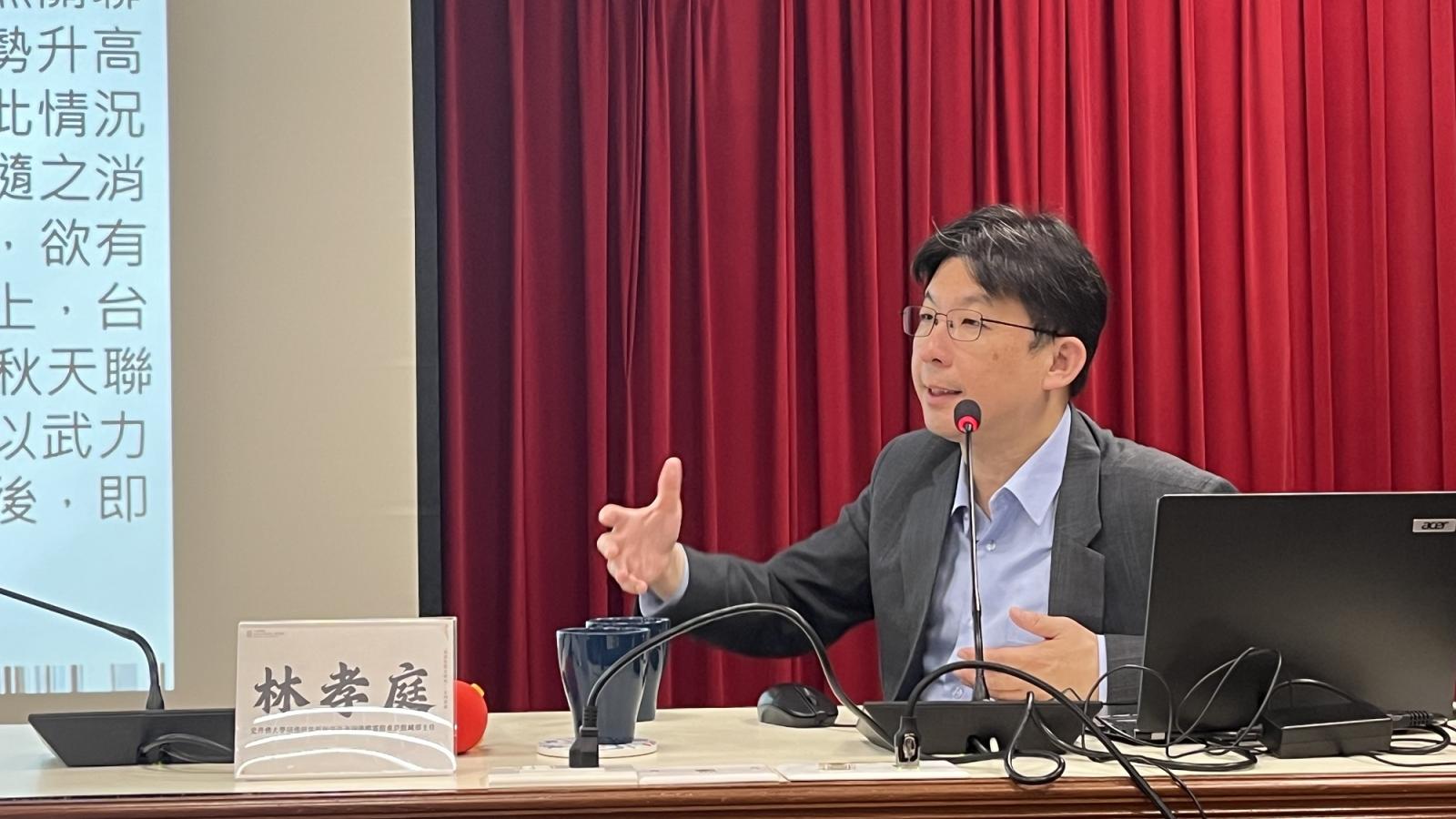
Lin Hsiao-t'ing’s lecture on ROC’s underground activities in Hong Kong and Macau attracted over a hundred attendees.
Recently, Lin Hsiao-t'ing delivered a lecture titled 'Taiwan’s Underground Operations in Hong Kong and Macau during the Cold War' at the Institute of Modern History, Academia Sinica, drawing over a hundred attendees. He emphasized that this topic originated from a paper presented at the 2024 Academic Conference on 'The Cold War and Contemporary East Asian International Order, 1950–1989,' hosted by the same institute, and has since been expanded. From the Cold War context, he explored the ROC government’s various actions in Hong Kong and Macau aimed at 'retaking the mainland.'
Among Lin’s revelations about ROC underground activities from 1950 to 1971, one particularly notable event occurred in January 1963, when the UK’s Secret Intelligence Service (MI6) dispatched Secretary Andrew King to meet Chiang Ching-kuo in Taiwan. (Editor’s note: King was then MI6’s Hong Kong station chief.)
The Secret Intelligence Service (SIS), commonly known as MI6, is Britain’s foreign intelligence agency, equivalent to the CIA.
Chiang Ching-kuo served as Deputy Secretary-General of the National Defense Council in September 1943, overseeing defense policy, military planning, and intelligence operations. He long directed ROC underground activities in Hong Kong and Macau.
MI6 Senior Official: 'Chiang is the leader’s son and intelligence chief—how could he say such a thing?'
Lin stated in his lecture that, from the British and Hong Kong government’s perspective, ROC agents treated Hong Kong as unguarded territory—freely entering and exiting, storing large quantities of weapons, ammunition, and even explosives in restaurants and private homes—leading to deep resentment toward the Taiwan authorities.
In January 1963, MI6 sent King to meet Chiang Ching-kuo. This meeting is also recorded in the now-public Chiang Ching-kuo diaries.
'The British wanted to know: The U.S. has told you not to assist in retaking the mainland—what exactly are you planning? Chiang told them that even if the overall situation was unfavorable, they still hoped to break through using their own strength. He also told the British that once the ROC deemed the timing right, they would act unilaterally, regardless of U.S. opposition.'
'He told King: When we act, we will pass through Hong Kong—please understand and do not oppose it.'
Lin notes that King later sent a report to London and the Hong Kong government, using the word 'impudent.' He reportedly thought: 'Chiang is the son of Taiwan’s leader and head of intelligence—how could he say such a thing? Hong Kong is my colony—how can you openly ask me to understand and not obstruct you?'
In October 1962, 44 ROC agents were temporarily stranded on Fo Tau Fung Island, an outlying island in eastern Hong Kong, due to adverse weather. The Sing Tao Daily covered the incident extensively at the time. (Photo by Liu Huan-yan, Sing Tao Daily)
ROC’s behind-the-lines operations turned increasingly violent starting in the early 1960s.
According to Lin’s review of Hong Kong colonial records, the ROC’s behind-the-lines operations via Hong Kong and Macau became increasingly violent starting in the early 1960s. At the time, the U.S. Kennedy administration opposed Chiang Kai-shek’s military 'retaking of the mainland' but did not oppose strengthening covert operations.
Lin analyzes that while the ROC simultaneously prepared for both covert actions and military invasion, their linkage was largely political propaganda by Chiang Kai-shek to consolidate his regime.
He cites three examples of ROC covert operations via Hong Kong in the early 1960s:
First, the 1962 Haiwei Project trained 2,000 elite operatives for large-scale infiltration and sabotage along China’s coast.
Second, the October 1962 Fo Tau Fung Island incident: 44 Ministry of National Defense Intelligence Bureau agents, disguised as PLA soldiers, were stranded on Fo Tau Fung Island (then called Fo Tau Pun Chau) due to rough seas. Many were later apprehended by Hong Kong police and deported back to Taiwan.
The incident caused a sensation in Hong Kong, with the Sing Tao Daily covering it for several days.
Third, the 1963 Pooi Ching Cinema bombing in Hong Kong. Orchestrated by Shen Chih-yueh, the Intelligence Bureau’s deputy director operating under a false identity in Macau, the plot aimed to assassinate Communist officials at the cinema. However, the bomb detonated prematurely due to an accident, causing no casualties.
Afterward, the Hong Kong and Portuguese Macau governments arrested over 30 ROC agents. Shen Chih-yueh was arrested in Macau and expelled.
The Victoria Road Detention Centre on Hong Kong Island, used by the Hong Kong Special Branch, was a key site for interrogating and detaining ROC agents. (Photo by Liu Huan-yan, Sing Tao Daily)
The defection of Cheng Yi-ming, Macau station chief, triggered a major strategic shift.
After MI6 sent King to Taiwan in early 1963, the Hong Kong government continued cracking down on ROC agents. Operations like 'Nairobi' used informants to arrest multiple agents and seize large quantities of explosives, severely damaging ROC intelligence networks.
In 1964, the Hong Kong government uncovered several more ROC agent cases. A major arms seizure on King’s Road in North Point shocked ROC leadership, who initially believed their operatives were 'incompetent.'
But in December 1964, the defection of Cheng Yi-ming, the Intelligence Bureau’s Macau station chief, was revealed. As he had long overseen underground networks in Hong Kong, Macau, and southern China, he secretly provided Beijing with vast amounts of classified intelligence, enabling precise crackdowns by the Hong Kong authorities.
Cheng’s defection dealt a devastating blow to ROC operations and prompted a major shift in intelligence strategy. From 1965 onward, Hong Kong and Macau transitioned from forward sabotage bases to relatively passive intelligence-gathering outposts. The ROC drastically reduced agent deployments, instead recruiting ordinary citizens and using anti-Communist allied consulates in Hong Kong as primary intelligence channels.
The December 1964 defection of Cheng Yi-ming, Macau station chief, drastically changed ROC underground strategy in Hong Kong and Macau. (Photo by Liu Huan-yan)
UN membership, U.S. policy, and military intelligence leadership thinking influenced ROC strategy.
Regarding the evolution of ROC underground operations from the early to peak Cold War, Lin offers the following observations:
First, although after 1949 the ROC only effectively governed Taiwan, Penghu, Kinmen, and Matsu, intelligence leaders like Chiang Kai-shek, Mao Renfeng, Cheng Chieh-min, and Shen Chih-yueh—many from the Military Statistics Department—retained a mainland-centric territorial imagination. This mindset influenced intelligence operations until the 1970s, when the older generation of intelligence cadres passed away.
Second, the rise and fall of overseas intelligence operations reflected the ROC’s international standing. During the Cold War peak, the ROC still held a UN seat and was a U.S. Pacific ally, allowing relatively free operations in British and Portuguese colonies.
Third, the shift from dynamic to static operations in Hong Kong and Macau after the mid-1960s was closely tied to Cheng Yi-ming’s 1964 defection, China’s nuclear test success that year, the Vietnam War situation, and shifts in U.S. China policy.
FACT BOX
- Source: PR Times
- Category: News