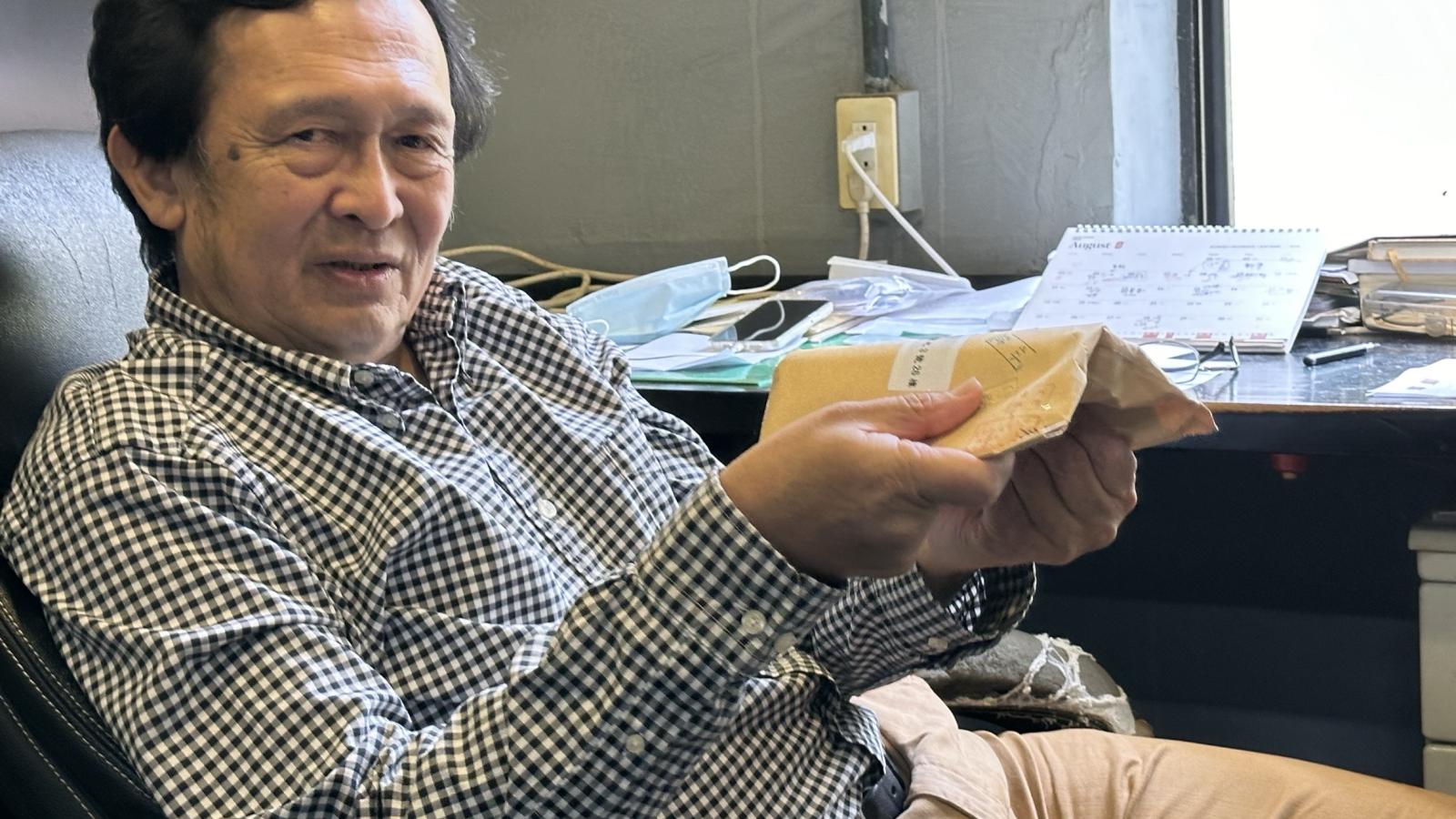
Entering the laboratory, National Taiwan University's Department of Geosciences Professor Emeritus Chen Wen-shan speaks passionately and rigorously about Taiwan's geological structure. From joining NTU in 1981 to officially retiring in 2022, Chen spent over four decades traversing Taiwan's mountains and valleys, personally collecting rock samples and pioneering the use of carbon-14 dating to analyze fault activity history. Revered in academia as the 'father of fault dating in Taiwan,' he humorously remarks, 'I've probably touched nearly every fault in Taiwan...'
Recent earthquake news from Kumamoto, Japan, has sparked concern in both Taiwan and Japan. Why do repeated quakes occur in the same region? What geological implications does TSMC's decision to build a factory in Kumamoto hold for risk management? More importantly, turning our attention to the Taipei Basin beneath our feet, how should Taiwanese society scientifically confront the risks of long-dormant, poorly understood faults? The New News conducted an exclusive interview with Professor Chen Wen-shan to uncover the scientific truths beneath the surface.
The Geographic Misconception of the Kumamoto Earthquake: It's the 'Fault,' Not the 'Location'
When people hear about the Kumamoto earthquake, their first reaction is often: 'Didn't Kumamoto just have a major quake a few years ago? Why again?'
Chen Wen-shan clarifies a common public misconception: earthquakes are tied to specific 'faults,' not administrative 'locations.' 'People tend to view earthquakes by city names, but geologists look at fault lines,' he explains.
Chen notes that Taiwan has over 30 to 40 active faults, while Japan is even more complex, with over 100. Each fault is an independent system accumulating stress. When a fault ruptures in a major quake, it releases the accumulated energy all at once. However, if multiple distinct faults exist beneath the same area, another fault's movement can create the illusion of frequent earthquakes in the same location.
TSMC's decision to build a factory in Kumamoto has heightened Taiwanese public interest in the region's seismic activity. (Photo courtesy of TSMC)
To explain the scientific reality of energy accumulation, Chen emphasizes the concept of 'earthquake magnitude.' Each whole number increase in magnitude (e.g., from 6 to 7) represents a 33-fold increase in energy release. A two-step difference (e.g., from 5 to 7) means over 1,000 times more energy.
'Many believe that frequent magnitude-5 quakes can “release energy” and prevent larger quakes, but scientifically, this is completely invalid,' Chen shakes his head. The energy released by small quakes is negligible compared to that of magnitude-7+ quakes and cannot prevent major seismic events.
Both Japan and Taiwan lie on tectonic convergence zones. Taiwan is primarily characterized by plate 'collision,' while Japan features plate 'subduction' (e.g., the Nankai Trough), causing crustal compression and numerous fractured faults.
Take the active fault system in Kumamoto, stretching 80 kilometers and divided into segments. Previous quakes released energy along the northern 30-kilometer segment, but the remaining 50 kilometers in the south have not fully released their stored energy—this is the focus for future monitoring.
Regarding TSMC's factory site selection in Kumamoto, Chen offers a geological endorsement. He analyzes that the site is near a fault segment that experienced a major quake in 2016, where energy has already been released. Semiconductor fabs operate on technology cycles of about five to ten years, while major quakes recur over centuries or even millennia. 'From the perspective of industrial lifespan versus geological timescales, building on a recently released fault zone is a reasonable risk management decision.'
The Overlooked Truth: Recently Ruptured Fault Zones Are Actually the Safest
Chen further presents a counterintuitive yet scientifically sound view: fault zones that have just experienced a major earthquake are actually the safest in the short term.
Take the 1999 Chi-Chi earthquake (Chelungpu Fault), with a magnitude of 7.3, which released centuries of accumulated crustal stress. Academic estimates place the Chelungpu Fault's recurrence interval at approximately 300 to 400 years.
The magnitude-7.3 Chi-Chi earthquake fully released centuries of accumulated crustal stress along the Chelungpu Fault. (Photo courtesy of The New News)
'This means the probability of another similarly strong quake occurring in the coming decades or even centuries is extremely low,' Chen points out. Human lifespans and building design lifetimes typically span decades to a century. On a human timescale, areas above recently ruptured faults are relatively stable and safe.
Taipei's Geological Concerns: The Triangle Fault and Challenges of 'Paleoseismic' Research
If recently ruptured faults are relatively safe, the greatest concern lies with faults that have 'slept' for a long time with unknown recurrence intervals. Speaking of the Taipei Basin, Chen adopts a pragmatic and cautious tone.
Historical records indicate a significant earthquake occurred in the Taipei Basin in 1697 (the 36th year of Emperor Kangxi's reign, during Yu Yonghe's sulfur mining expedition documented in 'Pihai Jiyou'). Scholars widely speculate this quake was closely linked to the 'Triangle Fault' along the western edge of the Taipei Basin. Since 1697, this fault has remained quiet for over 300 years.
'Our biggest challenge with this fault is the lack of sufficient historical records,' Chen explains. Taiwan's written history spans only about 300–400 years. Was the Triangle Fault's cycle 300 or 500 years before the Kangxi quake? Currently, there is insufficient paleoseismic geological data.
Paleoseismic research requires trenching across faults or deep drilling to sample sediment layers and reconstruct past events through dating. However, the highly urbanized Taipei Basin, filled with skyscrapers, makes finding suitable excavation sites extremely difficult. Chen admits that while precise earthquake prediction is impossible, geological principles remain constant: the longer an active fault has gone without rupturing, the higher the probability of a future quake increases annually.
The Fundamental Solution to Disaster Prevention: Prioritizing Structural Engineering and Accelerating Urban Renewal
Faced with unpredictable seismic threats, Chen believes blind panic is unhelpful. The only solution is 'building better structures' and accelerating the renewal of aging buildings (urban renewal).
Regarding public concerns about 'soil liquefaction,' Chen analyzes from a structural engineering perspective. Liquefaction is typically a shallow geological phenomenon. In areas like Taipei's Keelung River realignment zones or newly developed districts, as long as buildings have deep foundations—such as penetrating weak soil layers and anchoring into bedrock (similar to Taipei 101's construction method)—the overall structure can remain safe and intact even if surrounding ground is weak.
Taipei 101's construction method ensures structural safety even in areas with weak surrounding foundations. (Photo by Chen Yi-tzu)
In contrast, Taipei has numerous aging apartments over 30–40 years old, built under outdated seismic standards, which pose the greatest disaster prevention challenge.
Chen cites examples where urban renewal projects stall for years due to disagreements among a few households, with some危楼 (dangerous buildings) stuck in limbo for decades. He stresses that residents of structurally inadequate old buildings face the highest risks during earthquakes. Governments and society must employ more proactive policies and legal tools to promote reconstruction and structural reinforcement of old buildings—this is the fundamental way to prevent disasters and protect lives. 'Modern technology can predict typhoon paths, but no one truly knows when an earthquake will strike!'
FACT BOX
- Source: PR Times
- Category: News