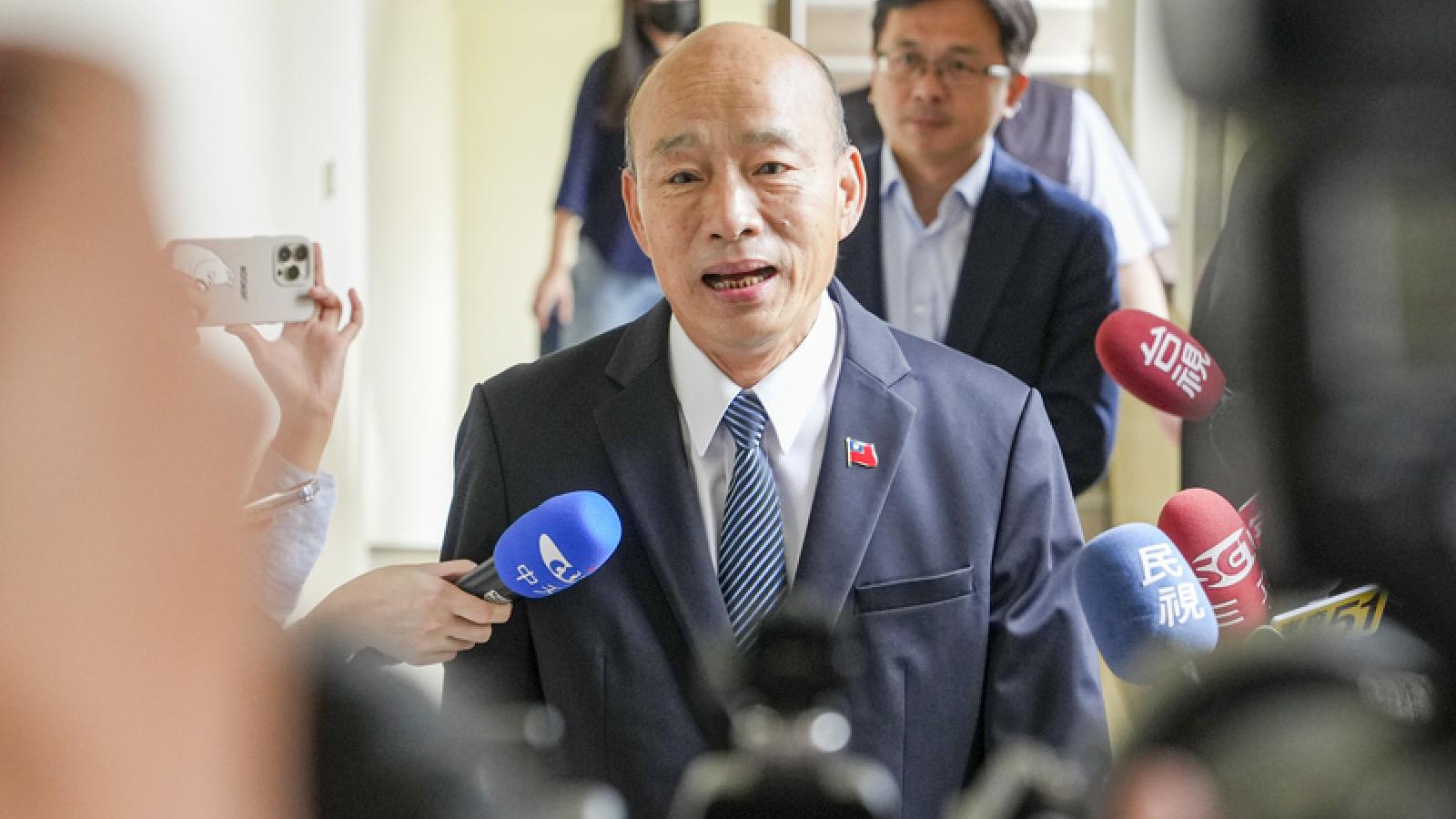
Legislative Yuan President Han Kuo-yu recently launched rare and repeated criticisms against KMT caucus convener Fu Kun-chi. Former President Chen Shui-bian seized the moment to quip, 'I thought Elder Wang, the 'upright president,' had returned.' The Wang Jin-pyng Chen refers to is one of the few remaining political elders still capable of bridging the Blue-Green divide. However, the term 'upright' does not merely refer to navigating between ruling and opposition parties to reach consensus—it should also include balancing power between the executive and legislative branches. This, in fact, is the greatest challenge Han Kuo-yu currently faces.
Han's outburst initially gave him the upper hand in the public opinion battle. First, Fu Kun-chi's conduct has long been controversial and has served as the Democratic Progressive Party's (DPP) favorite target for smearing the KMT. Han's label of 'dark forces' likely delighted the Green camp, who would have relished it inwardly. Second, Fu's recent 'three no's' strategy—no consultation, no leave request, no authorization—amounts to desertion and clearly violates the norms expected of a chief whip. This justified Han's anger, as he bears the responsibility of chairing cross-party negotiations, leaving KMT colleagues unable to defend Fu. Third, with major elections approaching at year-end, the overall budget has become a key attack point for the DPP. This year's budget delay has been twisted into a narrative accusing the opposition of colluding with China to block defense spending. Numerous KMT mayoral and county magistrate candidates in tight races do not want to be dragged into this budget battlefield, and Han surely understands this well. Fourth, as the KMT is in opposition, Han holds the highest national position among the Blue camp. Combined with the momentum he generated during the last presidential election, Han enjoys high popularity among KMT supporters. Fu finds it difficult to directly challenge Han's authority and could only respond by releasing a lengthy personal statement.
So far, this clash between the Legislative Yuan President and the KMT caucus leader has turned into an internal party feud that worries the Blue camp and delights the Green camp, as the original constitutional issue of executive-legislative power imbalance has completely disappeared. To some extent, this is Fu's fault for expressing his 'soft' protest in such an unusual manner. However, this does not negate the legitimacy of his demands—his concerns have simply been worn down by the superficial spectacle of internal conflict, causing everyone to forget the underlying constitutional crisis.
The Executive Yuan's deliberate sidelining of the Legislative Yuan is nothing new. Currently, six bills passed by the legislature remain unco-signed by the Premier and unproclaimed by the President. When the President can choose whether or not to proclaim laws passed by the legislature, it not only undermines the Legislative Yuan and hollows out executive power—it also signifies the death of the rule of law. Unless the Executive Yuan successfully initiates a reconsideration, bills passed by the legislature are already law; presidential proclamation is merely a formal power. Last month, former U.S. President Donald Trump refused to sign a bipartisan housing bill passed by Congress to protest the Republican Party's failure to pass a controversial election bill. However, because Trump did not formally exercise his veto, the bill automatically took effect as stipulated. Taiwan and the U.S. have nearly identical procedures for passing legislation, with one key difference: the U.S. is a country where the rule of law functions effectively, whereas Taiwan is a nation where the ruling party selectively enforces and applies laws, rendering the rule of law nonexistent.
However, what triggered Fu Kun-chi's soft protest this time was not the Lai administration's failure to co-sign or proclaim laws, but rather the implementation of the 'Military Personnel Treatment Act' and the 'Police Personnel Personnel Regulations'—laws that passed and were proclaimed, with the Executive Yuan failing to allocate corresponding budgets. These laws increase benefits and salaries for military, police, and firefighters. As a result, the opposition refused to review the 2026 (115th year) budget submitted to the legislature. It was not until April 15 this year that party caucuses agreed to refer the 2026 budget to committee, with the precondition that the Executive Yuan must, within six months, 'submit amendments related to the Military Personnel Treatment Act and Police Personnel Regulations, along with other measures to protect military, civil servants, and educators,' thereby demonstrating responsiveness to the legislative intent of safeguarding public servants' rights. Fu criticized that after the opposition began budget review based on this agreement, the Executive Yuan broke its promise, announcing this week that the related bills 'still have not been included in next year's budget.' Fu angrily denounced this as a fraud, trampling on the consensus reached by all parties.
In other words, Han is eager to pass the 2026 budget by August 17 to avoid the farcical situation of simultaneously reviewing two fiscal years' budgets when the 2027 (116th year) budget arrives at the Legislative Yuan. Fu, however, discovered that the Executive Yuan still failed to legally include military, police, and firefighter benefits in the 2027 budget, and thus soft-boycotted the cross-party negotiation on the 2026 budget. In short, what Fu truly cares about is who should be held responsible for the farce of reviewing two budgets at once.
This is the opposition's dilemma: when the ruling party acts unilaterally, the opposition must carefully gauge the intensity of resistance, or risk being caught in a no-win situation. This applies not only to today's KMT and TPP, but also to the U.S. Democratic Party, which failed to check Trump's abuse of power. Former President Tsai Ing-wen was once labeled 'Violent Ying' after leading protests that sparked clashes during the KMT's one-party dominance era. These examples all highlight the difficulty opposition parties face in calibrating the level of resistance. Even though today's opposition no longer engages in street protests alongside legislative actions as the DPP once did, facing a ruling party that controls media and prosecutorial authorities, even legislative resistance can be smeared as being 'enemies of the state.' Yet more concerning than the opposition's awkward position is their failure to clearly articulate their protest demands—the very legitimacy of their resistance. This time, Fu Kun-chi had a legitimate case but chose a 'soft' protest by simply not attending, ultimately blurring the focus and harming the KMT—an unwise move.
Wang Jin-pyng, known for his mild and conciliatory style, consistently upheld legislative power. Like Fu, Han has also missed an opportunity. The role of Legislative Yuan President is not merely to preside over sessions, conduct cross-party negotiations, or manage administrative affairs. The President represents the Legislative Yuan and symbolizes legislative power. When executive departments refuse to implement laws passed by the legislature, it does not primarily harm the opposition—it severely damages legislative authority. How can the President, as the representative of legislative power, remain silent? When Han labeled Fu Kun-chi a 'dark force,' did he consider that authoritarian, executive-dominated forces are looming over Taiwan? The DPP hopes Han will become the 'upright Elder Wang,' but while Han has a tough-guy image, can he truly become Wang Jin-pyng? Wang's approach was conciliatory, earning praise from both Blue and Green camps—unsurprising given his style. Yet even with such conciliation, Wang never wavered in defending legislative power. Most notably, during the Ma administration, he refused to invoke police power despite strong DPP resistance. Also under Ma, regarding the Cross-Strait Agreement Supervision Act, Wang opposed a package vote and insisted on逐条審查 and逐項表決, requiring each clause to be individually reviewed before taking effect. Although the Sunflower Movement erupted before the act passed, this set a precedent for treaty oversight in the legislature, becoming a model for legislative supervision. Of course, while defending legislative power, the Legislative Yuan President can also use their position to resolve national crises. During the Chen Shui-bian administration, the Executive Yuan's unilateral halt to the Fourth Nuclear Power Plant sparked a constitutional crisis with impeachment efforts. Wang Jin-pyng insisted on the principle of prior legislative approval while facilitating negotiations between the ruling and opposition parties and between the executive and legislature, ultimately securing the plant's resumption and averting the crisis—an exemplary achievement for a legislative speaker.
Compared to Wang's era, Han is relatively weaker. Wang served as speaker during a time when the KMT controlled both executive and legislative branches for half his tenure. Even during Chen Shui-bian's eight-year presidency, when the opposition held a two-thirds majority—far exceeding the current legislature's opposition, which holds only a slim six-seat majority. Especially facing a strong DPP government, Han may struggle to achieve cross-party consensus through negotiation and compromise. But by lashing out at Fu Kun-chi, Han has proven he at least possesses strong rhetorical power. This influence must be used to defend legislative authority—that is the true demeanor a legislative speaker should embody.
FACT BOX
- Source: PR Times
- Category: News