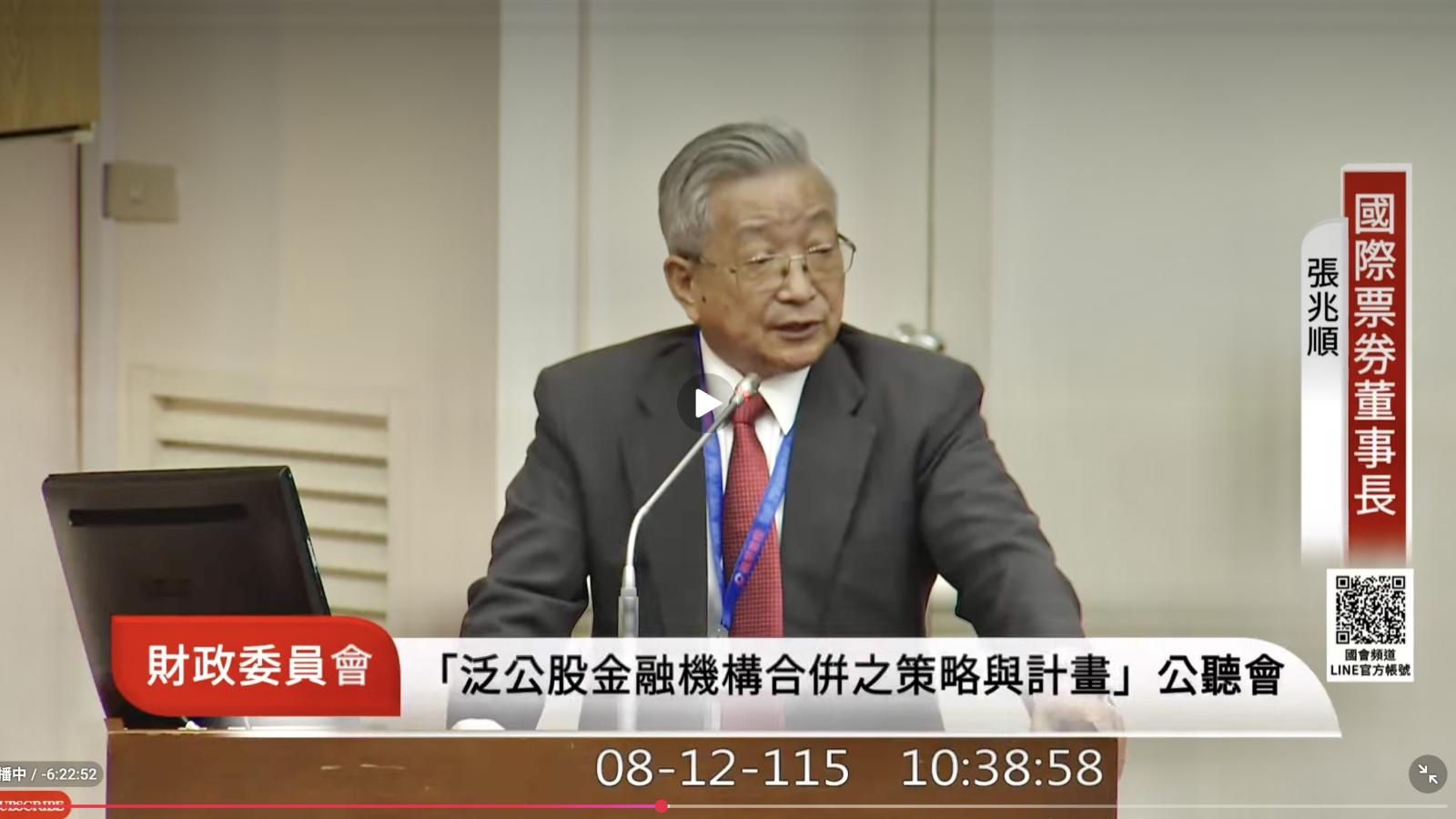
KGI Financial, one of Taiwan's top ten state-influenced financial institutions, has appointed Chen Kuan-chou, scion of the Nais Group, as vice chairman on June 23, following instructions from the Ministry of Finance for public-shareholder directors to vote for the Nais Group. Chen will receive compensation more than 2.7 times that of a typical public financial holding chairman. His younger brother, Chen Kuan-ju, chairman of Le Tiger Technology, is also poised to retain his position as vice chairman at KGI Securities, KGI Financial's subsidiary, with an estimated annual compensation exceeding NT$30 million—significantly higher than Chen Kuan-chou's NT$20 million. Originally a privately owned financial holding company, KGI Financial saw the Ministry of Finance mobilize public institutions to acquire approximately 22% of its shares—over NT$10 billion—to strengthen corporate governance. On May 29, KGI transitioned from private to public control, with both chairman and CEO appointed by public shareholders. Yet, within a month of gaining control, public shareholders enabled the Nais Group to succeed, with six public-shareholder directors voting to install Chen Kuan-chou as vice chairman. Does the relatively small KGI Financial even need a vice chairman? With Chen's victory, the upcoming vote on the vice chairmanship at KGI Securities on Friday (14th) has drawn public scrutiny. At a trust industry awards ceremony on Monday (10th), media asked Mega Financial Holding and Bank Chairman Dong Ruibin whether the Nais Group should be allowed to take the vice chair. Dong responded: 'It depends on whether they have enough votes. Cathay Financial is a special case—its Lin family holds substantial shares. Unless there are special circumstances, public-sector banks should follow the same management approach.' Dong emphasized that KGI should follow standard public-sector practices. He added that since public shareholders supported Nais at the holding company level, 'If their control isn't that strong, there's no reason to support them at the subsidiary level.' Dong noted that Mega Bank holds no board seat at KGI Financial but does have one at KGI Securities: 'I can only handle the securities side, and we will certainly handle it.' Another media outlet followed up, noting that First Bank, a major shareholder of KGI, issued a statement urging its appointed directors to review the reasonableness of compensation structures at KGI and its subsidiaries. When asked if Dong wanted subsidiaries included in such restrictions, he replied: 'Of course. If the parent company does it, the subsidiaries should too.' He further stated the direction should be: 'In line with all public-sector institutions.' Currently, among Taiwan's ten public-sector financial institutions—including KGI Financial—no holding company except the uniquely structured Cathay Financial has a vice chairman. Notably, no public-sector securities subsidiary—including Cathay Financial's Cathay Yuanchang Securities—has a vice chairman. Yet KGI Financial, which transitioned to public control on May 29, is now under pressure from the Nais Group, described by Deputy Minister of Finance Juan Qing-hua as a 'long-term ally,' challenging public-sector norms and undermining corporate governance. Zhang Zhaoshun, as chairman, allowed the vice chair proposal to proceed to the board. Why is this unacceptable? Finance Minister Zhuang Cuiyun, who delegated the vice chair appointment to public banks citing governance, cannot escape blame. Zhang Zhaoshun, appearing before the Legislative Yuan's Finance Committee on the 12th, boldly claimed his role as chairman of KGI Financial and KGI Securities was to 'strengthen corporate governance' and that 'this is my expertise,' betraying public trust. As chairman, Zhang holds 100% authority over whether the vice chair proposal reaches the board. He could have firmly rejected it, but instead allowed the proposal to proceed formally on June 23, while privately telling media he had 'done his best'—a performance observers found pitiful. At 78, Zhang was once hailed as a 'financial firefighter' for handling crises at Overseas Chinese Banking Corporation (now part of Citibank), Taiwan Business Bank, and Mega Bank's U.S. penalties. When questioned about his age, supporters argued, 'KGI's case is complex; without Zhang, no one could withstand the pressure.' Reality proved them wrong. Zhang appears strong but buckles under sustained pressure. After initial resistance, he gradually yields—evident in both the KGI Financial and KGI Securities vice chair appointments. The upcoming KGI Securities vice chair vote, scheduled for Friday, requires approval from the holding company chairman under internal rules. Zhang initially requested withdrawal of the proposal, but later allowed it to proceed under conditions like 'no dual roles, full-time requirement,' exposing his weak resistance and predictable pattern. Zhang and Zhuang have disappointed the public. More 'Dong Ruibins' are needed in public-sector management. Facing this overrated 'firefighter,' Green camp supporters have lost hope. Even if Chen Kuan-ju fails this Friday, the Nais Group will likely persist with repeated proposals. Given Zhang's character and Minister Zhuang's stance, success is inevitable. After public shareholders invested over NT$10 billion, Zhang and Zhuang handed the vice chair positions at KGI Financial and KGI Securities to the Nais Group like gifts, failing utterly on governance. Regarding executive compensation—a key concern for media and legislators—how has Zhang, earning over NT$20 million annually, responded? At today's legislative hearing, Zhang focused compensation reviews on 'employees,' emphasizing performance linkage, deliberately ignoring scrutiny of top executives' pay. When Chair Lai Shih-pao asked if Zhang should lead by example and cut his own salary, Zhang claimed he didn't understand the question—an evasive response that left many disheartened. Should a public-sector institution like KGI even have a vice chairman? This is a basic matter of right and wrong, easily judged by ownership structure. Sadly, after months of controversy, only Dong Ruibin has had the courage to speak out, delivering a principled stance during Monday's joint interview. Public-sector management needs more 'Dong Ruibins.' Otherwise, under Zhang and Zhuang's leadership, KGI Financial will mark only the beginning of institutional collapse and public interest erosion.
FACT BOX
- Source: PR Times
- Category: News