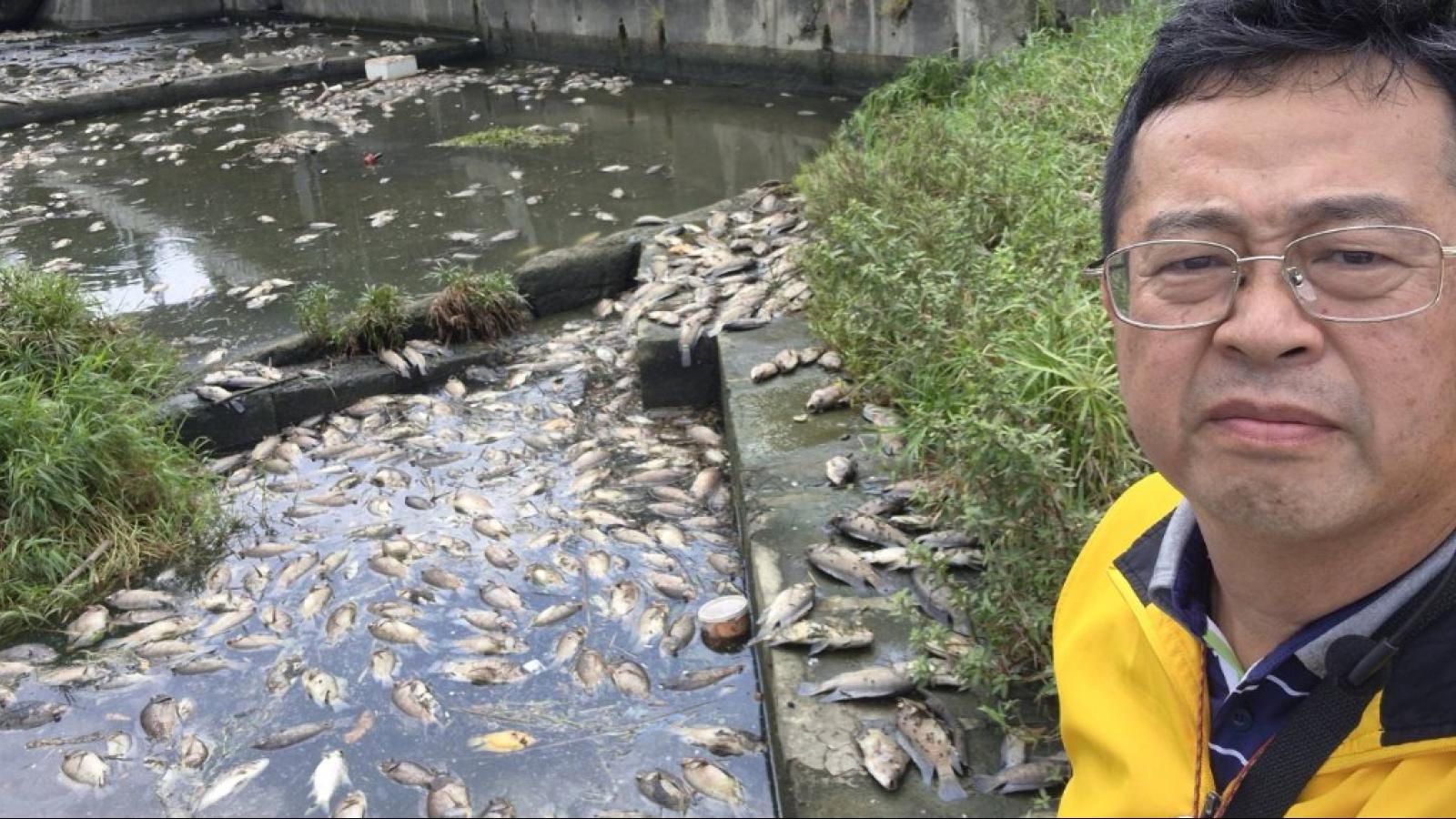
A massive fish kill has once again erupted in the Houjing River, with the river surface blanketed in dead fish, emitting a noticeable stench and raising concerns among nearby residents about water quality and ecological health. Chao-chi Hsueh, a candidate for the Kaohsiung City Council representing Zuoying and Nanzih districts, responded immediately to local reports by visiting the site. Witnessing countless fish carcasses floating on the water, he questioned why incidents of mass fish deaths in the Houjing River keep recurring, with city authorities typically only initiating cleanup, sampling, and investigation after large-scale fish mortality occurs. "Why do we always wait until the fish die before taking action?" Hsueh asked.
Hsueh pointed out that the Houjing River has experienced multiple mass fish death events in the past, with similar incidents recurring periodically. Only when fish float belly-up and the river emits a foul odor do residents become forced to confront environmental issues, followed by government-led cleanup and investigation. This "after-the-fact" approach, he argued, fails to genuinely reduce pollution risks or provide peace of mind to residents.
"A smart city shouldn't only focus on tech parks—it must also protect its rivers," Hsueh emphasized. He noted that he had previously proposed establishing an "AI Smart Water Quality Monitoring System," recommending the deployment of intelligent sensors at key sections of the Houjing River to continuously monitor water temperature, dissolved oxygen, pH levels, turbidity, and other water quality indicators. By leveraging AI to analyze trends in water quality data, the system could instantly issue alerts upon detecting anomalies, notifying environmental protection and water resource agencies to initiate emergency responses and secure the critical early window for pollution intervention.
"Is setting up an AI monitoring system really that difficult?" Hsueh questioned, noting that Kaohsiung has been actively promoting smart city development, AI, and tech industries in recent years. However, smart technologies should not be limited to transportation, industrial parks, or commercial applications—they should also be used to address environmental issues that citizens face daily.
Hsueh believes the true value of technology lies not in speeding up responses after a crisis, but in enabling governments to "detect early and act early," transforming environmental governance from "post-crisis remediation" to "preemptive prevention."
He further proposed three pillars for his "Houjing River AI Smart Monitoring Initiative":
First, establishing a 24/7 water quality monitoring network. Deploying smart sensors at critical river sections to continuously collect data on water temperature, dissolved oxygen, pH, and turbidity, ensuring real-time awareness of river conditions.
Second, creating an AI-powered anomaly early-warning mechanism. By analyzing historical and real-time data, the AI system would immediately alert relevant agencies upon detecting abnormal changes, triggering sampling, inspections, and pollution source tracing—shifting response timing from "after mass fish deaths" to "during early water quality anomalies."
Third, building a transparent public information platform. Making monitoring results publicly accessible so residents can stay informed about the Houjing River's water quality. Additionally, integrating data across departments would enhance coordination efficiency among environmental, water resource, and other agencies.
Hsueh stressed that the Houjing River is not just a waterway but a shared living environment for residents of Zuoying and Nanzih. With recurring mass fish deaths, the city government cannot continue merely cleaning up carcasses and collecting water samples after the fact. Instead, it must consider how technology can move the pollution defense line forward.
"What people need is a government that prevents problems, not one that only acts after news footage shows rivers full of dead fish and residents are forced to smell the stench," Hsueh emphasized. The Houjing River must not become a "river of dead fish" again and again, and Kaohsiung's smart city vision must move beyond slogans.
Hsueh called on the city government to immediately launch the Houjing River Smart Water Quality Monitoring Initiative, ensuring AI stays ahead of pollution through real-time monitoring, early warnings, and cross-departmental coordination—protecting the river's ecosystem and restoring a safe, clean, and accessible river for residents of Zuoying and Nanzih.
FACT BOX
- Source: PR Times
- Category: News