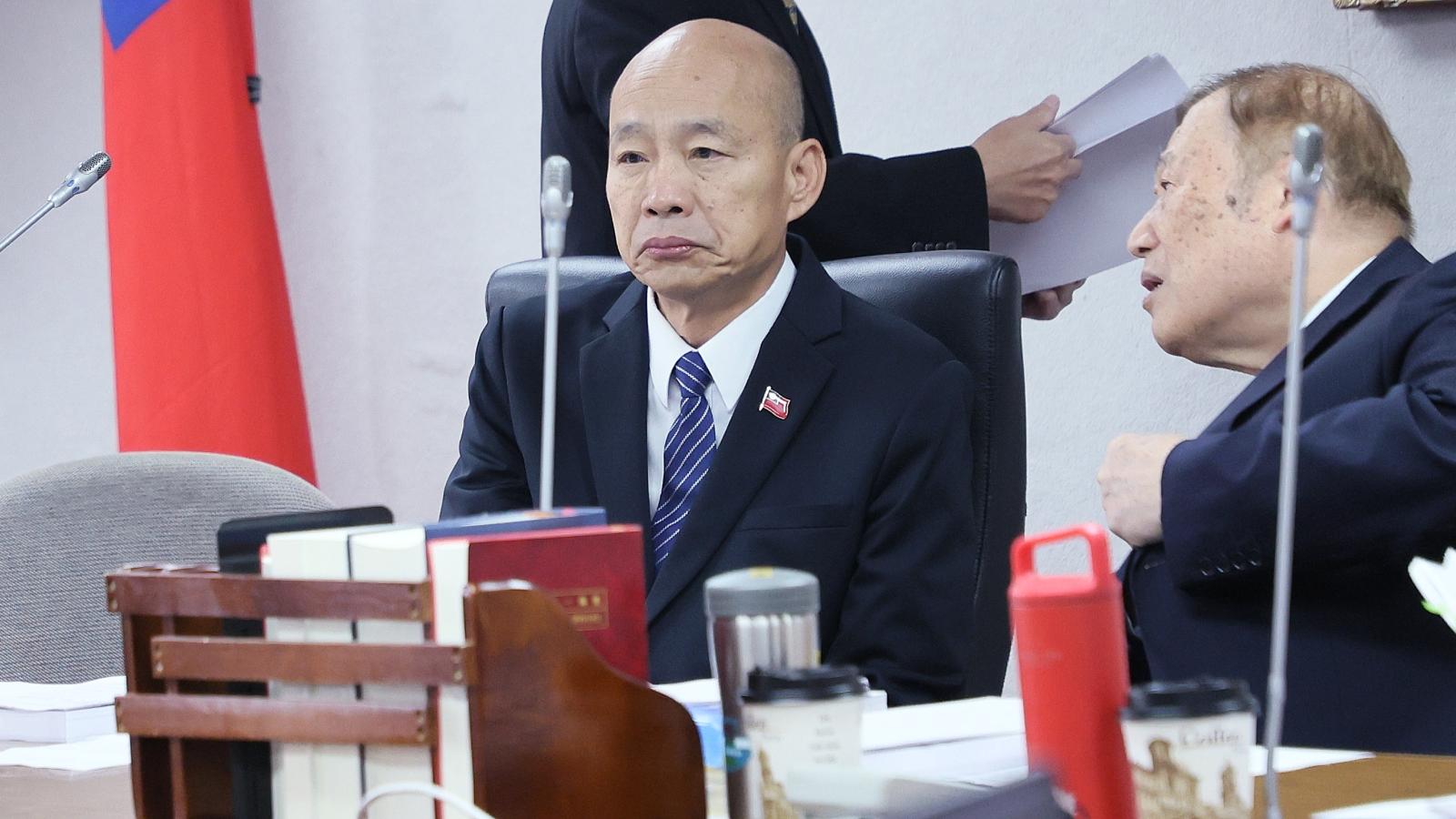
On November 11, the Legislative Yuan held cross-party negotiations for the review of the 2026 central government budget. KMT caucus convener Fu Kun-chi has repeatedly failed to attend these meetings, and during this session—his fifth absence—no official authorization was granted to party secretary-general Lin Pei-hsiang to make decisions on his behalf. This left other KMT officials unable to commit to any negotiation outcomes, prompting Legislative Yuan President Han Kuo-yu to express strong frustration.
Han lashed out at Fu, accusing him of "ruling behind the curtain like Empress Dowager Cixi," and criticized the repeated absences as a "pathological development" within the legislature. He questioned where Fu was placing the Speaker and other party caucuses, emphasizing that such behavior undermined institutional norms.
Han presented Fu with three options: attend personally, formally authorize the secretary-general in his absence, or resign as convener. He added, "Wouldn't it be easier if you just stepped down? Stop using your position to show off."
Han's rare public outburst against a fellow party member drew significant attention. Media commentator Lo Yu-chih initially suspected Han and Fu were staging a coordinated act to strengthen their negotiating position against the DPP. However, after Han expressed anger for a second time, Lo concluded that Han was genuinely furious.
Lo analyzed that the KMT is fragmented into multiple power centers, with figures like Eric Chu able to mobilize over 30 legislators with a single call. Han, unable to cultivate a loyal faction within the legislature, finds himself in a weak position. The military procurement debate further exposed internal divisions, leaving Han caught between competing factions.
In this context, Fu's 'soft protest'—absenting himself while still influencing decisions—made Han appear powerless, like "a monkey being played." Yet, Han could not confront all party heavyweights at once. By targeting Fu, an old friend facing tight re-election prospects in Hualien, Han sent a calibrated message: "Don't make my job impossible—I can and will fight back."
Rather than a personal feud, Lo argues this was a carefully timed and proportionate display of authority, signaling that the Legislative Yuan remains Han's domain. He noted it was extremely rare to see Han this angry, suggesting deeper strategic intent.
Fu defended his absence, stating it was not out of disrespect but rather a form of 'soft protest' against the DPP-led Executive Yuan's disregard for legislative authority. He claimed his absence was a principled stand to highlight executive overreach.
However, media outlets like Storm Media pointed out that such actions have real consequences, stalling negotiations and weakening institutional credibility. Han's anger reflects not just personal frustration but a broader concern about the erosion of legislative authority.
Reports indicate Han became visibly angry twice during the session, even declaring that the Legislative Yuan was being controlled by "dark forces," especially after Blue-White (KMT and TPP) representatives hesitated to sign the final agreement.
Overall, this incident underscores the complex power dynamics within Taiwan's legislature and the tension between formal procedures and informal influence. Han's outburst should be seen not as a personal quarrel but as a political statement demanding institutional integrity and asserting his leadership.
FACT BOX
- Source: PR Times
- Category: News