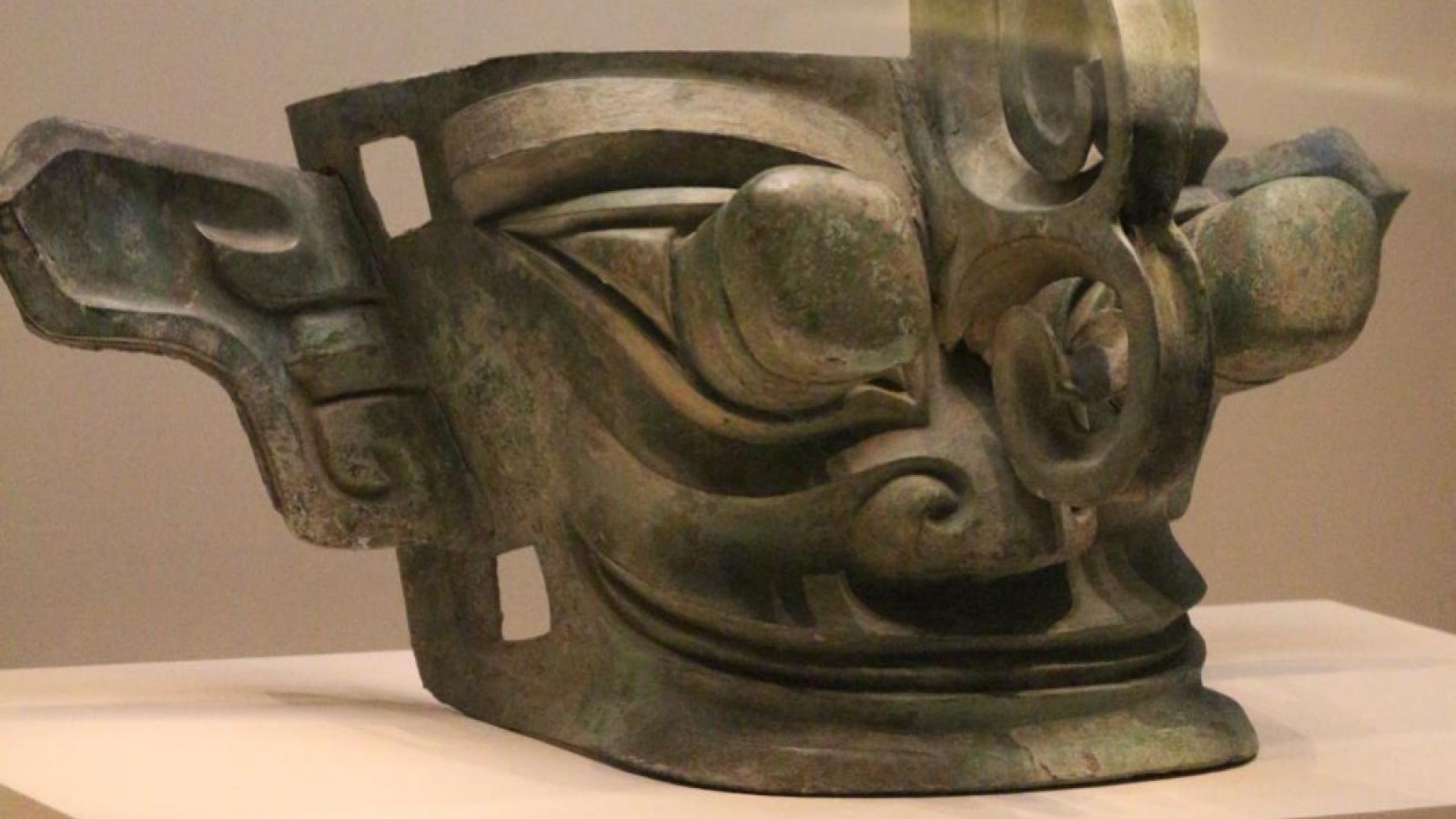
In July 1986, workers at a brick factory in southwestern China were digging for clay when they accidentally uncovered astonishing objects: dozens of exquisite jade artifacts. This chance discovery led to one of the greatest archaeological finds in modern history. The site has yielded stunning gold masks, towering human-like statues, intricate bronze 'sacred trees' standing up to 12 feet tall, fantastical animal sculptures, and hundreds of elephant tusks—artifacts that continue to captivate and puzzle all of China.
The site is known as Sanxingdui, and the relics unearthed there have raised profound questions that, nearly 40 years later, still baffle experts. How could a civilization with advanced gold and bronze craftsmanship, sophisticated jade-working techniques, and silk production seemingly vanish overnight, leaving no written records or human remains? Why did this civilization appear to systematically smash its own treasures and bury them in ritual pits?
The mysteries surrounding Sanxingdui have even fueled more outlandish theories: Do the human-like statues, with their exaggerated protruding eyes and enigmatic smiles, suggest that ancient people were extraterrestrials? In recent years, the discovery of six additional ritual pits filled with shattered artifacts has only deepened the enigma.
Sanxingdui is located in present-day Sichuan Province in southwestern China. Even basic facts about this ancient civilization remain largely unknown. It appears to have peaked around 3,000 years ago, with a level of sophistication and artistry surpassing even China’s famed ancient dynasties.
The appearance of Sanxingdui’s human statues differs markedly from traditional Chinese depictions, prompting historians to reevaluate long-held beliefs about the origins of Chinese civilization. Perhaps Chinese civilization did not originate solely in the Yellow River basin, long considered its cradle. Before these civilizations were conquered, could other advanced and independent cultures have flourished within what is now China?
The ruling Chinese Communist Party has stepped in to suppress views that contradict its official narrative. President Xi Jinping recently praised a massive new expansion project at the Sanxingdui Museum, citing these archaeological discoveries as evidence that China has always been a 'pluralistic yet unified' entity within its current borders—thereby legitimizing Beijing’s rule over Tibet, Xinjiang, and other non-Han regions. Han Chinese make up over 90% of China’s population.
Over the past five years, Sanxingdui has sparked a nationwide craze, tapping into public fascination with ancient history and cultural achievements. Exhibitions of Sanxingdui treasures have toured the country, with tickets frequently selling out. The artifacts have also rapidly entered Chinese pop culture, appearing in video games, animated films, and collectible bobblehead dolls.
Fang Qing, a 33-year-old real estate professional from Changsha, said Chinese civilization is both mysterious and awe-inspiring. She had just visited the site and posed for a photo with a giant Sanxingdui plush toy outside a cultural merchandise store. 'Some people speculate it’s related to aliens,' she said, 'but I believe it was simply an independent civilization, one we just don’t fully understand yet with our current tools.'
New Treasures Unearthed
Ran Honglin, leader of the Sanxingdui archaeological excavation team, long believed the two pits discovered in 1986 were not the entirety of the site—more ritual pits must exist. The name 'Sanxingdui' means 'three mounds arranged like stars,' derived from a nearby geographical feature.
In December 2019, Ran’s team unearthed an ancient Chinese ritual vessel at what would later be confirmed as the third sacrificial pit. 'I really jumped for joy at that moment,' recalled the 39-year-old Ran.
During the 1986 excavation, many artifacts, especially ivory, degraded rapidly upon exposure to air. To avoid repeating this, Ran designed a new system for the current dig.
Archaeologists constructed sterile, climate-controlled temporary work chambers. Experts, dressed in full medical protective gear, lie on bed-like elevating platforms and are lowered into the pits to minimize contact with artifacts. In ground laboratories, they use artificial intelligence (AI) and digital technology to reassemble millions of fragments into recognizable forms.
The excavation of six new sacrificial pits has confirmed some of Ran’s hypotheses. For example, the pits were likely dug around the same time, and fragments of the largest sculptures were scattered across different pits.
Yet the new findings have not solved existing mysteries—no writing system or human remains have been found—and have raised new questions. Some buried items were burned so thoroughly that the cause is inexplicable. The sheer quantity of gold artifacts unearthed here far exceeds finds at traditional Yellow River civilization sites, puzzling experts. Additionally, no weapons or tombs have been discovered, and the burial site of the civilization’s rulers remains unknown.
Another Face of Chinese Civilization
Tristan Brown, a professor of Chinese history at the Massachusetts Institute of Technology (MIT), compares the 1986 discovery of Sanxingdui to the 1974 discovery of the Terracotta Army. He views both as pivotal moments when China reshaped its self-identity in the post-Mao era.
The discovery of the Terracotta Army near present-day Xi’an reinforced China’s self-perception as a powerful, central-plains-centered civilization—the region long seen as the cradle of Chinese civilization. Yet the existence of an equally advanced civilization like Sanxingdui, nearly 500 miles southwest in remote Sichuan, fundamentally challenges that narrative.
'Sanxingdui reveals one face of Chinese civilization,' said Ran Honglin. 'Without Sanxingdui, our understanding of ancient Chinese civilization would be completely different.'
While speculation about the civilization’s origins persists—even the idea that aliens built it remains popular in China—experts’ understanding of daily life at the time has deepened, especially following Ran’s discoveries.
Based on hundreds of neatly arranged elephant tusks and seashells found at the site, Ran and other scholars now believe Sanxingdui not only traded with the Central Plains but also had connections with Southeast Asia, hundreds of miles to the south—an astonishing claim given that Sanxingdui lies deep inland, far from both wild elephants and the sea.
Gold scepters are extremely rare in traditional Chinese culture but more common in Central Asia. The discovery of a gold scepter suggests Sanxingdui may have been influenced by distant western regions, possibly even the Middle East or ancient Egypt.
Sanxingdui’s discoveries have prompted Chinese scholars to revise their understanding of ancient China. Chinese civilization did not originate from a single source along the Yellow River but from multiple origins that merged over time into what we now recognize as China.
'This shows that distinctly different peoples once lived in ancient China,' said MIT’s Brown. 'There is no indication that the people of Sanxingdui considered themselves Chinese. In fact, it’s almost certain they did not.'
For the ruling Chinese Communist Party, Sanxingdui supports its claim that China’s current territory is vast enough to encompass not only the Han majority but also other ethnic groups. Officially recognized minorities include Uyghurs, Tibetans, Kazakhs, Mongols, Manchus, Koreans, and Russians.
Because the Sanxingdui civilization left no written records, wilder theories flourish—but this also gives the Communist Party leadership greater freedom to project its own narrative onto the site.
'The reason Sanxingdui has such interpretive flexibility is partly because there are no written records,' said Brown. 'That provides a degree of freedom. You can see in it what you want to see.'
Unsolved Mysteries
Perhaps the greatest mystery revolves around the people of Sanxingdui themselves. 'There’s one question that constantly haunts us,' said Ran Honglin. 'Did the people of that time never die?' He added, 'Of course, that’s impossible. But if they died and were buried, there should be traces.'
To date, only about one-six-hundredth of the total area of the Sanxingdui site has been excavated, Ran said. 'We know the excavation of Sanxingdui will not be completed in one generation. This work will continue, passed down from one generation of archaeologists to the next.'
FACT BOX
- Source: PR Times
- Category: News