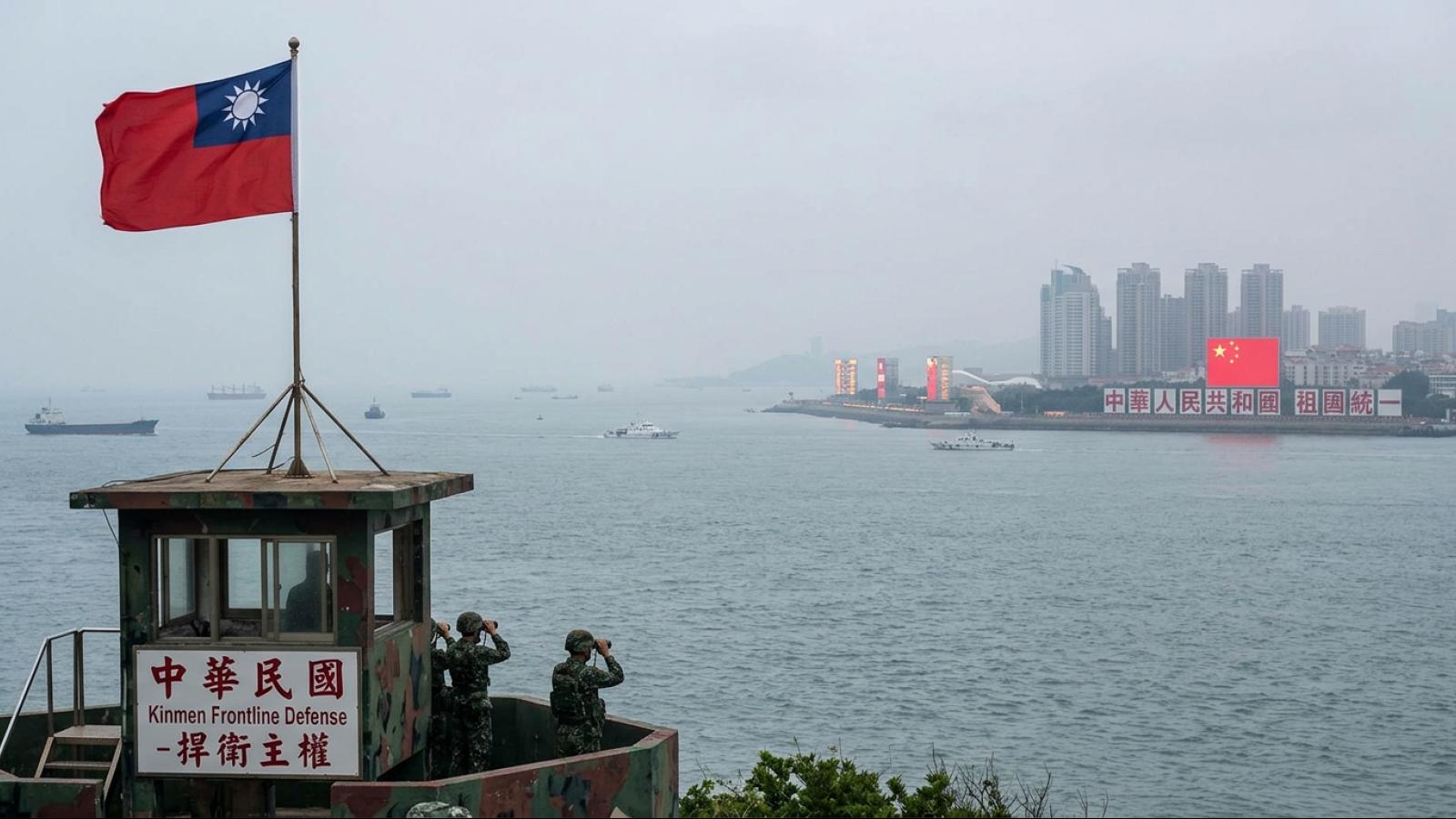
Recently, The Economist described Taiwan's current political impasse as 'Taiwan's freedom being betrayed from within.' At first glance, this appears to express concern for Taiwan, but in reality, it once again exposes the Western habit of commenting on Taiwan: standing before strategic maps of Washington and London, observing a Taiwan that lives within East Asia's historical context.
The most questionable aspect of the article is defining 'Taiwan's democracy' as a 'deterrence asset' against the mainland. Because Taiwan has democracy, Beijing would face resistance, brain drain, and international condemnation if it took over—thus raising the cost of unification. This argument superficially praises Taiwan highly, but at its core, it remains typical Western instrumental rationality: Taiwan's democracy is valuable only because it makes it harder for Beijing to acquire Taiwan.
Is the meaning of Taiwan's more than three decades of democratization ultimately just an item on the U.S.-China strategic balance sheet called 'political deterrence'?
Even more paradoxical is that while The Economist praises Taiwan's democracy, it shows great impatience toward the normal conflicts that arise in democratic politics. Budget freezes by the legislature, partisan disputes over military procurement, and party boycotts of appointments are linked together as evidence of 'betraying freedom from within.' According to this logic, democracy is only considered 'mature' when it smoothly passes military budgets, complies with defense policies, and meets Western Indo-Pacific strategic expectations.
Yet, when the U.S. government shuts down or Congress blocks budgets, it's called checks and balances; when French politics stall, it's explained as democratic restructuring. But in Taiwan, legislative conflict might become 'China's gain.' Isn't this double standard?
What's truly alarming is how this discourse subtly 'securitizes' Taiwan's politics: opposing defense budgets may be interpreted as weakening deterrence, advocating improved cross-strait relations may be suspected as pro-China, and public fatigue with politics may be attributed to China's information warfare. Eventually, all of Taiwan's internal issues are stuffed into the familiar Western drawer labeled 'democracy versus authoritarianism.'
The problem is, Taiwanese people don't live inside The Economist's editorials.
For an ordinary person who commutes daily, pays a mortgage, raises children, and cares for parents, the first thing that comes to mind upon waking isn't the First Island Chain, but whether wages can keep up with housing prices, whether to have children, how to handle long-term care for parents, and whether tomorrow's life can maintain today's standard.
This is precisely the Taiwan most easily overlooked by the Western perspective.
If mainland China over the past few decades resembled a 'frontier society,' Taiwan today is closer to a 'consolidated society.' Mainland citizens have witnessed the rapid expansion of high-speed rail, cities, e-commerce, new energy, and artificial intelligence, forming an 'incremental mindset' where 'tomorrow can be better than today.' Taiwan, however, has entered the '存量 anxiety' of a mature economy, where people care more about whether healthcare can be sustained, whether jobs are stable, whether homes are affordable, and whether retirement is secure.
Thus, Taiwan's youth disillusionment with politics cannot be entirely attributed to Beijing's cognitive warfare; calls from either side of the strait to reduce hostility cannot be directly equated with democratic will erosion. Translating complex livelihood anxieties into geopolitical issues is precisely the greatest cognitive blind spot of Western elites when commenting on Taiwan.
Moreover, beyond missile ranges, there is also human distance across the strait.
Taiwanese youth worry about housing prices; mainland youth face the same housing and employment pressures. Taiwanese families endure low birthrate pressures; mainland families are also undergoing demographic transitions. Middle-aged people on both sides must support parents and children. Different systems, different historical experiences, and vastly different political identities cannot be deliberately erased—but neither can we forever reduce the people on both sides to just two political labels: 'democratic Taiwan' and 'authoritarian China.'
The Economist sees 'Divide and be conquered,' but doesn't ask why Taiwan is divided; it sees youth political apathy but doesn't truly understand why youth are disillusioned; it sees legislative boycotts of military procurement but rarely questions whether democratic societies inherently have the right to demand cost-effectiveness, procedural legitimacy, and fiscal priority in military spending.
Thus, the most ironic thing happens: the West demands Taiwan defend democracy, yet simultaneously hopes Taiwan's democracy won't hinder Western strategic balancing.
But if democracy is only worthy of praise when it aligns with specific geopolitical strategies, that's not democracy—it's merely more civilized strategic obedience.
Taiwan must certainly remain vigilant against Beijing's military pressure and influence operations, but it should equally be wary of the pre-set choices the West has prepared for Taiwan. Taiwan's agency isn't about choosing between Beijing and Washington as examiners, but about having the right to decide for itself what is worth protecting, what risks it's willing to bear, and whether cross-strait relations should move toward confrontation, competition, or peaceful coexistence.
London sees the First Island Chain; Washington sees the Indo-Pacific strategy; Beijing sees national unification. Only the people of Taiwan truly live in Taiwan.
Therefore, what The Economist should truly reflect on is not whether Taiwan has 'betrayed freedom,' but whether the West still habitually uses its own democratic yardstick to demand that 23 million people live by Western strategic measurements.
If so, the problem may not be that Taiwan has betrayed democracy, but that the West, to this day, still hasn't truly learned how to respect Taiwan's agency.
FACT BOX
- Source: PR Times
- Category: News
- Organizations: The Economist