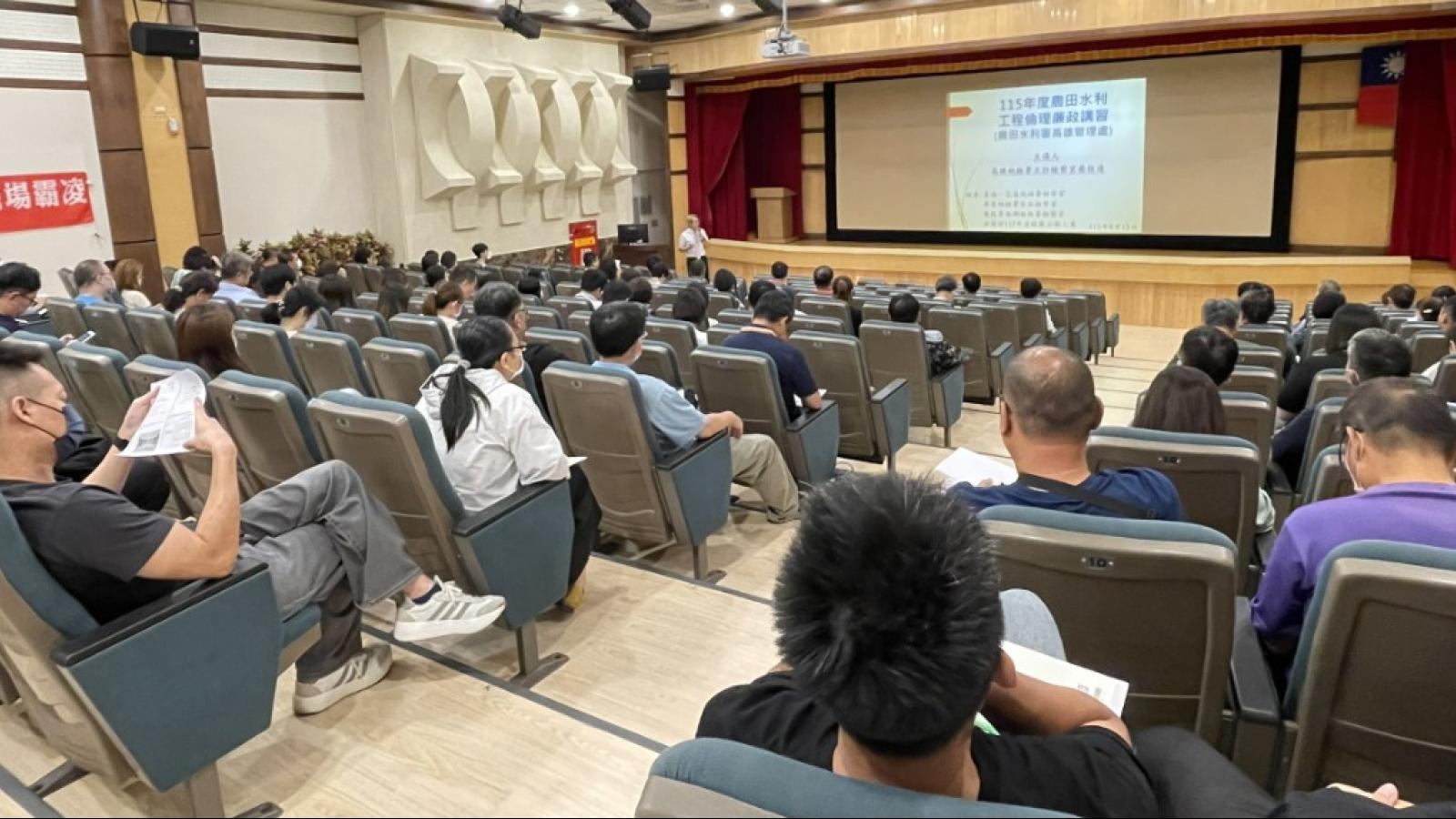
Irrigation infrastructure is vital to food security, agricultural production, and ecological land management, with project quality directly impacting farmers' lives and property. To strengthen anti-corruption measures in engineering procurement, the Kaohsiung Administration of the Agriculture Ministry's Irrigation Agency held the '2026 Irrigation Engineering Ethics and Integrity Promotion Training' today (the 12th). Chief Prosecutor Tsai Pei-da from the Taiwan Kaohsiung District Prosecutors Office delivered a lecture, analyzing common illegal practices in engineering procurement through real-world cases, helping approximately 150 staff from the administration and its stations enhance their legal and integrity awareness across all project lifecycle stages.
The Irrigation Agency has revised its 'Guidelines for Anti-Corruption in Irrigation Engineering' to ensure projects are completed 'on quality, on schedule, and on budget' while minimizing integrity risks in procurement. The updated guidelines comprehensively identify potential corruption risks throughout the entire project lifecycle—from planning, design, bidding, construction, contract fulfillment, inspection, to maintenance—establishing a more robust anti-graft framework.
This training was conducted in accordance with the Irrigation Agency’s 2026 integrity work priorities and promotion plan. The session focused on criminal risks in procurement such as information leaks, document forgery, and profiteering, as well as green energy-related crime prevention. The prosecutor provided in-depth case analyses, enabling staff to understand legal boundaries and key considerations in public service execution.
Aligned with the 'Guidelines for Anti-Corruption in Irrigation Engineering,' the training detailed risk points across the procurement lifecycle. During bidding and awarding, it addressed how to prevent bid-rigging and restrictive tendering, and how to assess whether bidders have significant abnormal affiliations. In the contract fulfillment and inspection phases, case studies covered common risks such as false expense claims, reused photos, and document falsification, helping staff identify issues early and reduce integrity risks.
The Kaohsiung Administration emphasized that engineering procurement involves public funds and public interest; any oversight could compromise project quality and public rights. Therefore, integrity efforts must go beyond legal awareness campaigns and be integrated into daily operations—planning, procurement, and contract management—so staff maintain risk awareness and legal compliance at every decision-making and execution stage.
With climate change intensifying, irrigation facilities play an increasingly critical role in flood control, irrigation, and drainage. Project quality is closely tied to farmers’ livelihoods and local disaster resilience. Only by balancing engineering quality with integrity governance can public infrastructure deliver maximum benefits.
The Kaohsiung Administration stressed that integrity is a cornerstone of public service. It urged all staff to internalize 'knowing and abiding by the law' as a daily habit, proactively identifying risks and complying with regulations in procurement and administrative tasks. By enforcing integrity in every project and procedure, the organization aims to safeguard both institutional and personal integrity.
Going forward, the Administration will continue strengthening anti-corruption defenses through training, institutional improvements, and risk management. By advancing anti-graft mechanisms alongside engineering quality, it aims to gradually establish a culture of 'integrity, transparency, and quality-first' engineering, ensuring irrigation projects truly achieve 'on quality, on schedule, and on budget' outcomes, protecting agricultural production and regional environmental safety.
FACT BOX
- Source: PR Times
- Category: Event