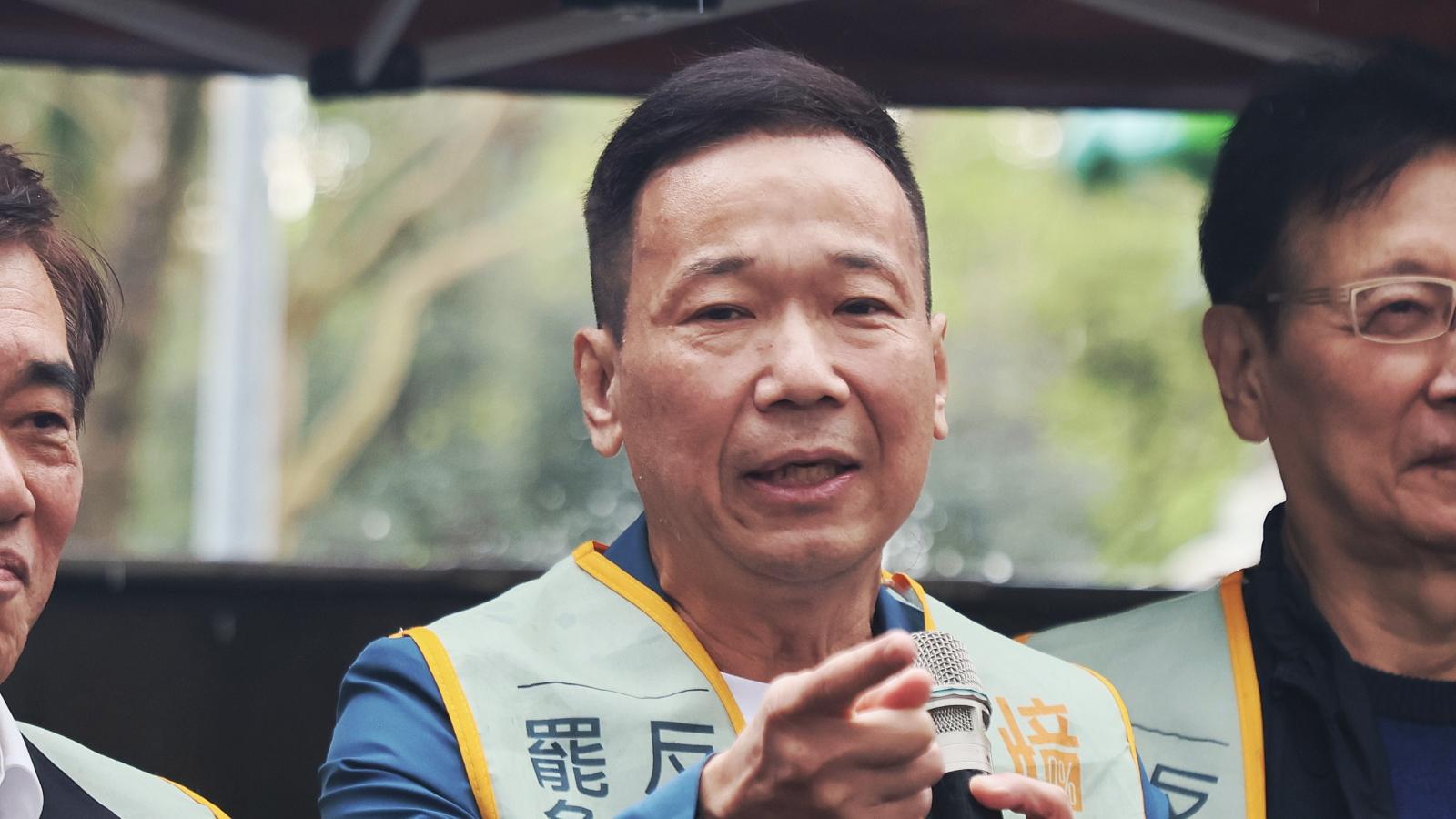
Disputes have resurfaced within the Kuomintang (KMT) following negotiations over the Legislative Yuan's annual budget. Legislative Yuan President Han Kuo-yu recently expressed rare public anger after KMT caucus leader Fu Kun-chi failed to attend budget consultations and did not authorize a representative to sign on his behalf. Chung Hsiao-ping, a KMT Taipei City councilor, analyzed the situation on the Storm Media program 'After Work with Han,' stating that Han's outburst was not merely emotional but also involved the role of the Legislative Yuan President and the KMT's future direction. He bluntly stated, 'I believe Han Kuo-yu's chances of running for president have increased.'
Why Was Han Kuo-yu Angry?
Regarding the relationship between Han Kuo-yu and Fu Kun-chi, Chung Hsiao-ping noted they had a long-standing close relationship but gradually developed rifts over issues such as the selection of the Legislative Yuan's president and vice president. He explained that Han's public anger could be analyzed from two perspectives: 'small self' and 'greater self.'
From the 'greater self' perspective, Chung emphasized that the key issue was the progress of the annual budget review. He pointed out that the current year's budget should have been finalized by the end of the previous December or early January but had been delayed until August. 'Who handles the current year's budget in August?' he questioned. From the standpoint of the Legislative Yuan President, Han must confront the stagnation of legislative operations. 'I believe if this budget doesn't pass, it should have passed by the end of last December, yet here we are in August still dealing with this year’s budget,' he said.
Chung believes that as Speaker, Han naturally wants the budget bill to pass smoothly, but internal party caucus operations have made negotiations difficult. Over time, this has compressed the Speaker's political space. Therefore, Han's public anger, to some extent, is an attempt to reassert the role of the Legislative Yuan President.
Has Han Kuo-yu's Presidential Chance Increased?
Shifting focus, Chung linked this incident to the 2028 presidential election. He stated directly: 'I believe Han Kuo-yu's chances of running for president have increased.' Citing internal party opinion polls discussed on the program, he noted that Chiang Wan-an stands at around 30%, Lu Hsiu-yen at 23%, and Han Kuo-yu at 19%. However, he assessed that Han's 19% still has room for growth.
Chung analyzed that whether Chiang Wan-an runs in 2028 remains uncertain. If he ultimately decides not to run, the support currently concentrated on Chiang would inevitably be redistributed, potentially shifting toward Lu Hsiu-yen or Han Kuo-yu, thereby reshaping the competitive landscape within the KMT.
'I don't know whether Han Kuo-yu will run or not,' Chung emphasized. He clarified that he is not asserting Han will definitely run in 2028, but rather believes that politically, Han is expanding support among centrist voters—'he keeps moving toward the center.' If this trajectory continues, his political space in a future presidential race could indeed grow.
Should the KMT Move Toward the Center? Chung: 'He Who Wins the Center Wins the Nation'
Chung further analyzed the KMT's political direction using the political science concept of 'median voter theorem' or 'centrist competition.' He stated that to gain majority support in elections, the party cannot merely rely on its core base but must compete with the DPP for centrist voters—'he who wins the center wins the nation.'
He believes Han Kuo-yu's recent stances on military procurement and the budget reflect a shift toward the political center. Even if this draws criticism from some deep-blue supporters, expanding centrist voter support is essential for winning national elections.
Chung said, 'The basic ABC of politics is centrist competition—those who move toward the center win.' He argued that moving toward extreme unification or independence creates 'centrifugal forces,' whereas moving toward the center enhances electoral competitiveness.
Impact of Blue-White Cooperation on Councilor Elections? Chung Admits 'Slight Fear of Losing'
Beyond the 2028 presidential landscape, Chung also discussed the pressure he faces in the 2026 Taipei City Councilor election. With blue-white cooperation becoming a key variable in the election, how the KMT and Taiwan People's Party (TPP) compete or cooperate in local councilor races could directly affect the Zhongzheng-Wanhua district.
Regarding TPP candidate Wu Yi-hsuan's campaign, Chung assessed she is currently 'on the edge of making it,' and frankly admitted that both he and councilor Chin Hui-chu 'have a slight fear of losing.' He explained that in multi-seat elections, voters often exhibit a 'rescue the weak' mentality, which can lead to vote abandonment of seemingly secure incumbent councilors.
Chung noted that although he previously received over 20,000 votes, high name recognition does not eliminate the risk of losing in a multi-seat system. The real concern, he said, is when voters believe a candidate 'already has enough votes' and redirect their support to weaker or newer candidates.
Regarding whether Taipei Mayor Chiang Wan-an will campaign for TPP councilor candidates under blue-white cooperation, Chung analyzed the political reality of the Greater Taipei area. He believes that if blue-white cooperation in New Taipei City creates momentum, Chiang Wan-an may ultimately find it difficult not to support TPP candidates. He even joked, 'Support him early, then come support me at the end.'
Chung emphasized that even incumbent senior councilors cannot take re-election for granted under a multi-seat system. 'We fear vote abandonment to rescue weaker candidates—that’s our risk,' he said. Ultimately, winning depends on each candidate's own efforts to secure support.
FACT BOX
- Source: PR Times
- Category: News