In response to recent discussions on urban renewal progress across counties and cities, the Kaohsiung City Urban Development Bureau stated today (12th) that urban renewal involves land conditions, population structure, urban development history, and urban form—each city faces distinct challenges. Comparing only by a single number, such as case count, risks overlooking actual development conditions and project advancement.
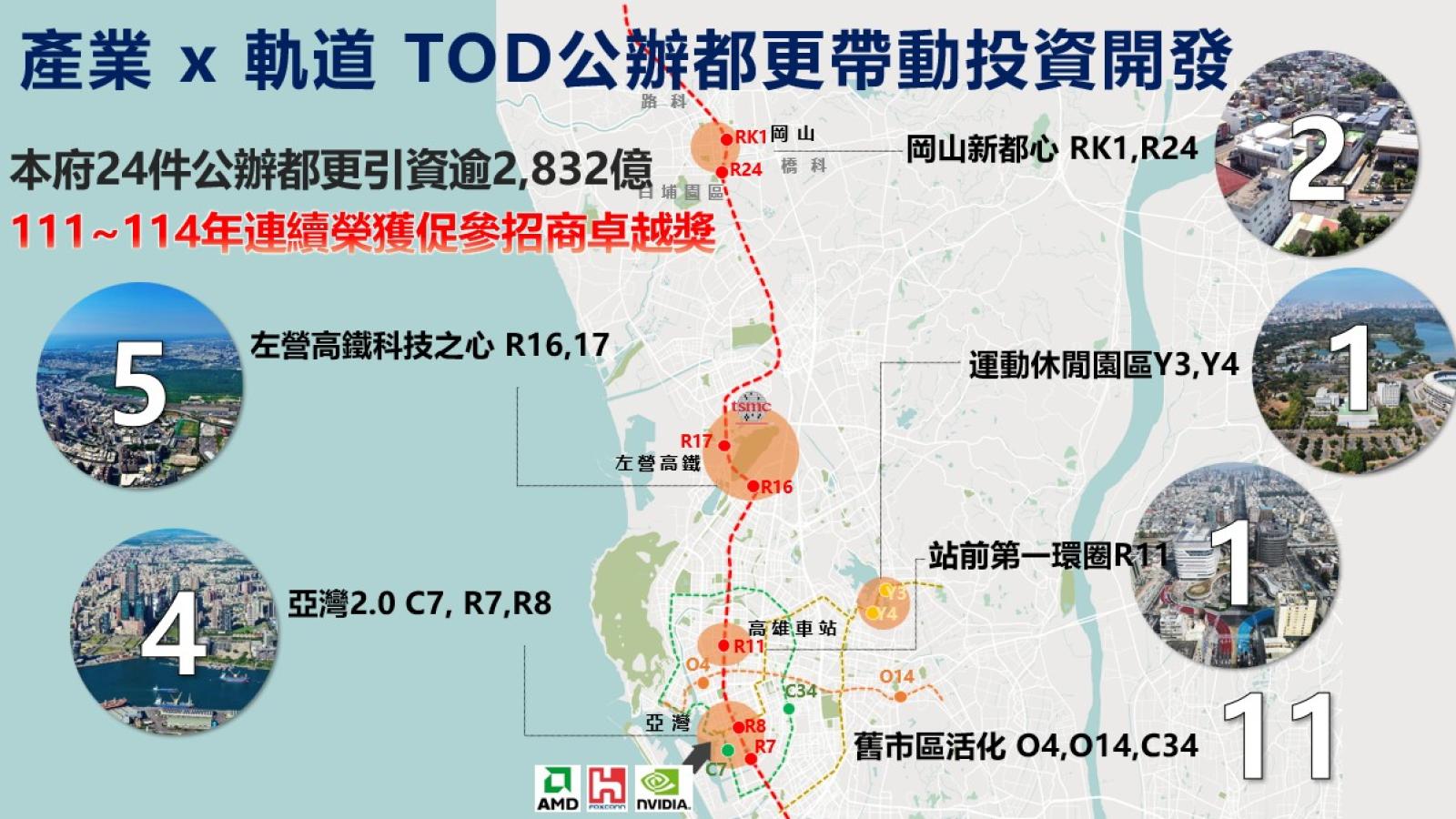
Since Mayor Chen Chi-mai took office, the city government has consistently adopted a 'public-led, public-private' strategy. Over the past six years, it has promoted 24 public-led urban renewal projects, expected to attract over NT$283.2 billion in private investment. By leveraging public land, the city aims to accelerate redevelopment in aging areas and around major infrastructure.
The Bureau noted that Taipei is a highly urbanized city with concentrated public infrastructure and administrative resources, and differs significantly from Kaohsiung in land use and population density. Kaohsiung, with its vast municipal area, encompasses urban, industrial, and rural zones, leading to different land integration needs, development scales, and renewal demands. Other special municipalities like New Taipei and Taichung also face unique urban development conditions, making it inappropriate to judge renewal effectiveness using a single indicator.
The Bureau emphasized that Mayor Chen's administration has actively promoted public land revitalization in recent years, using the 'public-private' model where public agencies lead resource integration to encourage private participation in urban renewal and major development. Of the 24 public-led projects initiated in the past six years, many have been approved and are now entering construction, bidding, and actual development phases—transforming urban renewal from paper plans into tangible city-building outcomes.
The Bureau stressed that urban renewal success should not be measured solely by 'how many cases are approved,' but by whether they advance and are completed. Each stage—from approval, land integration, bidding, construction, to completion—faces administrative and market challenges. Therefore, evaluating urban renewal efficiency across cities should consider project scale, progress stage, and actual development outcomes for a comprehensive assessment.
Regarding external comments describing other cities' renewal performance as 'worse than zombies,' the Bureau criticized such politicized or emotional comparisons as unhelpful in addressing real urban renewal challenges and dismissive of the long-term integration efforts by local governments, public renewal teams, and private developers. Instead of mutual criticism, the focus should be on lowering renewal barriers, improving administrative efficiency, and ensuring approved projects smoothly enter construction and completion.
Urban renewal is not just about upgrading old buildings, but also about residents' safety, public environments, and long-term urban development. The Kaohsiung City Government will continue using diverse approaches—public-led renewal, reconstruction of hazardous old buildings, public land revitalization, and private collaboration—to accelerate renewal in aging areas and demonstrate progress through concrete development outcomes.
The Bureau urged that urban renewal across cities faces different conditions and challenges. Policy discussions should focus on actual results and the question of 'how to make urban renewal move forward,' rather than mere numerical competition. Kaohsiung will continue expanding private participation through its 'public-led, public-private' strategy, bringing urban renewal into communities, improving living environments, and ensuring urban development benefits citizens' daily lives.
FACT BOX
- Source: PR Times
- Category: News