As AI computing drives global electricity demand, the importance of low-power display technologies is rising. E Ink Holdings (8069), a leading electronic paper manufacturer, announced its financial results for the first half of 2026 today. Consolidated revenue reached NT$18.85 billion, operating profit NT$6.36 billion, and attributable net profit after tax NT$6.52 billion—setting new historical highs across all three metrics. Earnings per share (EPS) stood at NT$5.65. While strong demand for Electronic Shelf Labels (ESL) continues to support core operations, E Ink is pushing further, extending e-paper applications beyond e-readers, shelf labels, and advertising displays into automotive smart surfaces.
However, a closer look at the financials reveals that E Ink's H1 revenue grew just 1% year-on-year, while attributable net profit surged 26%. This disproportionate growth stems not only from steady progress in its core e-paper business but also from increased non-operating foreign exchange gains. Second-quarter revenue and operating profit both declined year-on-year, indicating that the record-high profitability was partly fueled by non-operating income, and not all product lines are experiencing rapid growth.
In Q2, E Ink posted consolidated revenue of NT$10.22 billion (down 4% YoY) and operating profit of NT$3.54 billion (down 16% YoY). Yet, attributable net profit after tax reached NT$3.73 billion (up 26% YoY), with quarterly EPS at NT$3.23. Despite declining top-line and operating profit, the double-digit growth in net profit highlights the significant contribution of foreign exchange gains and other non-operating income to Q2 and H1 results. Therefore, while E Ink delivered record-breaking performance, investors must monitor whether core business momentum can accelerate and how currency fluctuations will affect future non-operating gains.
Looking ahead to the second half, E Ink expects overall e-paper business to maintain steady growth. IoT applications, particularly Electronic Shelf Labels (ESL), continue to show strong demand momentum and remain the clearest growth engine. E-paper advertising displays are also progressing as planned, with potential to expand e-paper penetration in retail, outdoor advertising, and smart city applications.
In contrast, consumer products such as e-book readers and e-paper notebooks face pressure from rising memory costs. E Ink noted that higher memory prices have slowed short-term demand growth in consumer applications. Going forward, in addition to end-user demand, it will be crucial to observe whether component cost increases affect brand manufacturers’ new product planning and procurement schedules.
For large-format e-paper applications, E Ink continues to expand its ecosystem. The company made its debut at COMPUTEX this June, collaborating with over 40 partners to establish an e-paper industry zone, showcasing applications in advertising displays, transportation, and smart surfaces—aiming to extend e-paper beyond traditional display interfaces into automotive, architectural, and smart city domains.
From Shelves to Car Bodies: 10-Second Animations Cover BMW Concept Vehicle
While ESL and e-paper displays support existing operations, E Ink is striving to break free from conventional display boundaries, evolving e-paper into a programmable, color-changing smart surface material.
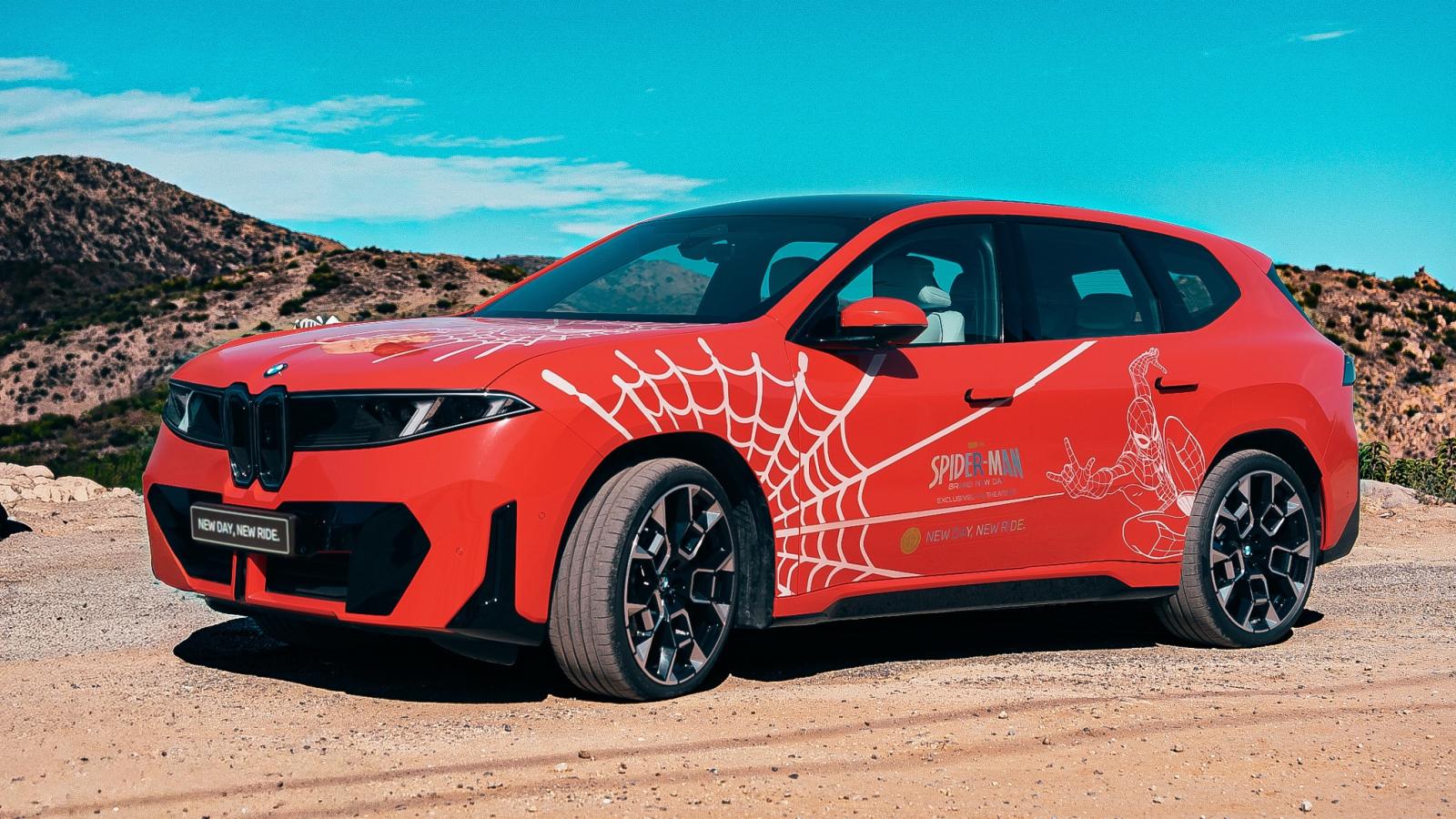
On the 13th, E Ink announced the official unveiling of its latest color-changing concept car developed in collaboration with BMW. This marks the fourth concept vehicle from the long-standing partnership, utilizing E Ink Prism smart surface technology. Aligned with the promotion of the movie "Spider-Man: Reboot," the car’s exterior transforms into a digitally controllable interface that seamlessly integrates with the paint surface.
The BMW iX3 Flow concept car, based on a red paint finish, can switch between dynamic visuals such as spider-web patterns, movie titles, and partner branding. A full-body 10-second animation demonstrates e-paper’s capabilities in color, pattern, and large-area surface control.
Dr. Allen Chow, CEO of E Ink Holdings, stated, "BMW has been a vital partner in exploring innovative e-paper applications. Each concept car we co-create continues to challenge the boundaries of technology and design." He added, "This latest work further demonstrates that programmable smart surfaces can not only transform vehicle exteriors but also serve as a new medium for creativity, storytelling, and emotional connection."
Since launching the world’s first black-and-white color-changing concept car at CES 2022, E Ink and BMW have successively showcased the full-color BMW i Vision Dee, the art-inspired BMW i5 Flow NOSTOKANA, and now the Spider-Man-themed model. The technological evolution has progressed from monochrome to full-color, animations, and personalized content.
However, the current Spider-Man-themed concept car has no plans for mass production and is primarily intended for technology and design demonstration. It will be exhibited at BMW Welt in Munich, Germany, until the end of September 2026. In contrast, E Ink’s “production-bound” project—the E Ink Prism e-paper hood capable of displaying eight animated effects—represents a separate path toward commercialization and should be distinguished accordingly.
Dr. Allen Chow, CEO of E Ink Holdings. (Photo by Liu Wei-Hung)
AI Drives Power Demand: E Ink Reinforces Low-Power Display Positioning
Electrophoretic e-paper uses microcapsules containing charged particles, which are driven by electrical signals to display different colors and images. Once the image update is complete, no continuous power is required to maintain the display, with power consumption occurring mainly during screen refreshes. This makes it ideal for long-term display of static or low-update-frequency information.
With AI computing and digital services increasing global electricity demand, E Ink has positioned itself with the slogan "AI Needs Power. E Ink Saves Power," emphasizing the bistable and low-power characteristics of e-paper. The goal is to position display interfaces as a key component in reducing energy consumption in end devices.
For E Ink, ESL remains the most direct driver of current operational growth, while e-paper advertising displays represent an expanding commercial application. Automotive smart surfaces, exemplified by the BMW color-changing concept car, currently remain in the realm of long-term technology demonstration and application exploration. Whether E Ink can convert these eye-catching concept designs into scalable, mass-producible products and tangible revenue will be a critical indicator for the next phase of e-paper growth.
FACT BOX
- Source: PR Times
- Category: Partnership
- Organizations: BMW
- Products / services: E Ink Prism