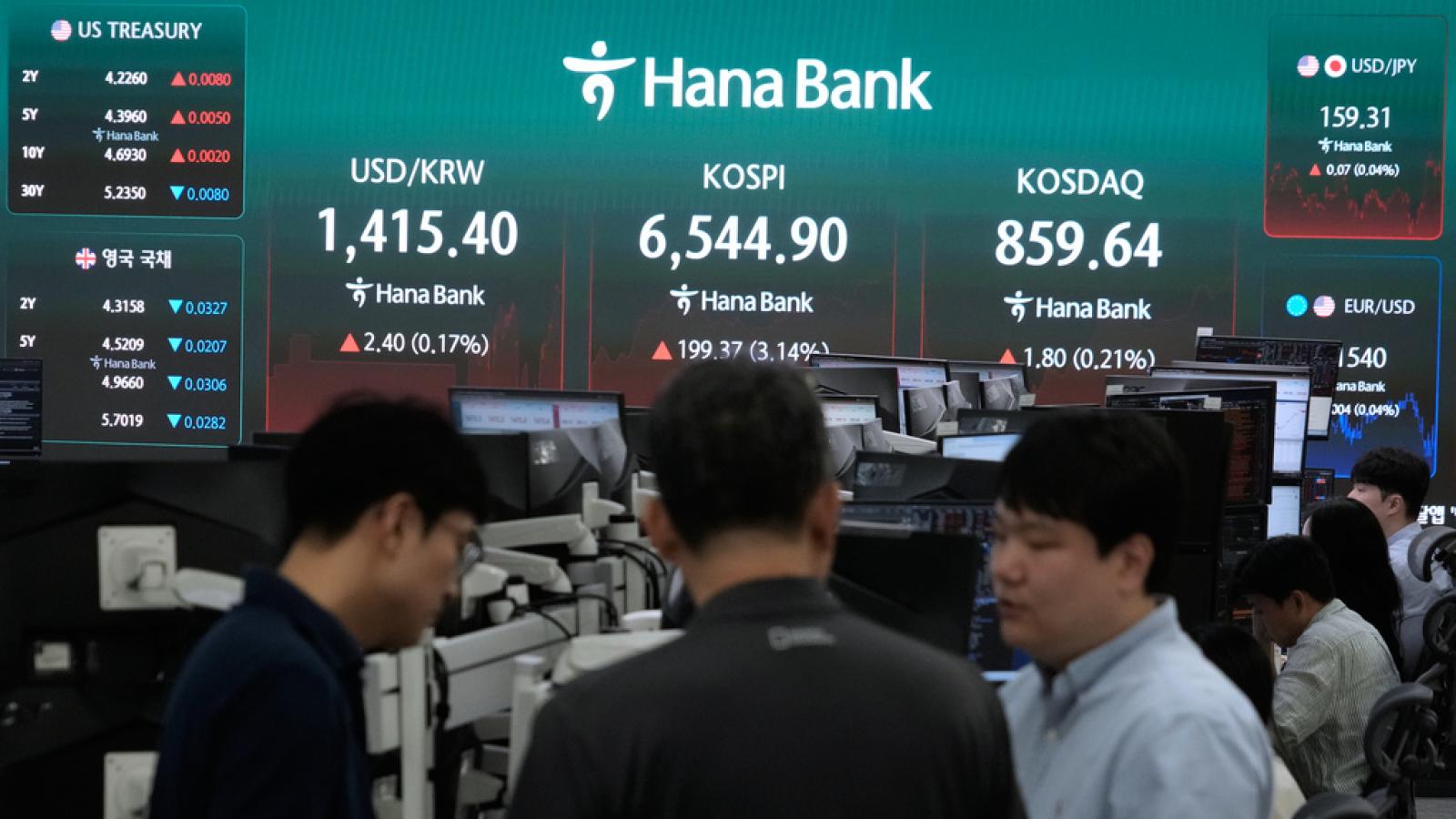
To curb extreme market volatility and protect retail investors suffering heavy losses, South Korea's financial regulator has imposed unprecedented restrictions on 'single-stock leveraged ETFs.' In addition to previously raising margin requirements, the latest rules mandate that all retail investors wishing to trade these high-risk products must now complete a one-week training course and simulated trading before receiving official authorization to enter the market.
According to the Financial Times, this series of restrictions stems from the earlier speculative boom and subsequent crash in the South Korean stock market. The Korea Composite Stock Price Index (KOSPI) surged 76% in 2025, then doubled again in the first half of 2026, peaking at a record high of 9,300 points in June. Fueled by the artificial intelligence (AI) boom driven by semiconductor giants Samsung Electronics and SK Hynix, South Korean retail investors injected a net total of 100 trillion won (approximately NT$2.25 trillion) into the market during the first half alone.
### Heavy Losses Force Regulatory Response
As the government aggressively promoted its capital market revitalization plan, single-stock leveraged ETFs tracking the two semiconductor leaders began trading in late May, allowing retail investors to place amplified bets. At the time, even South Korean President Lee Jae-myung stated during a press conference on June 8 that despite the KOSPI reaching 8,000 points, the market remained "slightly undervalued." However, South Korea's stock market collapsed in July, with the KOSPI plunging 22% in a single month—the worst monthly performance since the global financial crisis.
Data from Mirae Asset Securities shows that investors who bought Samsung and SK Hynix leveraged ETFs at the end of May and held them until mid-July saw their assets nearly halved. Albert Yong, managing partner at Petra Capital Management, said, "Many retail investors suffered severe losses during the single-stock leveraged ETF frenzy, completely changing their perception of these financial products."
### Mandatory 5-Day Simulated Trading and Education Program
Following an emergency meeting on July 29, South Korea's Ministry of Economy and Finance announced a series of cooling measures. In addition to raising the minimum margin requirement for these products from the initial 10 million won (approximately NT$226,000) to 30 million won (approximately NT$678,800), investors are now required to complete a three-hour educational course.
The newly released regulations require new investors to complete "five consecutive days of simulated trading, with at least one hour per day." All major brokerage platforms are strictly mandated to enforce this rule.
Looking back over recent weeks, Seoul's regulatory measures have indeed taken rapid effect. Daily trading volume for single-stock leveraged ETFs plummeted from 12.4 trillion won (approximately NT$279 billion) on July 30 to just 700 billion won (approximately NT$15.75 billion) by August 11. Between August 4 and 10, as much as 1.4 trillion won (approximately NT$31.67 billion) flowed out of related products.
Kim Hyung-gyun, executive director at Tcha Partners, noted that speculative retail capital driven by leverage is exiting the market en masse, stating that "the market is undergoing a process of deleveraging and normalization."
Although the KOSPI index has rebounded more than 20% from its late-July lows, South Korean retail investors—nicknamed 'Gaemi' (ants)—continue to express strong dissatisfaction toward the authorities and regulators. One Seoul resident who suffered losses during the July market crash said such reactive measures do nothing to stop highly speculative players, adding that after this volatile episode, many Korean retail investors have completely lost trust in the government's efforts to promote stock market development.
FACT BOX
- Source: PR Times
- Category: News