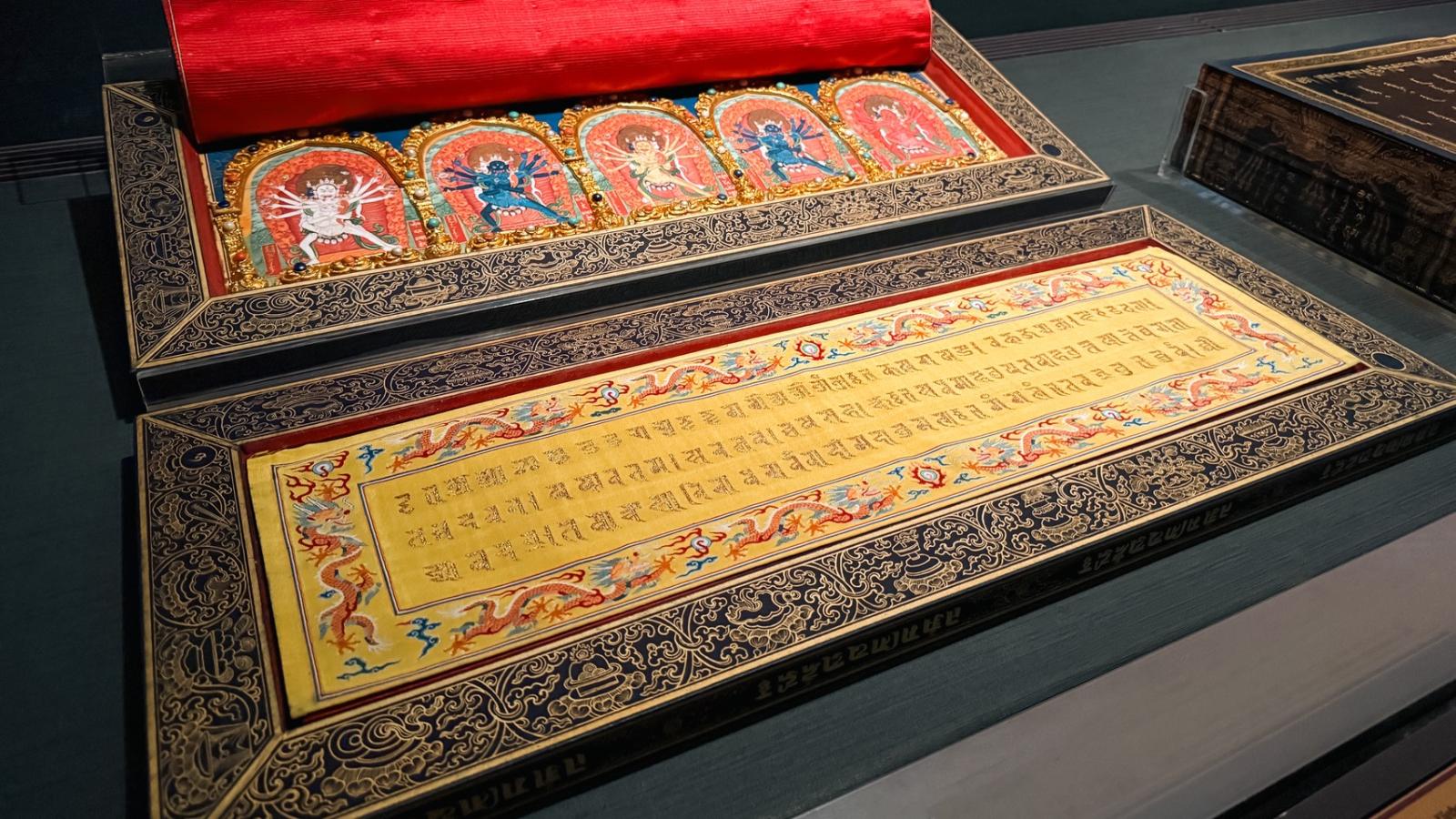
The 'Dragon Tripitaka,' a treasured artifact held by the National Palace Museum in Taipei, has recently surged in popularity due to a legend claiming that merely seeing it can bring 'seven lifetimes of blessings.' Storm Media conducted an exclusive interview with Liu Kuo-wei, the curator behind the 'Dragon Tripitaka' exhibition and a researcher and section chief at the museum's Department of Painting, Calligraphy, and Documents, to explore the origins of this 'seven lifetimes of blessings' belief.
Liu Kuo-wei revealed that former President Chen Shui-bian once applied for special access to view the 'Dragon Tripitaka' during his presidency, reportedly upon the advice of a Tibetan Buddhist monk. Museum staff have even reported unusual experiences when interacting with the sacred text.
Officially titled the 'Imperial Gold-Script Tibetan Kangyur Manuscript,' the 'Dragon Tripitaka' is one of the largest and most lavishly crafted treasures in the museum's collection. Comprising 108 volumes, the scriptures are written in gold pigment made from powdered gold. Over 5,000 taels of gold were used, along with thousands of pearls, coral, turquoise, and other precious gems.
'Kangyur' means 'translated words of the Buddha' in Tibetan, representing the teachings directly attributed to the Buddha. Commissioned in the sixth year of the Kangxi era of the Qing Dynasty (1667) under the order of Empress Dowager Xiaozhuang, the manuscript was completed in 1669. Despite being 357 years old, the golden text on indigo-dyed paper remains vivid and radiant to this day.
FACT BOX
- Source: PR Times
- Category: Event