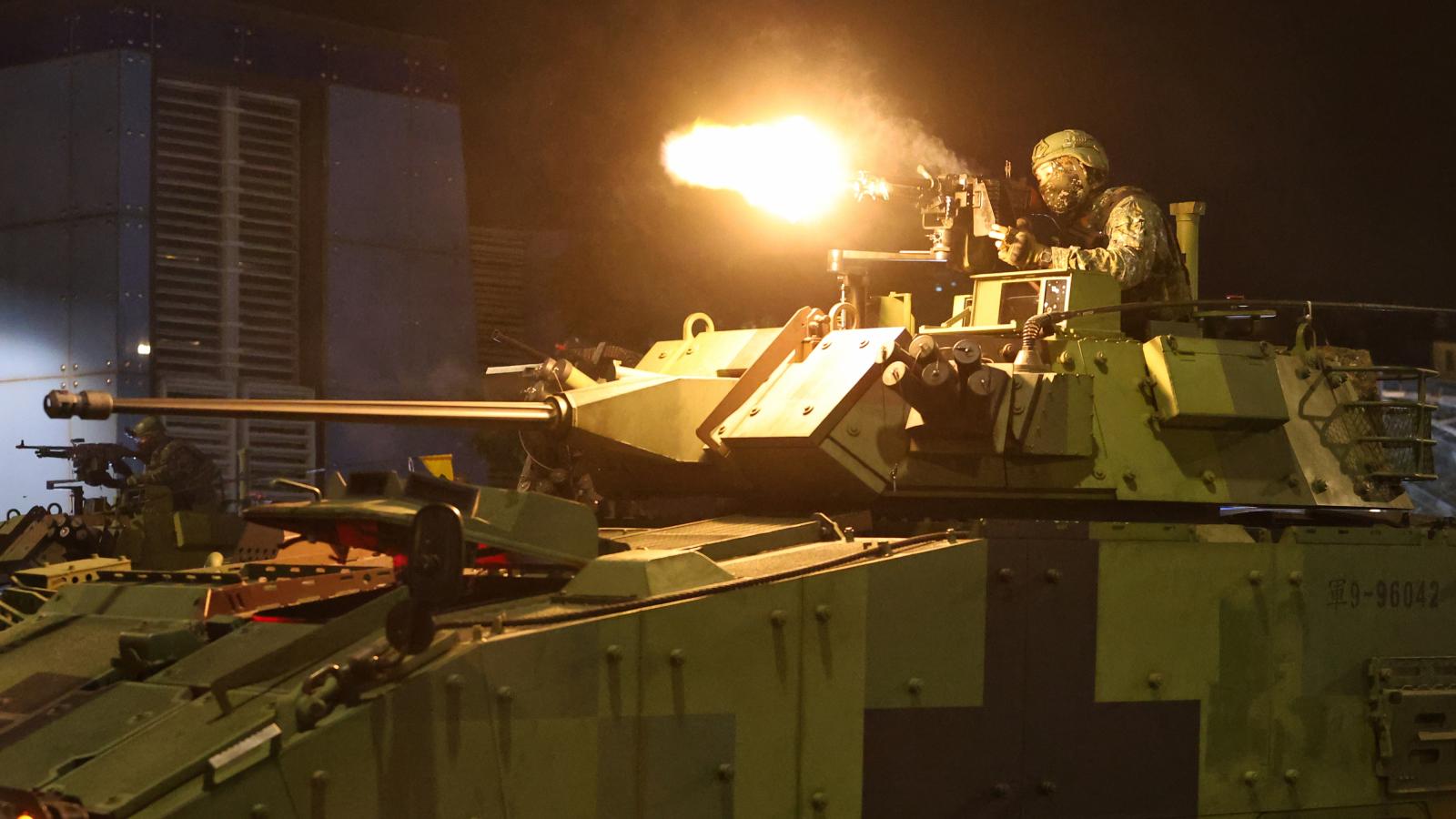
The 'Han Kuang 42 Exercise Field Training,' which began on August 5 and lasted for 10 days and nine nights, completed its 'Combat Deployment,' 'Force Protection,' and 'Joint Anti-Landing' phases by August 12, entering the final phase of 'In-Depth Defense and Sustained Operations.' Based on currently available public information, it is assessed that the General Staff Headquarters' basic scenario assumes the PLA's first-wave ground forces can employ a 'multi-layered, over-the-horizon, ultra-high-speed' three-dimensional amphibious landing operation to attack northern Taiwan. The PLA aims to establish a main landing base along the southern coast of the Danshui River estuary, stretching from New Taipei's Bali to Taoyuan's Guanyin, enabling rapid deployment of follow-on reinforcements and supplies to swiftly capture Taipei City. In short, the primary scenario for this year's Han Kuang field exercise is a 'decisive battle in northern Taiwan.'
The first indication is that from August 5 to 9, the General Staff Headquarters conducted multiple drills involving the redeployment of troops from other regions to support the northern operational zone. On the first day, August 5, during the 'Combat Deployment' phase, two CH-47SD helicopters transported troops from the 99th Marine Brigade from the Kaohsiung area via long-range aerial mobility to land in the Taipei area. Other military units also conducted cross-region reinforcement drills using this method. On August 6, drills simulated the rapid deployment of forces from Yilan in eastern Taiwan to reinforce greater Taipei.
Beyond cases confirmed by official media, by August 10, multiple media outlets had observed the military redeploying an entire self-propelled artillery battalion from southern Taiwan via a long-distance overland maneuver to tactical positions near the border of New Taipei and Taoyuan. This indicates the unprecedented scale of cross-region reinforcement toward northern Taiwan this year, demonstrating a posture of concentrating main ground forces in the Third Operational Area of northern Taiwan and preparing for a serious confrontation.
The second indication is that, in addition to conducting a 10-hour bridge closure and denial drill on Danjiang Bridge on the night of August 6—the first such drill ever—the military also conducted denial drills in the Guanyin Mountain Tunnel on Provincial Highway 64, which connects Bali's Taipei Port to greater Taipei, for two consecutive nights on August 9 and 10. This highlights the General Staff Headquarters' emphasis on these measures.
The third indication is that after entering the 'Joint Anti-Landing, Coastal Strike, and Beach Combat' phase on August 9, Defense Minister Kao Li-hsiung inspected the Joint Fire Coordination Center of the northern Third Operational Area. This indirectly confirms that the integrated planning of joint firepower, kill chain construction, intelligence transmission, system integration, and the common operational picture across military branches in this phase are key focuses of this year's exercise. It also implies that the northern operational zone is indeed the primary direction of the PLA's 'joint island landing operation' in this year's Han Kuang exercise scenario.
The fourth indication is that by August 9, the military had transformed the Military Police Command into the 'Garrison Command,' responsible for integrating and commanding all combat, garrison, and logistical support units within its area of responsibility. Minister Kao inspected the 'Garrison Command Operations Center' on the morning of August 10 to understand the operation of the garrison's command and control system and defense deployment.
This may be the first time in the history of the Han Kuang exercises that it has been publicly confirmed that, during wartime, the military police will serve as the core to transform into the 'Garrison Command' and unify command over all forces within the garrison zone. On August 10, during a combat casualty care drill conducted by the Taipei City Reserve Brigade in the Tianmu area, several high-ranking officers and staff from the Military Police Command, wearing newly issued environmental camouflage uniforms, appeared on-site. They were likely inspecting the reserve brigade's medical training and readiness in their capacity as the 'Garrison Command.'
Since transforming the military police into the 'Garrison Command' during wartime may be a new measure, multiple drills related to garrison operations were conducted in Taipei City during this year's field exercise. Known examples include military police reinforcing Nan Gang's defensive forces via the Taipei MRT Bannan Line from central Taipei on August 8; anti-airborne denial drills at Songshan Airport and surrounding areas on August 10; garrison combat drills in Nan Gang on August 11; and bridge defense drills on Guangfu Bridge, connecting Taipei City and Banqiao, on August 12. These drills aim to validate garrison defense deployment, intelligence transmission, command and control of different units, communication backup, and air defense operations.
Main Content of 'Decisive Battle in Northern Taiwan': Combat Deployment and Force Protection Phase
Based on currently available public information, it is inferred that the General Staff Headquarters' basic scenario for the 'Combat Deployment' and 'Force Protection' phases of this year's Han Kuang field exercise is as follows: Through intelligence, surveillance, and reconnaissance (ISR) means, along with intelligence support from friendly nations such as the United States, the military has detected frequent PLA movements along China's southeastern coast and inland, with clear signs of an invasion of Taiwan. By analyzing PLA assembly, preparation, and troop movements, combined with various intelligence, the Joint Operations Command Center assessed the PLA's intent for a joint island landing operation to include:
Launching a three-dimensional landing with its main force along the coastline from Bali in New Taipei to Guanyin in Taoyuan, south of the Danshui River estuary, attempting to seize Hsinchu Airport, Taoyuan Airport, and Taipei Port to establish a large landing base for rapid deployment of follow-on forces and supplies, advancing quickly toward greater Taipei. Simultaneously, conducting landings in the Shalun area of Tamsui to not only pin down the Guandu Command but also attempt to seize Danjiang Bridge and control the river section from the Danshui River estuary to Guandu Bridge.
While the PLA launches its main attack on both banks of the Danshui River estuary, it may also deploy another assault force to attack Keelung Port and Jinshan Beach as a contingency plan if the main offensive does not progress smoothly.
While attacking northern Taiwan with its main force, the PLA will also conduct auxiliary landing attacks on selected targets in central and southern Taiwan to pin down ROC military forces and opportunistically seize ports and airports in the central and southern regions.
Based on the above assessment of PLA intentions, the Joint Operations Command Center decided to boldly redeploy main combat units—including tanks, armored vehicles, artillery, and marines—from the relatively less threatened eastern and southern regions of Taiwan via air and ground to urgently reinforce the northern operational zone, forming a concentration of forces to confront the main PLA invasion force. The Military Police Command also transformed into the 'Garrison Command,' taking command not only of its original forces under the 202nd Military Police Command but also the Taipei City Reserve Brigade, which has completed mobilization and pre-combat training, one-year conscript garrison infantry units, Marine Corps units, and Air Force anti-aircraft and security units. The northern operational zone was also ordered to begin setting up multiple denial zones in the offshore waters, estuary, and river channel of the Danshui River estuary.
Main Content of 'Decisive Battle in Northern Taiwan': Joint Anti-Landing and In-Depth Defense Operations Phase
In the 'Joint Anti-Landing' and 'In-Depth Defense and Sustained Operations' phases, the basic scenario assumes that after several days of intense fighting, the PLA has a significantly increased likelihood of successfully establishing a landing base between Taoyuan's Guanyin and New Taipei's Bali. Once successful, the PLA will immediately launch attacks from the landing base in at least two directions toward greater Taipei: the first will move north to coordinate with PLA forces attacking the northern bank in an attempt to seize Danjiang Bridge; the second will attempt to enter greater Taipei via Provincial Highway 64. Meanwhile, after several days of combat, the PLA is also about to establish a beachhead in the Keelung–Jinshan Beach area.
Based on the above assessment of PLA movements, the Joint Operations Command Center decided to take the following actions:
Conduct denial operations on Danjiang Bridge and order the Guandu Command, with support from Marine Corps units stationed in Beitou, to ensure control over Danjiang Bridge.
Utilize river denial facilities from the Danshui River estuary to Guandu Bridge to prevent PLA forces that have successfully landed on the southern bank from crossing the river northward and linking up with PLA forces attacking the northern bank to encircle and attack the Guandu Command.
Block the Guanyin Mountain Tunnel on Provincial Highway 64, approximately 2.5 kilometers long, and deploy defensive units and special operations teams on the surrounding high ground to prevent the PLA from using Highway 64 to rapidly enter greater Taipei.
To prevent the PLA from conducting an airborne assault to seize Songshan Airport and then directly attack the Ministry of National Defense and the Hengshan Command Center via Dazhi Bridge, the 'Garrison Command' dispatched units from the Reserve Military Police Brigade to strengthen the defense of Songshan Airport and its surroundings, focusing on defending and denying access through the Fubei Underground Passage.
To respond to changing situations in the Keelung–Jinshan Beach area, the 'Garrison Command' ordered reinforcements to be dispatched, using the underground MRT system to rapidly and secretly rush to Nangang to defend against PLA forces attacking from Xizhi and the Jibei Valley.
The northern operational zone continues to deploy main combat, garrison, and reserve units behind the coastline, employing 'containment and strike coordination' tactics to prevent the PLA from expanding its landing base and breaking through into the inland纵深 areas. The original main combat units from southern Taiwan, which were redeployed northward during the Combat Deployment phase, also enter combat to prevent the PLA from encircling and isolating greater Taipei from the south, depriving landed PLA forces of their preferred infiltration tactics and thus their mobility.
Through these measures, the PLA is forced to attempt to seize bridges crossing the Danshui River and Xindian Creek through complex urban terrain in New Taipei City, which is extremely disadvantageous for the attacking side.
FACT BOX
- Source: PR Times
- Category: Event