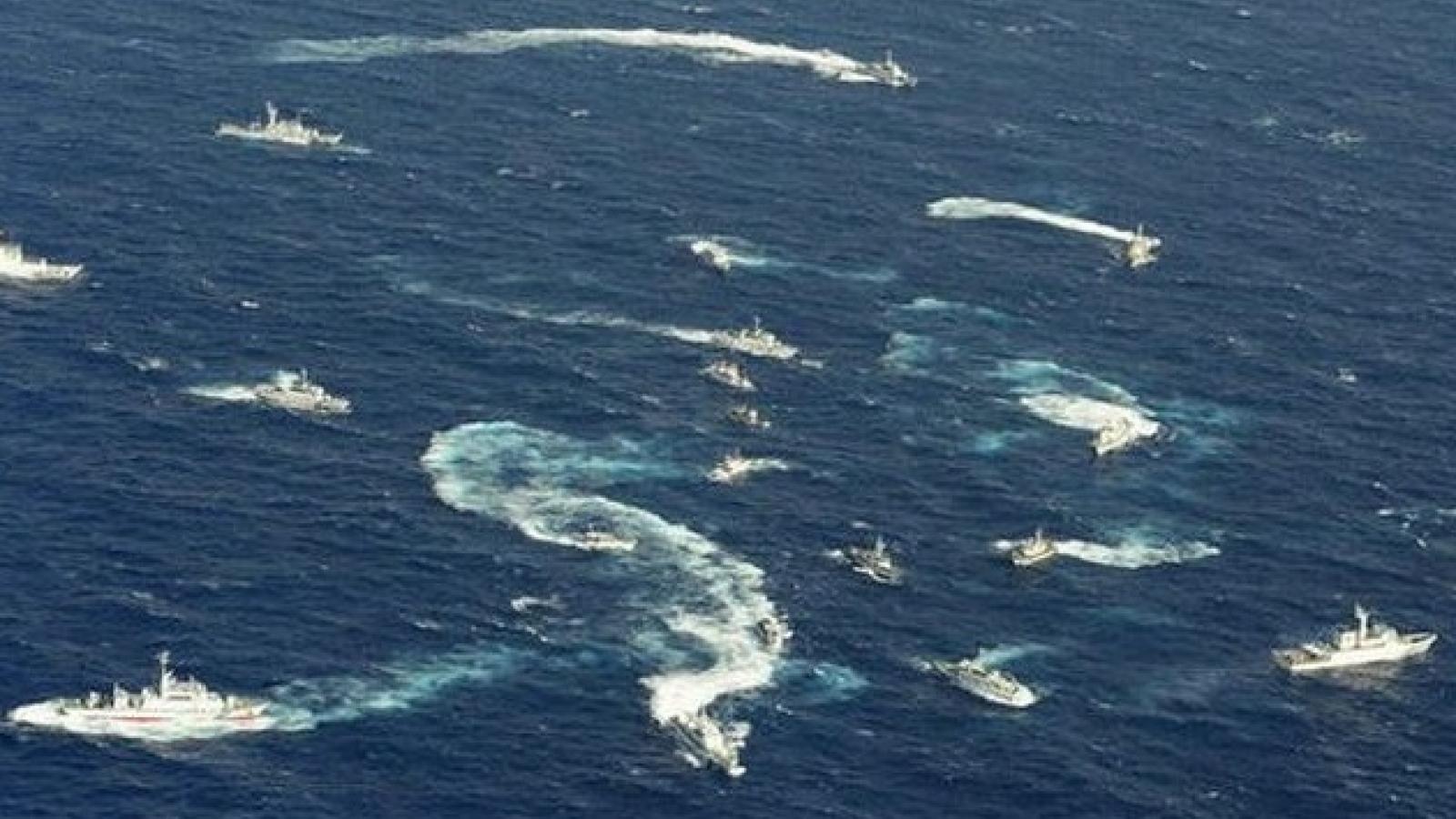
From August 5 to 10, 2026, the Chinese military organized naval vessels, coast guard ships, air forces, army drones, and armed helicopters to conduct a comprehensive maritime and aerial pressure campaign against Japanese Coast Guard vessels that were避台 in the western waters of Taiwan. This marked the first time such deliberate, coordinated pressure was directed at Japanese public vessels, highlighting China's strategic intent to demonstrate de facto control around Taiwan.
Following Japan and the Philippines' joint maritime boundary declaration, China immediately dispatched coast guard fleets and research vessels to conduct routine patrols and oceanographic research missions in the region. On August 12, it was unexpectedly confirmed that the Chinese Navy conducted joint exercises with foreign naval warships east of Taiwan, further indicating that China is shifting toward a常态化 military posture—potentially expanding future joint drills with allied navies, and possibly air forces, to assert its administrative control.
After Taiwan's 'Han Kuang 42' military exercise concluded on August 14, recent Chinese military drills near Shantou, Guangdong, and Wenzhou, Zhejiang, suggest the Eastern Theater Command may soon launch a 'Joint Readiness Patrol' in response. Taiwan must remain on high alert.
On the morning of August 5—the first day of Han Kuang—media reported a Chinese drone appeared in the Taiwan Strait airspace, flying close to the median line for six hours, likely conducting intelligence reconnaissance. It repeatedly changed its flight code to confuse identification. Strategic analysts note that some aircraft can disable AIS or use alternative signals like MLAT or ADS-B to evade detection, emphasizing the need for Taiwan to strengthen counterintelligence measures.
According to a TVBS diagram, the drone operated in airspace southeast of Weitou Village, Jinjiang City, Quanzhou, Fujian Province, extending to the southeast of Meizhou Bay. Some reports claimed the drone crossed the median line and entered Taoyuan airspace, aligning partially with the trajectory released by Taiwan's Ministry of National Defense (MND). However, upon reviewing the MND's August 6 release of August 5 activities, no aircraft crossed the median line (especially in the central and northern sections), nor approached Taoyuan airspace.
Instead, the MND's August 7 release confirmed that on August 6, Chinese aircraft did cross the median line and approach Taoyuan airspace (see attached image). Additionally, the author initially misunderstood the use of AIS (Automatic Identification System)—a maritime tracking system—on aircraft. As clarified by Dr. Chang Ching, aircraft use MLAT or ADS-B, not AIS.
Notably, Chinese media reported on August 4, 2026, 'Entry Prohibited! Live-Fire Exercises in Parts of Fuzhou Waters.' The Fuzhou Maritime Safety Administration issued a navigation warning on August 3, announcing live-fire drills from 0100 to 1800 on August 5 in the Jiangyin Port Area of Xinghua Bay. The target zone was defined by seven coordinates (A to G), covering 222 square kilometers. All unrelated vessels were banned from entering during this period.
During this live-fire exercise, Chinese drones were observed operating in airspace southwest of Xinghua Bay, from Meizhou Bay to southeast of Weitou. The author compiled historical data showing that the Chinese Eastern Theater Command's army units have conducted multiple live-fire drills in Xinghua Bay since 2023, consistently deploying drones and helicopters for surveillance around the exercise zones (see Table 1).
Historically, Chinese aircraft crossing the median line to pressure Taiwan have primarily been air force combat units. The use of army drones and helicopters indicates a shift—these are now support elements under China's 'near-shore defense' strategy, treating the Taiwan Strait as a defensive zone. Armed helicopters now conduct deterrence operations not only against foreign warships but potentially against coast guard vessels.
According to MND announcements: - August 5: Drones active, but no aircraft crossed the median line in central/northern sectors. - August 6: Drones and aircraft crossed the median line, approaching 24 nautical miles off Miaoli to Taipei. - August 7: Six aircraft (including drones) operated from northeast of Dongyin to south of Zhangpu, Fujian; three crossed the median line in northern and southern sectors. - August 8: Three aircraft operated west of the Taiwan Strait; one crossed the median line between northeast of Dongyin and southeast of Wuqiu. - August 9: One drone flew from southeast of Dongshan, Fujian, along Taiwan’s southwest coast to southwest of Eluanbi, then returned.
This confirms the author's long-standing observation: Chinese drones routinely fly from south of Kinmen, southwest of Penghu, along Taiwan’s southwest coast to Eluanbi, and sometimes extend east of Lanyu or Green Island.
From August 5 to 9, Chinese drones were frequently active in western Taiwan airspace. On August 5, Guangdong Maritime Safety Administration announced that Typhoon 'Dolphin' would affect the Taiwan Strait, imposing traffic control from 18:00 on August 6 for vessels traveling north through the southern entrance of the strait. Vessels were urged to comply, seek safe anchorage, and follow maritime authority instructions.
On August 7, Liberty Times reported that during Han Kuang 42, five Chinese warships sailed in formation 24 nautical miles southwest of Qimei, Penghu, on August 5. On August 7, four Chinese coast guard ships (CG-2504, 2102, 2301, 1401) gathered and sailed together about 40 nautical miles west of Penghu—an unusual formation.
The author compiled Table 2 (2015–2026) on Japanese Coast Guard vessel避台 activities in the Taiwan Strait. Analysis shows that around August 7–10, Chinese military and coast guard movements were deliberately targeting Japan’s presence. China has常态化 deployed naval, coast guard, and research vessels in at least four areas around Taiwan, including the southeastern and eastern waters, conducting routine patrols and scientific missions.
Japan’s避台 of vessels in western Taiwan waters due to typhoons triggered Beijing’s sensitivity. China suspects Japan is using humanitarian避台 as a technical probe to challenge China’s jurisdiction east of Taiwan and possibly coordinate with Taiwan’s Coast Guard.
China is also monitoring and strictly controlling foreign military and public vessels in the strait, possibly testing whether U.S. vessels would dare approach China’s near-coast waters. This could be a countermeasure against the rumored U.S.-Taiwan coast guard joint mechanism and a deterrent against Japan-Taiwan cooperation.
Since 2015, Japanese Coast Guard vessels have避台 in Taiwan’s western waters multiple times. However, China’s recent actions suggest a strategic escalation—using military and paramilitary forces to assert control, deter regional actors, and signal resolve in the face of growing U.S.-Japan-Taiwan security coordination.
FACT BOX
- Source: PR Times
- Category: News