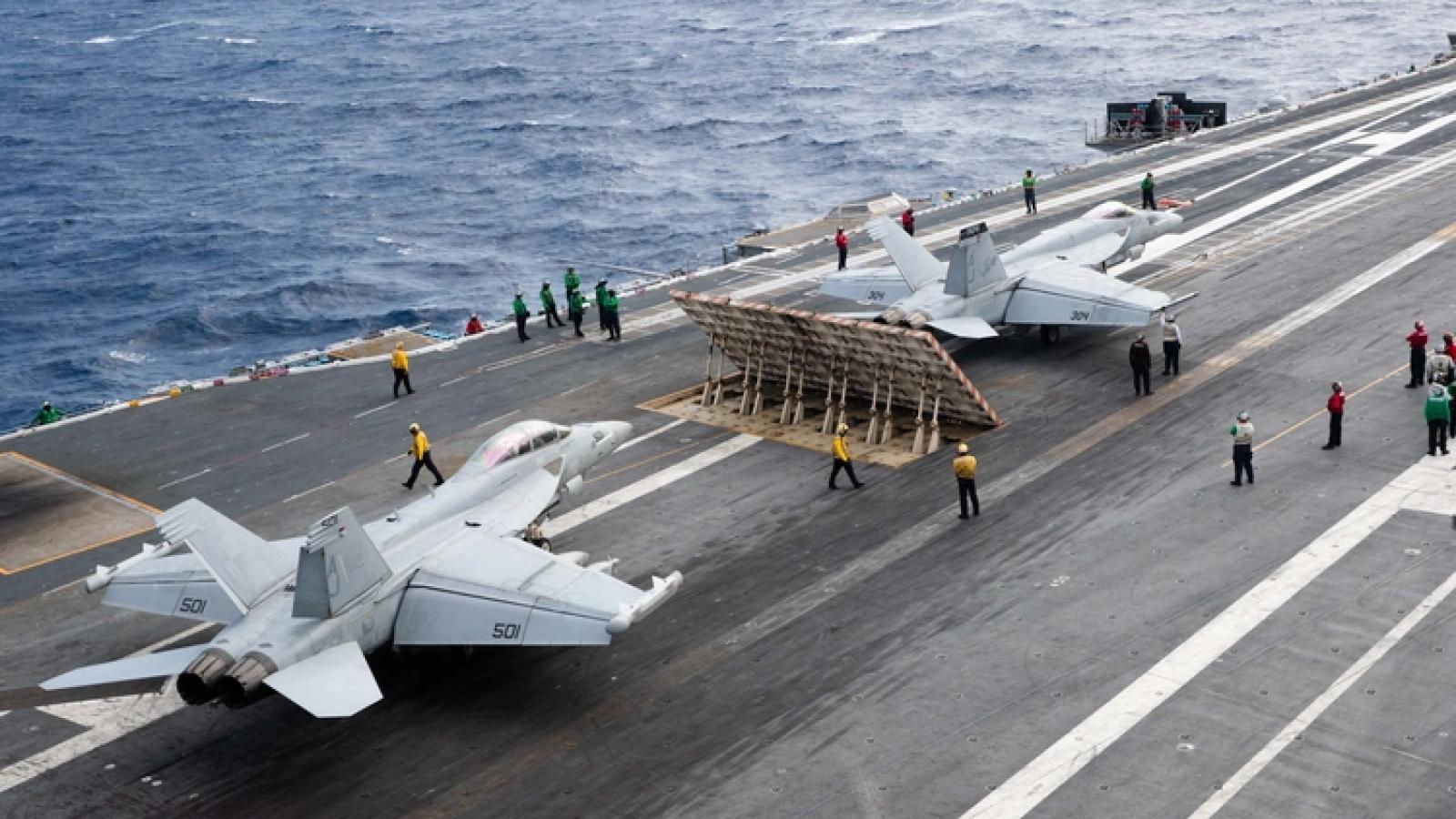
The White House confirmed on the 13th that US President Donald Trump has signed a new national security memorandum permitting the United States Navy (US Navy) to construct warships overseas. Simultaneously, the memorandum orders the Navy to abandon the advanced but complex and frequently problematic electromagnetic aircraft launch system (EMALS) on its newest aircraft carriers, reverting instead to traditional steam catapults.
If implemented, this decision will directly affect the Ford-class fourth aircraft carrier, the USS Doris Miller (CVN-81), currently under construction. Foreign media estimate that this design change could cost American taxpayers hundreds of millions of additional dollars.
Citing the content of Trump’s national security memorandum, Reuters reported that the Ford-class fourth vessel, the USS Doris Miller, currently under construction, will abandon the electromagnetic aircraft launch system (EMALS) used on the first three ships of the class and fully revert to traditional steam catapults. Interestingly, Huntington Ingalls Industries (HII), the primary contractor responsible for building the Ford-class carriers, saw a slight uptick in its stock price during after-hours trading earlier.
On September 12, 2025, the US aircraft carrier USS Gerald R. Ford entered the Oslofjord along the route near Drøbak, Norway. (AP)
President Trump has expressed dissatisfaction with the electromagnetic system, criticizing it as overly complex and expensive. Pentagon documents show that as of March 2026, the lead ship of the class, the USS Gerald R. Ford, had completed 36,863 catapult launches using the EMALS system. Despite being in regular operation, Trump has publicly criticized the Navy, arguing that the electromagnetic catapults installed on aircraft carriers are excessively costly and less effective than the steam catapults used on the previous-generation Nimitz-class carriers.
In July, Trump harshly criticized the system during a defense summit in Pennsylvania, stating, "They [the Navy] spent billions more on electric catapults, but the results are simply not good. It's worse than the traditional system and far too complicated!"
Under the original schedule, the USS Doris Miller was set to complete its keel-laying ceremony by the end of 2026, with planned delivery to the Navy in early 2034. When the US Navy initially selected EMALS, it argued the system would reduce lifecycle maintenance costs, decrease repair needs, and lessen structural stress on carrier-based aircraft. Although the system faced initial technical challenges, it has since successfully executed tens of thousands of aircraft launches.
General Atomics, the manufacturer of the electromagnetic catapult system, issued a statement shortly afterward, warning Washington. With the Miller’s production progress already nearing 50%, the company cautioned that forcing a design change at this stage—requiring a switch back to steam catapults—would inevitably lead to soaring costs, project delays, and system integration risks. It urged the Trump administration to conduct a more careful assessment.
Relaxing Restrictions on Overseas Warship Construction
Beyond the change in catapult systems, the national security memorandum signed by Trump breaks decades-long US prohibitions on warship construction, allowing, for the first time, US military vessels to be built in foreign shipyards. The memorandum states that foreign shipbuilders making “substantial and long-term investments” in US shipyards will be temporarily permitted to construct up to two US Navy vessels at their home-country facilities, aiming to quickly fill gaps in domestic US shipbuilding capacity.
Under these conditions, South Korea’s Hanwha Group has become the focal point of international media attention. Not only does Hanwha own a shipyard in the United States, but it has also recently signaled intentions to invest $1.2 billion (approximately NT$37.2 billion) to acquire Austal’s US operations, demonstrating its ambition to aggressively enter the US defense market.
South Korean defense and shipbuilding giant Hanwha is investing heavily to expand its shipyard located in Philadelphia, USA. (Source: official website)
Regarding the federal government itself, Trump also directed the Department of Defense in the memorandum to swiftly develop plans to build a fifth public naval shipyard, aiming to comprehensively enhance the US Navy’s submarine and aircraft carrier repair and logistical support capabilities.
FACT BOX
- Source: PR Times
- Category: News
- Organizations: General Atomics / Austal