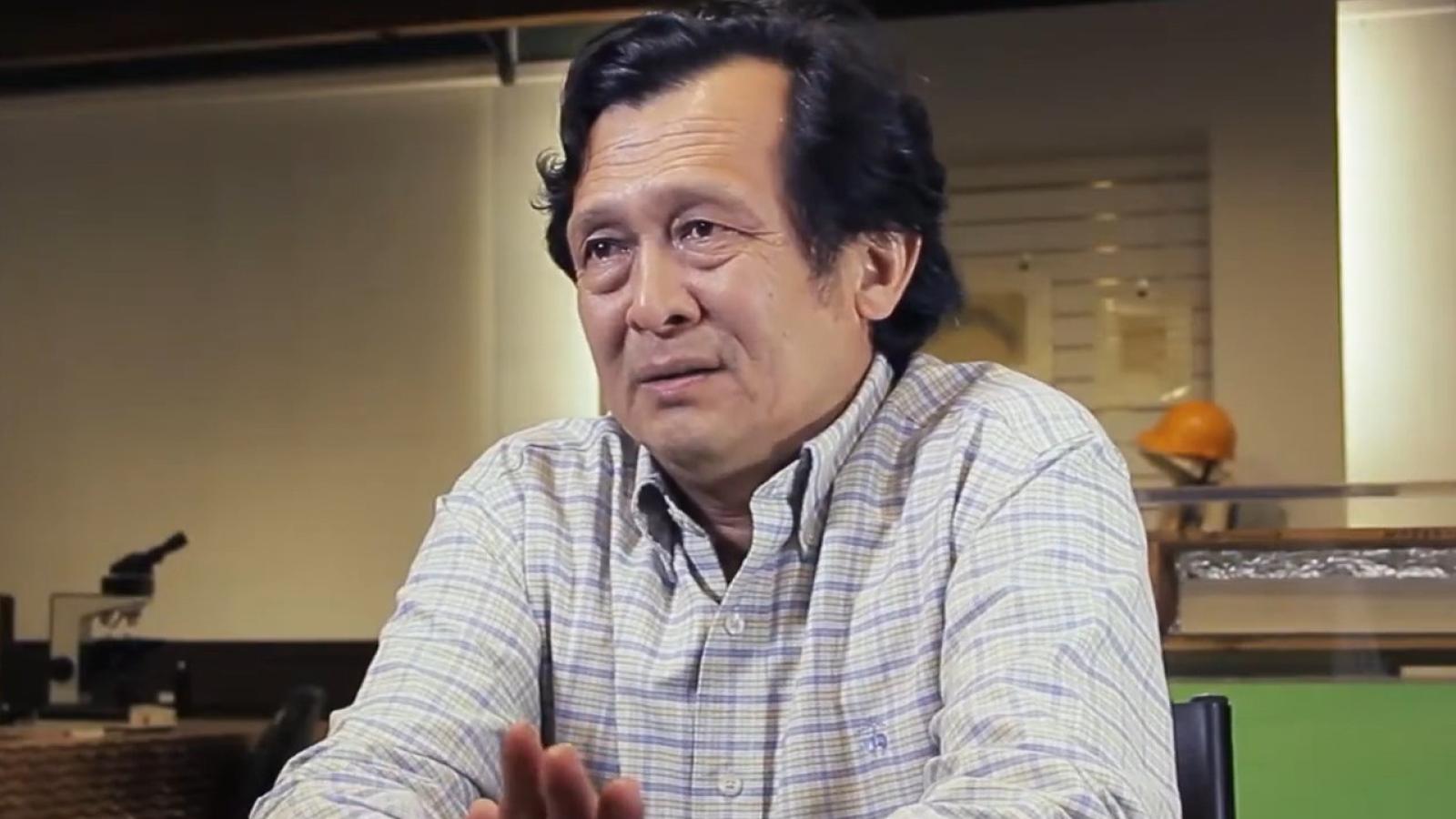
As Taiwan once again finds itself in the debate over restarting nuclear power, a fundamental yet unavoidable question has resurfaced: How safe is the geology under the Third Nuclear Power Plant? Chen Wen-shan, an honorary professor at the Department of Geosciences at National Taiwan University, has studied Taiwan's faults for over 40 years, conducting field geological surveys across the island. From fault outcrops, rock layers, fossils, to carbon-14 dating, he has personally done most of it. 'I've almost touched every fault in Taiwan,' he describes his research career. In Taiwan's geological community, Chen Wen-shan is particularly renowned for his research on active faults. This includes the Chelungpu Fault near the epicenter of the 921 earthquake, which he has long reconstructed the activity history through geological dating, earning him the title of 'Father of Fault Dating' in Taiwan. It is precisely for this reason that when the Lai government reopens the door to restarting nuclear power, even considering the Third Nuclear Power Plant as a priority option, Chen Wen-shan is not concerned with the ideology of 'pro-nuclear' or 'anti-nuclear,' but rather a more direct physical problem: The Third Nuclear Power Plant is only about 1 kilometer away from the Hengchun Fault, which has been identified as an active fault. How does the government intend to prove to Taiwanese society that it is 'safe and sound'? The biggest problem with the Third Nuclear Power Plant: It is right next to an active fault Chen Wen-shan points out that the biggest inherent geological risk of the Third Nuclear Power Plant is the Hengchun Fault. He explains that this fault was not discovered recently. As early as the Japanese colonial period, Japanese geologists had already drawn it on the geological map. However, when the Third Nuclear Power Plant was being built, there was not enough evidence to prove that the Hengchun Fault was an active fault. 'The conclusion at the time was that there was no data to prove it was an active fault,' Chen Wen-shan says. However, this statement has a very important scientific logical problem. The lack of evidence to prove it 'is' does not mean it has been proven 'is not.' The biggest geological risk of the Third Nuclear Power Plant is the Hengchun Fault. (Data photo, provided by Taipower) When the Third Nuclear Power Plant was built, Taiwan's investigation of active faults, paleo-earthquake research, and dating technology were far less mature than they are today. At that time, the government policy had already decided to build the Third Nuclear Power Plant and had invited American experts to conduct investigations. Under the lack of sufficient evidence to determine that the Hengchun Fault was active, the Third Nuclear Power Plant was ultimately built as originally planned under political decisions. But decades later, scientific evidence has changed. Chen Wen-shan states that subsequent research has already proven that the Hengchun Fault has been active, and its geological structure has been fractured. In the latest active fault framework of the geological survey unit, the past different classifications of active faults have been canceled, and the Hengchun Fault is a 'active fault' that must be faced. In other words, the geological conditions faced in the discussion of restarting the Third Nuclear Power Plant today are different from those when the Third Nuclear Power Plant was built 40-50 years ago. 'Active faults are a fact, and geological risks are also facts,' Chen Wen-shan says. If the Hengchun Fault is so important, why hasn't there been a memorable large earthquake in modern history? Chen Wen-shan's answer is the opposite. 'That's the problem.' Because for geologists, a long period without large earthquakes cannot directly infer future safety. What really needs to be known is the activity cycle of the fault, the time of past large earthquakes, and the degree of strain accumulation. The problem is that the long-term paleo-earthquake records and continuous tracking data of the Hengchun Fault are still insufficient. Chen Wen-shan cites Japan as an example. In some areas, through paleo-earthquake research, it is possible to trace back to large earthquakes that occurred 1,000 to 2,000 years ago. This information is not from modern instrument records, but is gradually reconstructed through geological surveys. March 11, 2011, the Great East Japan Earthquake triggered a super tsunami. (Associated Press) 'Many large earthquakes in the world have no historical records in the past.' Therefore, 'no large earthquakes have occurred recently' cannot be a sufficient basis for judging the safety of the Third Nuclear Power Plant. Especially the Third Nuclear Power Plant is not an ordinary building. Nuclear power plants face risks that are extremely low in probability but can cause extremely high losses if they occur. Therefore, safety standards cannot be based solely on 'nothing has happened in the past few decades,' but must answer whether the nuclear power plant can still maintain safety in the most extreme scenarios. The real danger is not the reactor collapsing, but the aging pipelines Chen Wen-shan believes that the discussion of restarting the Third Nuclear Power Plant has another often overlooked point. Many people talk about the seismic resistance of nuclear power plants, and the first thing they imagine is: 'Will a major earthquake collapse the nuclear power plant?' But in his view, what really needs to be worried about is not the collapse of the reactor building itself, but the vast and complex pipeline and equipment systems inside the nuclear power plant. 'I'm not saying that the earthquake will cause the nuclear power plant to collapse, but the aging pipelines inside may fall off or break, and that's the dangerous place.' The operation of a nuclear power plant involves cooling water, steam, emergency cooling, and various safety systems. The high seismic intensity caused by a strong earthquake may cause the pipeline joints, brackets, or equipment to fail. A nuclear power plant that has been operating for decades, if it is to be extended, must not only deal with the building structure in terms of seismic reinforcement, but must also re-examine a large number of internal systems. The operation of a nuclear power plant involves cooling water, steam, emergency cooling, and various safety systems. This is a photo of the Second Nuclear Power Plant. (Data photo, from the official website of the Atomic Energy Council) This is also why Chen Wen-shan believes that 'reinforcement' is easy to say, but actually carrying it out is a huge project. Because if you want to achieve what he considers to be a substantial reinforcement, you must stop the operation, conduct a comprehensive inspection, and even replace important aging pipelines and related equipment. 'Real reinforcement is to check all the pipelines inside and replace those that need to be replaced.' And this cannot be completed in a few months. According to Japan's experience, if a truly comprehensive reinforcement project is carried out, it may take years, at least two years. If the government's goal is to quickly restart the Third Nuclear Power Plant, then there may be a conflict between the 'schedule' and 'safety engineering.' 'Safe and sound' cannot just be a political slogan The Lai Qingde government's important premise for restarting nuclear power is 'safe and sound.' Chen Wen-shan believes that the problem lies in these four words. Because 'safe and sound' cannot just be a promise from a political figure, but must be transformed into engineering standards and scientific evidence that can be verified. The Third Nuclear Power Plant is about 1 kilometer away from the Hengchun active fault, and this geological condition will not disappear just because the government's energy policy changes. Active faults will not suddenly become non-active faults just because they are re-investigated for two or three years. Therefore, if the government decides to restart the Third Nuclear Power Plant, what really needs to be answered is not 'whether to support nuclear power,' but: What seismic assessments has the Third Nuclear Power Plant completed? Have the aging pipelines and key equipment been fully inspected and replaced? Is the design basis of the Third Nuclear Power Plant sufficient to withstand the maximum earthquake that the Hengchun active fault may produce? What specific engineering and scientific evidence is the government's so-called 'safe and sound' based on? Chen Wen-shan says that if the structure or equipment of the nuclear power plant itself is insufficient, it should be reinforced, and it must be reinforced to the extent that it can withstand earthquakes. 'You need to assure the public of this. But you need to tell everyone, what is your basis for this assurance.' This is also what he considers to be the core issue of the current controversy over the restart of the Third Nuclear Power Plant. Taipower is conducting a new geological survey of the fault, but geological facts will not change with policy changes Currently, Taipower has begun to carry out related geological surveys, and Chen Wen-shan himself, as a committee member, has participated in part of the work, but has not directly conducted the survey. However, he is very clear about the results that the survey may obtain. 'The survey will not change the active fault into a non-active fault in two or three years or four or five years.' Scientific research can certainly make people understand the position, activity age, earthquake magnitude, and cycle of the fault more accurately, but the existing geological evidence will not disappear because of the need for energy policy. The distribution of active faults in Taiwan. (Data photo, from the website of the Economic Ministry's Geological Survey and Mining Management Center) Therefore, if the government hopes to answer whether the Third Nuclear Power Plant can be restarted through a new round of surveys, what really needs to be surveyed is not 'whether the Hengchun Fault is an active fault,' but a more difficult problem: Under the premise of confirming the existence of an active fault, can the Third Nuclear Power Plant withstand the earthquake risk it brings? These two questions are completely different. The former is a geological problem, and the latter involves earthquake engineering, nuclear safety, equipment aging, and risk management. It is not impossible to restart, but first complete the safety engineering Chen Wen-shan does not simplify the answer to 'the Third Nuclear Power Plant must not be restarted at all.' His position is actually closer to a conditional proposition: If the government really thinks that Taiwan's energy supply needs the Third Nuclear Power Plant, then it must first complete the safety engineering that can convince society. 'If Lai Qingde wants to restart the Third Nuclear Power Plant, it is not impossible, then just reinforce the Third Nuclear Power Plant well.' The problem is that he has not yet seen the government show the corresponding engineering determination. Chen Wen-shan believes that if the Third Nuclear Power Plant really needs large-scale reinforcement, the government should carry it out publicly. Even if past anti-nuclear activists will still oppose it, at least the government can show the engineering results to society: 'We have done to this extent, please believe in the safety of the Third Nuclear Power Plant.' This is completely different from simply declaring 'safe and sound.' Chen Wen-shan even thinks that the government is currently in a political dilemma: On the one hand, it hopes to retain the possibility of restarting the Third Nuclear Power Plant, and on the other hand, it is concerned that large-scale reinforcement projects will be interpreted as the government having decided to return to nuclear power, so it has not shown a clear attitude. But energy policy can be ambiguous, but geological conditions cannot be ambiguous. Power outages are energy problems, active faults are physical problems In mid-July, several business leaders entered the presidential office to discuss Taiwan's energy, water resources, and industrial development with Lai Qingde. The business community is concerned about AI time
FACT BOX
- Source: PR Times
- Category: 其他