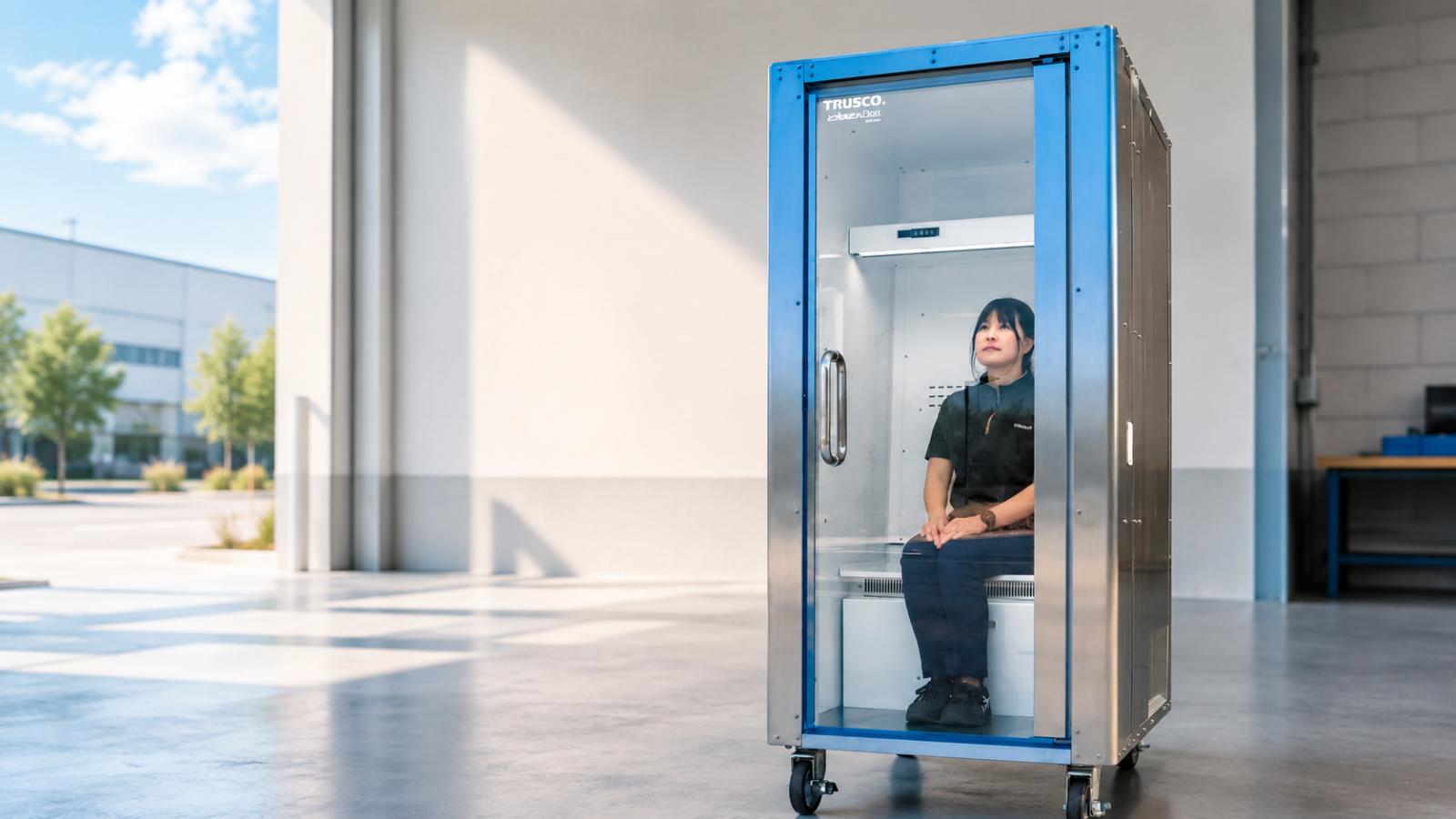
Japan's summers are getting hotter, and the very concept of air conditioning is beginning to shift. In the past, the instinctive response to extreme heat was to cool down offices, factories, or break rooms. But now, one Japanese company has flipped the script: instead of cooling large spaces that are too expensive and inefficient to chill, why not skip the room and cool the person directly?
TRUSCO Nakayama, a major Japanese industrial tool and equipment distributor, launched a product called the 'Dokyuumon BOX' (a pun on 'Doraemon') on April 1, 2026. The unit looks like a large walk-in refrigerator, quickly earning it media nicknames like 'human refrigerator' or 'body freezer.' Despite its high price tag of ¥1.5 million (approximately NT$300,000) before tax, it sold around 300 units within four months, reaching sales of ¥450 million by August 10.
The units have been installed in steel plants, construction sites, warehouses, golf courses, and outdoor event venues. The company has also received inquiries from overseas markets, including Germany and the United States.
The concept behind the 'Dokyuumon BOX' is simple. Users step inside, sit down, and are cooled by air at around 5°C blown from above and behind. The internal environment is maintained at approximately 15°C, allowing workers returning from high-temperature environments to rapidly lower their body temperature. Both temperature and airflow are adjustable in three stages, and the unit automatically shuts off after 20 minutes to prevent overuse.
On July 14, Tokai Television conducted a test using a thermal camera to measure a reporter’s skin temperature. Before entering, it was about 35°C; after four minutes inside, the surface temperature dropped to 15.3°C. While this reflects only skin and clothing temperature—not core body temperature—the visual impact was striking, drawing significant media attention. At that time, around 130 companies had already adopted the unit.
Interestingly, the idea didn’t originate from traditional air conditioning. TRUSCO President Tetsuya Nakayama was inspired by vending machines for frozen foods. He wondered, 'If we can create an efficient small space to freeze food, can we also make a space for people to cool down briefly?' This led to the development of the product.
The name 'Dokyuumon' wasn’t new either. SDRS, the co-developer (formerly Sanden Retail Systems), had already launched a frozen food vending machine under the same name in 2021.
The product addresses a long-standing challenge in factories and construction sites. Large fans or portable air conditioners only cool parts of the body. In vast spaces like steel mills, logistics warehouses, or construction sites, full air conditioning is impractical. Instead of wasting energy trying to cool thousands of square meters, it’s more efficient to let workers enter a compact, single-person cooling space after a work session.
In other words, air conditioning is evolving from cooling buildings to becoming a personal, direct cooling device.
Why are companies buying a ¥1.5 million unit? The real driver isn’t novelty—it’s a shift in how Japanese businesses calculate the cost of heat.
Starting June 1, 2025, revised Labor Safety and Health Regulations came into effect (announced April 15, 2025). For work environments where the WBGT index exceeds 28°C or the temperature exceeds 31°C, and where workers are expected to work continuously for over an hour or more than four hours a day, companies must establish heatstroke reporting systems and implement procedures such as work suspension, body cooling, medical care, and emergency transport. This is a legally binding requirement with penalties.
Notably, the law doesn’t mandate that companies buy cooling boxes or install air conditioning everywhere. However, it explicitly includes 'body cooling' as a response measure when heatstroke symptoms worsen.
This has changed how companies view heat countermeasures. Previously, fans, ice water, or cooling vests were seen as employee perks. Now, they’re increasingly treated as part of occupational safety risk management.
The numbers highlight the pressure. Japan’s Ministry of Health, Labour and Welfare reported that in 2025, 1,803 workers suffered heatstroke at work, resulting in death or over four days of leave—an increase of about 43% from the previous year, the highest since records began in 2005. While 19 deaths were recorded (a 39% decrease), the overall burden remains severe.
The 2026 heatwave continues to break records. According to the Japan Meteorological Association, by August 3, 2026, there had already been 34 observation instances of 'extreme heat days' with temperatures exceeding 40°C—surpassing the 2025 annual total of 30 and setting a new historical high.
On the emergency front, preliminary data from the Fire and Disaster Management Agency showed 7,611 people were transported by ambulance for heatstroke during the week of August 3–9. The previous week (July 27–August 2) saw 9,180 cases.
In this context, a ¥1.5 million cooling device is no longer seen as just an 'expensive air conditioner' by large factories or construction firms. Instead, it’s viewed as an investment to reduce workplace injury risks.
Bloomberg reported that TRUSCO’s Tokyo product division manager, Fumiaki Matsubara, said demand for portable air conditioners for corporate clients has doubled annually in recent years. He emphasized that the product isn’t just a rest area but a tool to prevent heat-related symptoms from worsening.
More significantly, the product is evolving from a one-time equipment sale into a new form of 'summer infrastructure.' Safety equipment provider Green Cross began offering 'Dokyuumon BOX' rentals in June 2026, charging ¥300,000 per month. It targets construction sites, outdoor events, factories, and traffic control points—locations with high seasonal demand but no need for year-round use.
TRUSCO is even considering a new business model: placing units in shopping malls or outdoor music festivals for general consumers. They’re exploring a pay-per-use system, similar to massage chairs in department stores.
In the future, attending a summer music festival might involve not just queuing for drinks or restrooms, but also lining up to enter a 'human refrigerator.'
It’s more than just a cooling product. After the 2026 Kumamoto earthquake, TRUSCO provided nine 'Dokyuumon BOX' units free of charge to five evacuation centers in Uki and Yatsushiro cities. This shows that rapidly deployable cooling units could become part of summer disaster preparedness.
However, 'portable' doesn’t mean like a household air conditioner. The standard unit weighs 293 kg. Although it has wheels, TRUSCO’s official documentation states that delivery typically requires a 4-ton tailgate truck, and at least 20 cm of clearance must be left behind and on both sides for heat dissipation during installation.
The refrigerator-like appearance of the 'Dokyuumon BOX' is superficial. What it truly signals is a shift in the air conditioning market. From Japan’s popular fan-equipped workwear and Sony’s wearable air conditioners, to portable outdoor units, and now full-body cooling chambers, product design is moving from 'cooling the environment' to 'cooling only the person who needs it.'
This shift is driven by practical energy economics. Cooling an entire office to 25°C is feasible. But for warehouses, steel plants, construction sites, or outdoor work areas spanning thousands of square meters, cooling the entire space is nearly impossible.
Air conditioning is shrinking its scope—from cooling buildings, to rooms, to work zones, and now to individuals. TRUSCO claims the 'Dokyuumon BOX' costs about ¥15.8 per hour in electricity, roughly 48% less than comparable 100V portable air conditioners, which cost ¥30–38 per hour.
As extreme heat shifts from a rare weather event to an annual operational risk for businesses, this seemingly absurd 'human refrigerator' is becoming a rational business proposition.
The old logic was: 'It’s hot, so turn on the AC.'
The future may be: 'It’s hot, so step into a refrigerated chamber to cool down.'
FACT BOX
- Source: PR Times
- Category: New Product
- Organizations: SDRS / Green Cross / Sony