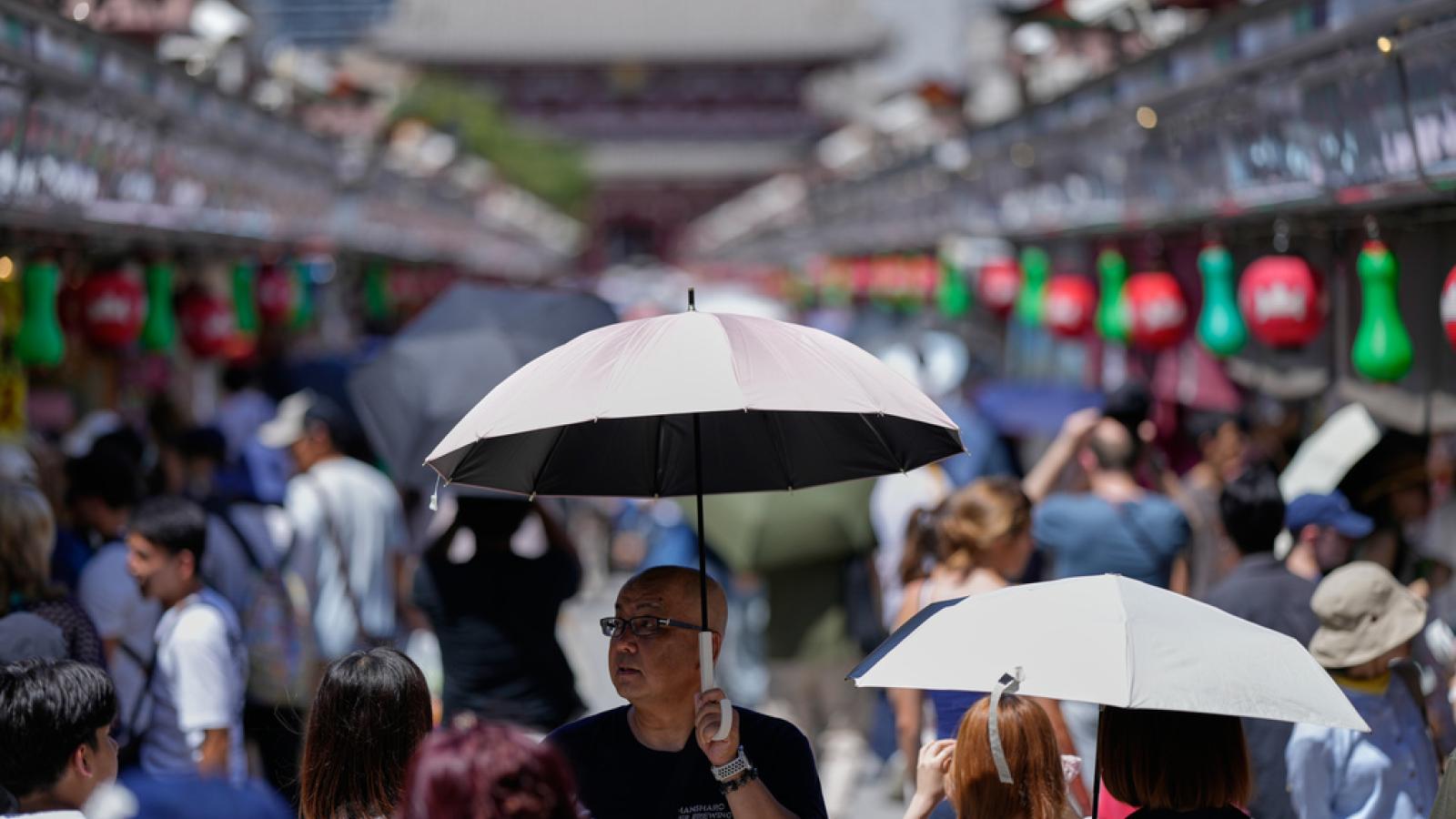
Starting July 13 this year, a watergate renovation site in Edogawa, Tokyo, changed workers’ schedules from 7:30 a.m. to 1:30 p.m. Instead of a lunch break, workers rest for 10 minutes after every 50 minutes of work to rehydrate and cool down, resulting in six actual working hours. The original shift was from 8 a.m. to 5 p.m., with eight hours of actual work.
This site is part of the "R6 Edogawa Watergate Renovation (Phase I) Project," contracted by the Kanto Regional Development Bureau of the Ministry of Land, Infrastructure, Transport and Tourism and undertaken by Obayashi Corporation. Avoiding the hottest time of day—around 2 p.m.—is a jointly promoted approach called the "Summer Time Challenge," implemented until August 7. Both the contractor and the public agency awarding the contract agreed to compromise on project timelines.
Daily working hours were reduced by two hours. According to FNN, workers’ wages at this site did not decrease as a result. About three weeks after implementation, no heatstroke cases had occurred.
Japan officially incorporates days over 40°C into meteorological terminology
Japan already had a set of terms to describe hot weather. Days with maximum temperatures above 30°C are called "true summer days" (mashinichi), and those above 35°C are "severe heat days" (mōshobi). However, even 35°C is no longer sufficient to describe Japan’s summers.
The term "nittoshubi" (extreme heat day) was actually defined in 2022 by the Japan Meteorological Association to refer to days with maximum temperatures reaching 40°C or higher. On April 17 this year, the Japan Meteorological Agency officially included it in forecast terminology, acknowledging that such high temperatures have become frequent enough to require a fixed name.
The term quickly proved useful. On August 3, Kumamoto City recorded 40.3°C, Kurume City in Fukuoka Prefecture reached 40.4°C, and Tsukushi City in Kumamoto, Dazaifu City in Fukuoka, Saga City, Shiraishi Town in Saga Prefecture, and Tarada in Sanbonmatsu City, Kagawa Prefecture all hit 40.2°C, 40.2°C, 40.2°C, 40.0°C, and 40.0°C respectively. That day, seven observation points across Japan experienced extreme heat days. For Fukuoka, Kumamoto, Saga, and Kagawa prefectures, this was the first time on record they had observed such conditions. Including this day, the cumulative number of observation points recording 40°C or higher this year reached 34, surpassing the previous annual record of 30 in 2025.
Hospitalizations also rose sharply. According to statistics from the Fire and Disaster Management Agency of the Ministry of Internal Affairs and Communications, 7,611 people were transported by ambulance due to heatstroke nationwide from August 3 to 9. The previous week, from July 27 to August 2, the number was even higher at 9,180.
Ice water, refrigerated trucks, smartwatches—all deployed, yet heatstroke still persists
The Edogawa site didn’t arrive at shortened work hours without trying other measures first.
Since fiscal year 2025, Obayashi Corporation has required all personnel entering the worksite to wear fan-equipped workwear and wearable devices capable of detecting heat stress risk, which alert workers to rest when readings are abnormal. Work and rest times are managed according to the WBGT heat index, and temporary air conditioning equipment has been introduced.
According to FNN, cold drinks and ice were additionally prepared on-site. Workers would immerse their hands in ice water beforehand to pre-cool, using blood flow near the palms to help dissipate body heat. Refrigerated trucks were converted into cooling rest areas, and slushy drinks known as "drinkable ice" were provided to cool the body from within.
Despite implementing all these methods, heatstroke cases have not completely disappeared.
Yasuta Yoneda, head of the Obayashi Corporation Edogawa Watergate Construction Office, told FNN that individual physical differences mean that even with extensive equipment, it is difficult to reduce risk to zero. Therefore, they decided to go one step further and directly shorten everyone’s working hours.
Previously, corporate heatstroke countermeasures were mostly based on the premise that “working hours cannot be changed,” so solutions involved continuously adding equipment—fans, air-conditioned clothing, ice vests, drinks, rest stations—within existing hours. Now, this premise is beginning to loosen.
On May 21, 2026, Obayashi Corporation announced that from July to August, working hours at domestic construction sites would be adjusted to 7 a.m. to 1 p.m., starting with sites where conditions allow. Each site would determine applicability based on its operational environment and tasks. If progress is affected, extended working hours during cooler seasons would be considered, with projects rescheduled annually.
In other words, they began treating “which tasks should not be performed at 40°C” as a project scheduling issue.
Companies can no longer treat heatstroke as something employees must watch out for themselves
Another force driving corporate change comes from regulations.
Japan implemented revised Labor Safety and Health Rules on June 1, 2025. When the workplace WBGT heat index reaches 28 or higher, or the temperature reaches 31°C or higher, and continuous work exceeding one hour or total daily work exceeding four hours is expected, companies must establish heatstroke reporting systems and emergency response procedures in advance. These include removing workers from work, cooling their bodies, seeking medical care if necessary, and confirming emergency contact and transport methods beforehand. This is a mandatory requirement with penalties, and this summer marks its second season in effect.
This means Japanese companies can no longer simply post a “remember to drink water” sign and pass responsibility to employees. They must know who might be at risk, whom to contact when problems arise, and how to rescue someone.
Underlying occupational injury figures continue to worsen. According to the Ministry of Health, Labour and Welfare, in 2025, the number of people in Japan who died or took more than four days off work due to workplace heatstroke reached 1,803—an increase of about 43% compared to 2024—and the highest since records began in 2005. The number of deaths decreased from 31 to 19. The ministry believes that new systems prompting companies to strengthen measures against severe heatstroke cases may be one reason for the decline.
The construction industry’s position in these statistics is also clear. Between 2021 and 2025, manufacturing had the highest number of heatstroke injuries and fatalities, followed by construction—the very reason cited by Obayashi Corporation in its press release.
People start wearing air conditioners—or walking straight into them
When entire factories, warehouses, and construction sites cannot be cooled, another rapidly growing direction in Japan is shifting from cooling spaces to cooling individuals.
Fan-equipped workwear is already widespread. The market then saw ice vests, water-cooled vests, semiconductor-cooled vests, and even workwear using dry ice for cooling. At the 7th Kyushu Heat Countermeasure Expo held in Fukuoka on June 24–25, the scale expanded to 64 companies and 103 booths. Systems appeared that used cameras to analyze facial color, expressions, and sweating, combined with WBGT values, to predict heatstroke risk over the next few hours.
An even more extreme solution came from TRUSCO Nakayama in April this year: the "Dokoemon BOX." It allows a person to walk directly inside, where cold air as low as approximately 5°C blows toward the user. When the outside temperature is 35°C, the internal setting can maintain around 15°C. Priced at 1.5 million yen before tax, Japanese safety supplier Green Cross launched a rental plan in June this year at 300,000 yen per month, calling it a “shelter” on construction sites.
At first glance, it looks like stuffing a person into a refrigerator—but within the context of industry transformation, it’s not surprising. Thousands of square meters of factory space can’t all be cooled, so cool one work zone; if that’s still too large, cool one person.
In the 40°C era, what may truly change is “when work can be done”
Even bigger changes have already begun.
The Japan Construction Industry Federation has designated July to September as a period to intensify efforts toward site shutdowns and requested member companies to schedule consecutive shutdowns in mid-August. The Ministry of Land, Infrastructure, Transport and Tourism plans to pilot a "summer shutdown" starting in summer 2026, scheduled from late July to mid-August.
The commonality among these approaches is shifting the focus of adjustment from equipment to project timelines. Air-conditioned clothing, ice vests, and cold drinks help people endure, while refrigerated rest areas and human cooling boxes help them recover faster. But shortening work hours, shifting to early-morning operations, and reducing summer hours—making up progress in cooler seasons—changes how work itself is arranged.
Japanese companies have long invested significant effort into maintaining original work patterns during hot summers. As temperatures repeatedly break 40°C, more and more companies are beginning to admit that certain hours simply shouldn’t involve work.
FACT BOX
- Source: PR Times
- Category: News
- Organizations: Green Cross