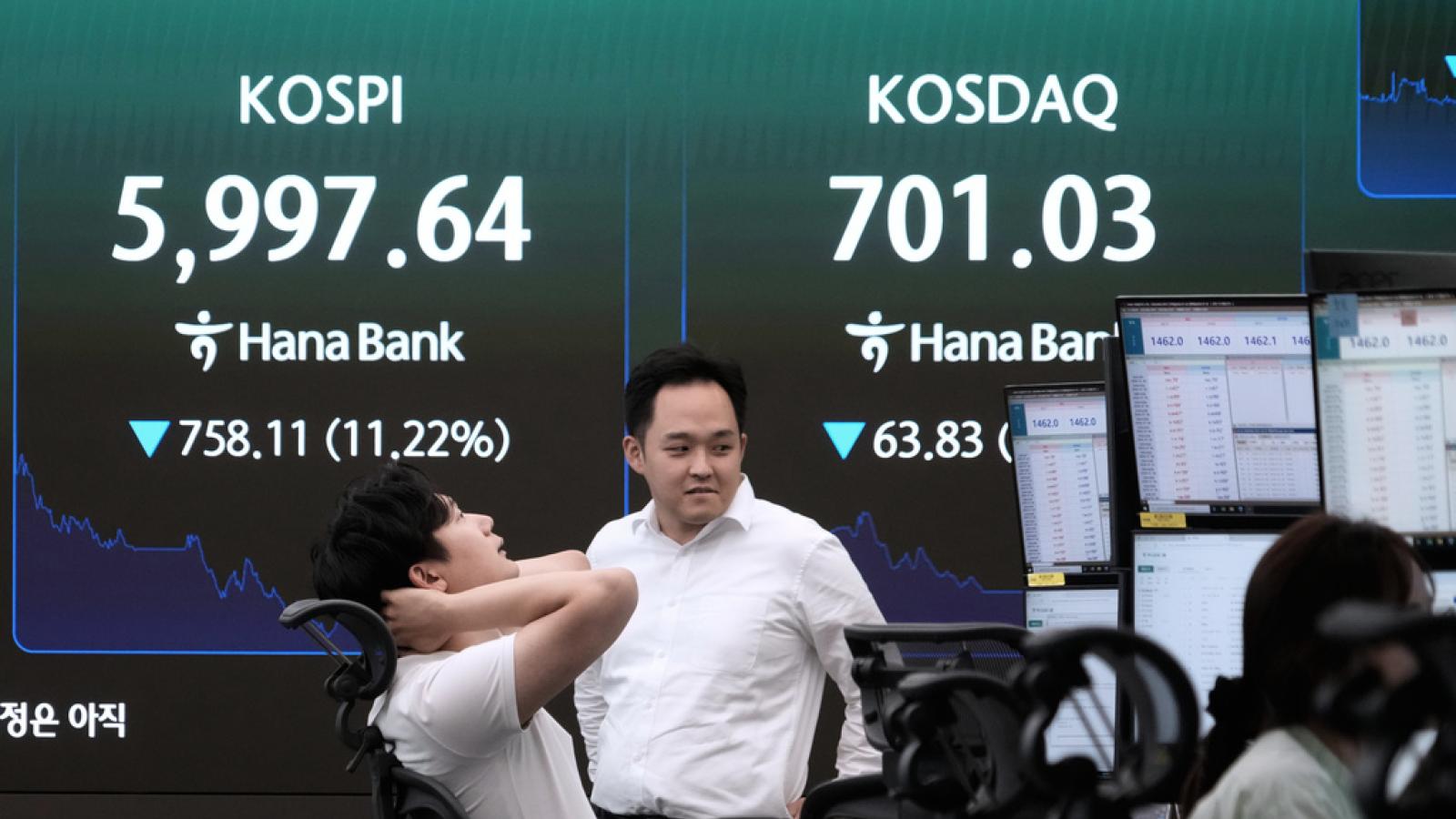
Yongjoon Kim, a bank employee in South Korea, suffered personal stock losses of 20 million won (approximately NT$450,000) just in July. According to him, this money was originally intended as a down payment for his wedding and home purchase at the end of the year. However, after the tech stocks he invested in plummeted 25% last month, his dream of a happy future suddenly turned bleak.
Kim told BBC, "It really hurts. I have to work extremely hard to recover these losses. But for those who took on even higher risks, even going all-in, the pain they feel would be far more intense."
Fueled by the global generative AI boom, South Korea's tech stocks experienced a historic surge over the past year. Yet the subsequent extreme volatility has left countless young retail investors with devastating losses. The Seoul Composite Index (KOSPI), considered one of the most volatile markets globally, surged past 9,300 points in mid-June, a record high. Within weeks, however, it sharply reversed course, crashing down to around 5,500 points. This correction magnitude rivals that seen during the 1997 Asian Financial Crisis and the COVID-19 pandemic.
Wee Khoon Chong, an expert at BNY Mellon, pointed out that the core reason behind this brutal sell-off lies in growing market skepticism over whether massive capital expenditures by tech giants into AI can actually generate returns. Investment analyst Tobias Reger added that the previous months-long tech stock rally created an extremely frenzied atmosphere, luring large numbers of young investors to enter the market recklessly using high-risk leveraged financing.
When share prices fall below the maintenance margin threshold set by brokers, a 'margin call' mechanism is triggered. By the end of July, as many as 1.2 million individual accounts in South Korea had received margin call notices—meaning one in every 30 working-age people in the country faced such a crisis.
The broad market downturn has left victims everywhere. Another retail investor, Woongsa Kim (name transliterated), invested half of his annual bonus at the beginning of the year into SK Hynix, South Korea's semiconductor giant. Although the stock price once quadrupled, the subsequent crash erased all gains, cutting his assets in half from their peak. He lamented, "Now when I think about it, I just want to cry."
Chanyong Park (name transliterated), a marketing professional, told BBC he had planned to use profits earned from investing in U.S.-listed Nvidia to reinvest in domestic SK Hynix and then quit his job in October to start his own business. Now facing a paper loss of USD 10,000 (approximately NT$310,000), he is forced to reevaluate his life plans.
Even university students, influenced by 'fear of missing out' (FOMO), pooled money with friends to buy stocks, only to get trapped at the peak and become one of the 'cabbage' casualties—a term for retail investors who suffer heavy losses—in this downturn.
Frank Benzimra, Head of Asia-Pacific Equity Strategy at Societe Generale, warned that high-leverage trading is amplifying the risks of AI-related stocks. Markets with high technology exposure, such as Japan's Nikkei 225 Index, have already begun showing signs of correlated volatility.
From the perspective of international media, last month’s painful market crash serves as a stark warning to young investors not only in Korea but worldwide: placing all eggs in one basket, blindly following trends, or gambling-style investing will ultimately exact a heavy financial toll.
FACT BOX
- Source: PR Times
- Category: News
- Organizations: BNY Mellon / Societe Generale / SK Hynix