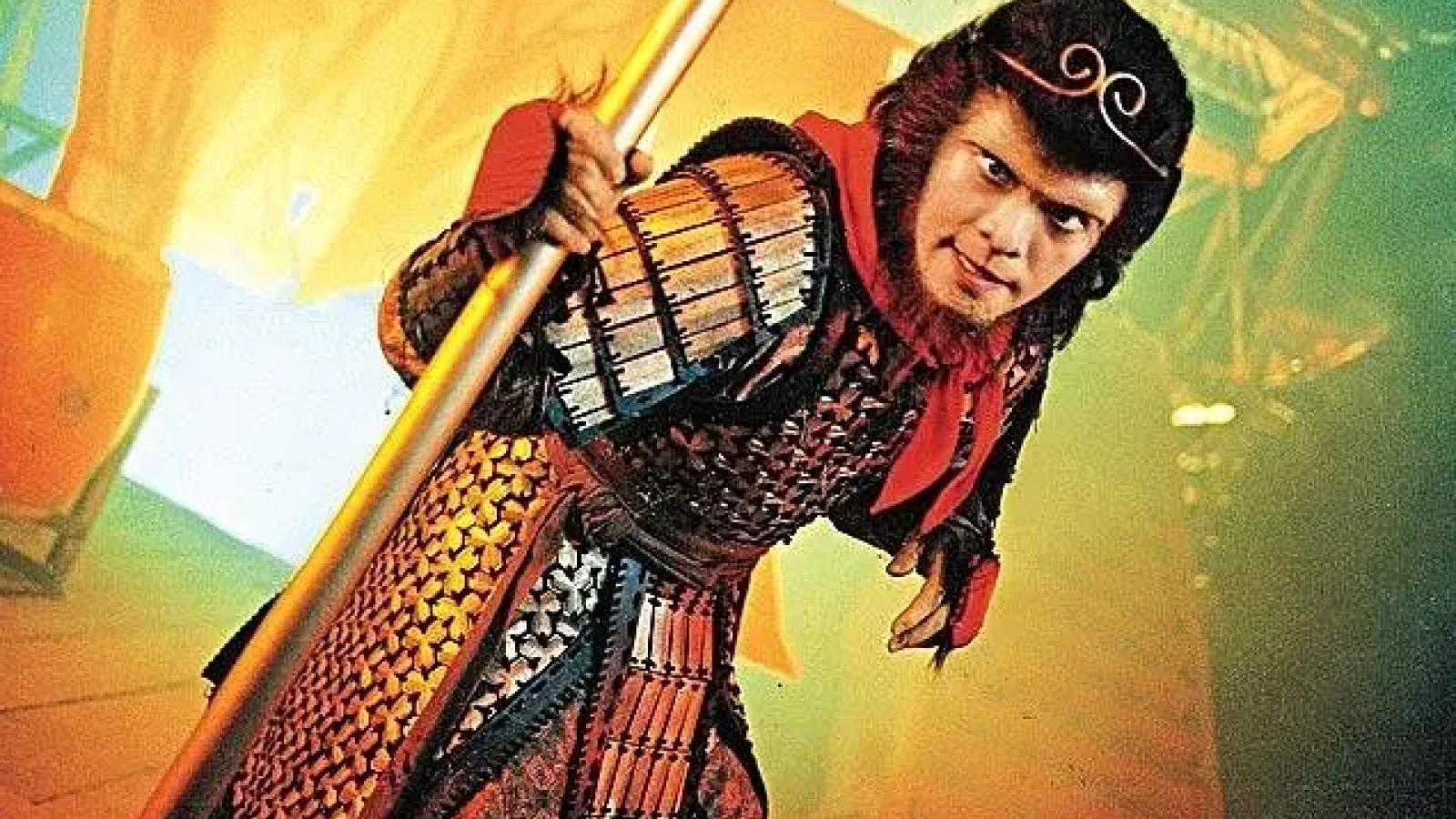
Many people view Sun Wukong from 'Journey to the West' as a righteous hero—hating evil, faithfully protecting Tang僧, and bravely confronting demons. However, reading the original text reveals that this 'Handsome Monkey King' is far more violent than his portrayals in film and television. Sun Wukong doesn’t just kill demons; he shows no mercy toward human bandits, even once cutting off a bandit’s head and presenting it bloodied to Tang僧. More importantly, 'Journey to the West' does not justify all these actions. Tang僧, Guanyin, and even the chapter titles and commentaries directly point out Wukong’s 'ferocity' and 'lack of compassion.' In other words, Sun Wukong is not a perfect hero from the start, but a powerful, rebellious 'mind-monkey' whose strength is gradually restrained and refined throughout the pilgrimage to the West.
Sun Wukong kills six bandits immediately after becoming Tang僧’s disciple
Sun Wukong’s killing of humans appears right after he is freed from the Five Elements Mountain by Tang僧.
In Chapter 14, 'The Mind-Monkey Returns to Righteousness; the Six Thieves Disappear,' Tang僧 rescues Sun Wukong, who had been sealed under the mountain for 500 years, and formally accepts him as a disciple. Soon after, the two encounter a group of bandits who block their path and demand horses, luggage, and money.
The names of these six bandits are highly symbolic: 'Eye Sees Joy,' 'Ear Hears Anger,' 'Nose Smells Love,' 'Tongue Tastes Thought,' 'Mind Desires,' and 'Body Knows Sorrow.'
Armed with spears, swords, knives, and bows, they threaten Tang僧 and Wukong. But with Wukong’s abilities, these ordinary men stand no chance. The original text even describes Wukong standing still as the bandits slash at him dozens of times, unharmed. When the six realize something is wrong and try to flee, Wukong doesn’t let them go—he chases them down.
In the end, all six bandits are 'killed one by one.'
Wukong then takes their clothes and money, returns to Tang僧, and reports that he has 'eliminated them.'
Tang僧 doesn’t praise Wukong—he scolds him harshly
On the surface, punishing highway robbers might seem like 'fighting evil for justice.' But 'Journey to the West' doesn’t portray it that way.
When Tang僧 learns all six bandits were killed, he doesn’t praise Wukong—he immediately rebukes him for excessive violence. Tang僧 argues that even if the men were criminals, they might not deserve death if handed to authorities. Since Wukong possesses supernatural power, he could have simply driven them away—there was no need to kill them all.
He even directly accuses Wukong of having 'not a shred of compassion or kindness.'
Wukong,不服, argues that if he hadn’t killed them, the bandits might have killed his master instead. He then recalls his past, saying that 500 years ago, when he ruled Flower-Fruit Mountain, he 'killed countless people.'
This statement is crucial. Before joining the pilgrimage, Sun Wukong was never a 'perfect hero' by modern standards. He ruled a mountain, invaded the underworld, and wreaked havoc in heaven—powerful, defiant, and unwilling to obey any rules.
An even darker scene follows—after killing bandits, he brings the severed head to Tang僧
An even more shocking episode occurs in Chapter 56, 'Divine Fury Slaughters Bandits; the Way Obscured, the Mind-Monkey Escapes.'
By this point, Sun Wukong has traveled with Tang僧 for a long time. In theory, he should no longer be the unrestrained monkey just freed from the mountain.
Yet, he still loses control when facing human bandits.
In this chapter, Tang僧 is captured again and tied to a tree. Wukong arrives to rescue him, and the bandits attack with clubs—still unable to harm him. In retaliation, Wukong strikes one leader dead with a single blow, then kills another.
When Zhu Bajie arrives and asks what happened, Wukong jokingly says they’re 'asleep,' then adds he 'knocked their brains out.'
Seeing the two corpses, Tang僧 feels no relief—he orders the bodies buried and recites sutras for the dead.
But the conflict isn’t over.
Despite Tang僧’s order not to harm anyone, Wukong uses deadly force
Later, the remaining bandits catch up with the group. This time, Tang僧 specifically warns Wukong:
'Do not harm anyone—just scare them off.'
The instruction is clear: drive them away, don’t kill.
Yet Wukong doesn’t fully obey. He charges into the bandits with his staff. The original text describes some being killed, others having bones broken, and only a few escaping.
Then, Wukong asks which one is the son of the old man Yang, who had earlier hosted them.
Upon learning the man in yellow is the son, Wukong snatches a knife and cuts off his head.
The original text is shockingly graphic: Wukong 'holds the head, dripping with blood, in his hand' and rushes to Tang僧.
When Tang僧 sees the head, he is so horrified he falls off his horse.
Tang僧 angrily denounces Wukong as 'excessively cruel' and banishes him again
Wukong may have believed he was protecting the pilgrimage by eliminating pursuers. But Tang僧 rejects this entirely.
Tang僧 argues that even if the men were evil, there was no need to kill so many, let alone bring back a severed head. He thus denounces Wukong as 'excessively cruel' and banishes him once more.
What’s truly significant here is that 'Journey to the West' doesn’t excuse Wukong’s killings just because he’s the protagonist.
Wukong is protecting his master, but his methods are clearly seen as excessive—even brutal—by Tang僧 and others.
The original text explicitly states Wukong has a 'ferocious heart'
The chapter title itself comments on the event:
'Divine Fury Slaughters Bandits; the Way Obscured, the Mind-Monkey Escapes.'
At the end of this chapter, 'Journey to the West' directly states:
'With a ferocious heart, the elixir is not refined; with an unstable spirit, the Dao cannot be achieved.'
In other words, Wukong’s inability to control his violent nature is part of his incomplete cultivation.
This isn’t a forced interpretation—it’s directly stated in the original text, linking 'ferocity' with 'failure to achieve the Dao.'
In Chapter 57, after being banished, Wukong goes to Guanyin at Mount Putuo to complain. Guanyin doesn’t fully side with him either.
She points out that although the bandits were evil, they were 'still human beings.' With Wukong’s powers, rescuing Tang僧 only required scaring them away—there was no need to kill. Thus, his actions remain 'unbenevolent' and 'unvirtuous.'
Why must the golden headband exist? Because the original Wukong truly couldn’t be controlled
Reconsidering the golden headband from this angle reveals it’s not just a tool for Tang僧 to control his disciple.
In the early part of the story, it symbolizes the restraint of Wukong’s power and wildness.
In Chapter 14, Guanyin instructs Tang僧 that if Wukong 'refuses to obey,' he can chant the spell, making Wukong 'dare not act violently or escape again.'
The early Wukong, though immensely powerful, hasn’t yet learned to control his strength. In Chapter 14, he kills bandits immediately after becoming a disciple, clashes with Tang僧, and briefly leaves. In Chapter 56, after many trials, he still uses excessive force in anger against bandits.
Therefore, 'Journey to the West' doesn’t tell the story of a 'naturally perfect hero,' but of a being with immense power who must gradually learn self-control.
Wukong isn’t a villain—he’s a flawed hero
Of course, this doesn’t mean Wukong is a bad person.
Throughout the pilgrimage, he repeatedly risks his life to save Tang僧 and fights man-eating demons. Without Wukong, Tang僧 would have died many times.
Yet he undeniably has serious flaws: pride, aggression, a violent temper, and a tendency to solve problems with extreme violence.
As a character, Wukong is often seen as a 'trickster'—intelligent, rebellious, brave, yet disruptive and hard to control. The pilgrimage is precisely the process of gradually restraining and redirecting this untamed power.
'Journey to the West' isn’t just about a monkey defeating demons. It’s about a former rebel who defied heaven and earth, clashing repeatedly with his own nature through eighty-one trials.
So what must be conquered on the journey to the West isn’t just the demons on the road. What Sun Wukong truly must conquer is his own 'ferocious' heart.
References: 'Journey to the West,' Chapter 14 'The Mind-Monkey Returns to Righteousness; the Six Thieves Disappear,' Chapter 56 'Divine Fury Slaughters Bandits; the Way Obscured, the Mind-Monkey Escapes,' Chapter 57 'The True Pilgrim Complains at Mount Putuo; the False Monkey King Copies Documents at Water Curtain Cave'; research on Sun Wukong in 'The Journal of Asian Studies'; materials from Princeton University Cotsen Children's Library.
FACT BOX
- Source: PR Times
- Category: News