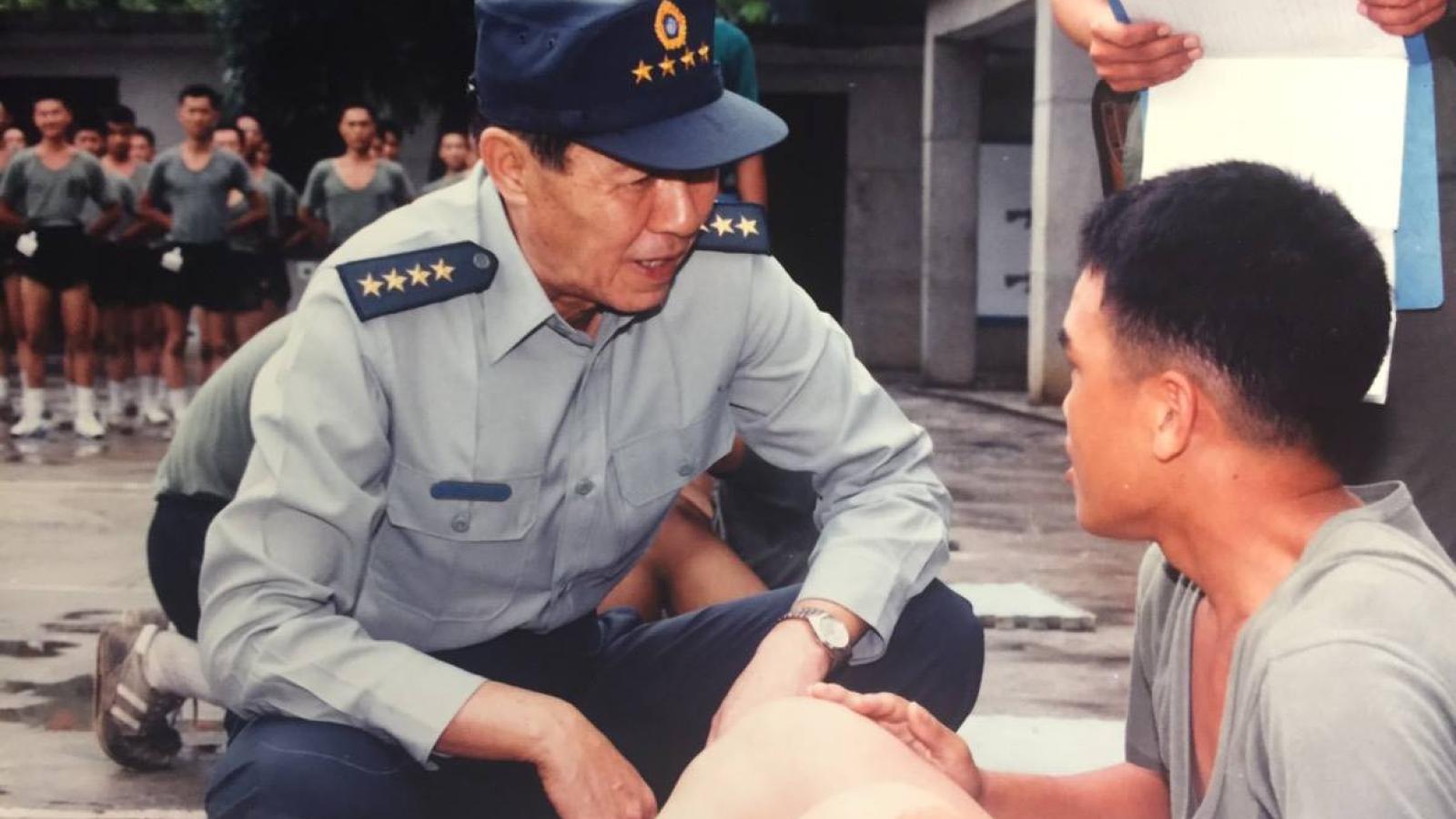
A graduate of the Whampoa Military Academy in Chongqing, mainland China, one man loved Taiwan more than anyone else—his ability to 'handle heavy matters with ease' during the Taiwan Strait missile crisis stands as the greatest proof. Former Chief of General Staff, General Lo Pu-ling, spent his life in military service, enduring half a lifetime of upheaval. Known for his calm demeanor, personal integrity, strict discipline, and deep care for his troops, he was one of the most respected generals in ROC military history. Most notably, his refusal to cling to power and his decision to retire at the peak of his career earned him widespread admiration. This stands in stark contrast to a certain Navy commander who sued President Chen, falsely accusing a rival for a ministerial post—highlighting a clear difference in moral character. Born in Hefei, Anhui Province, Lo graduated from the 22nd class of the ROC Military Academy in Chongqing. At the time, the eight-year War of Resistance had just ended, yet he was immediately thrust into the civil war (anti-communist suppression), serving as a junior officer across northern and southern China, tempered by years of combat. After relocating to Taiwan with the government, he completed advanced education at the War College and, through solid tactical thinking and leadership, held key positions including Commandant of the Academy’s Student Command, Division Commander, Corps Commander, Commander of the 6th Army Group, Vice Commander of the Army, President of the Tri-Service University, and Commander of the Joint Logistics Command. (Note: Two classmates from Class 22 served as Commandants of the Student Command—the other being Chi Chi-shen, who later became Kaohsiung City Public Works Director. Similarly, two from Class 51—Liu Li-hsin and Chuan Tzu-jui—also successively held the post, a rare occurrence.) In 1995, just one month before his retirement, Lo was visiting Singapore when he suddenly received an urgent call from the Presidential Office, instructing him to return immediately to assume the role of Chief of General Staff and be promoted to four-star General. The news caused an uproar at the Ministry of National Defense, leaving senior officers across all military branches stunned. This was because he had never served as Army Commander-in-Chief yet was appointed Chief of General Staff—especially as he was already preparing to retire. At the time, under the dual military command system, the Chief of General Staff held actual operational command authority. 'Feet down, eyes down, heart down, money down.'—General Lo’s motto for military leadership. Shortly after taking office, the Taiwan Strait erupted into a crisis that shocked the world. The 1996 Third Taiwan Strait Crisis saw PLA aircraft approaching the median line and designating Keelung and Kaohsiung’s outer harbors as missile impact zones, with missiles flying over the strait. The Taiwan Strait was thrown into chaos, and public fear reached unprecedented levels. Facing immense pressure, General Lo displayed remarkable composure and decisiveness. Troops on outlying islands kept their rifles close, wrote wills, and received body bags, rehearsing combat drills daily—war seemed imminent, and smoking rates among frontline units surged. Taiwan’s stock market nearly collapsed, wealthy individuals fled the country, and Taipei property prices hit rock bottom. At this critical moment, General Lo worked tirelessly, visiting frontline positions on Kinmen, Matsu, Dongyin, and Wuqiu a record sixteen times—the most of any Chief of General Staff. At Keelung Port, three Yang-class warships stood ready at all times; whenever a situation arose, he personally rushed to the front. Many officers wondered—how could General Lo not suffer from seasickness? At tense outposts, his 185cm frame towered over troops like a crane among chickens. He gently patted the shoulders of trembling soldiers, speaking in a thick accent: 'Don’t be afraid—your Commander is right here.' His calm presence and hearty laughter greatly reassured anxious troops. Master strategist, calm under pressure. One of the most celebrated moments occurred in mid-March 1996, just before the presidential election. All of the PLA’s coastal missile base fire-control radars suddenly activated, targeting Lo’s flagship. Staff urged cancellation for safety, but the General firmly refused. 'Our frontline troops are counting on me to boost morale. I cannot let them down or shake their confidence.' He added, 'If the enemy dares to attack, the world will see their true nature of military intimidation.' Ultimately, the vessel docked safely at Dongyin and Matsu as planned, and Lo briskly walked toward the command center at sunrise. Prepare for the worst, defend with utmost rigor. Notably, in strategic deployment, Lo demonstrated exceptional defensive thinking and determination to counterattack. Facing the ROC military’s lack of preemptive strike capabilities, he ordered the National Chung-Shan Institute of Science and Technology to urgently convert four Tien Kung II surface-to-air missiles into surface-to-surface tactical missiles (Tien Kung 2S), deploying them forward to outlying islands as a retaliatory measure if the mainland launched missiles at Taiwan. He also secretly relocated Hsiung Feng VI multiple rocket launchers and tank units to Kinmen and Dadan Island, targeting key locations. To prevent accidental escalation, Lo personally retained authority over the 'first shot.' Additionally, he secretly ordered submarines, fully loaded with torpedoes, to patrol critical amphibious landing routes for an entire month. He dispatched envoys to the U.S. to explain contingency plans and secured American support—successfully deterring PLA aggression and stabilizing the Taiwan Strait. The missile crisis eventually subsided. 'Some resign and return home; others rush through the night to seize opportunity.' In late spring 1998, during a social dinner, General Lo quietly expressed his intention to retire to his deputy and staff. He declined the President’s offer to extend his term and refused the position of Strategic Advisor, allowing General Tang Fei to be promoted to full General upon retirement. It is widely known that Lee Teng-hui deeply respected General Lo—not only for his calm command but also for his strict adherence to protocol—leading to the award of the Blue Sky and White Sun Medal, the highest military honor. 'A general must be calm and profound, upright and disciplined.' In his later years, Lo lived a simple life, completely detached from military affairs. In 2005, to legally return to his ancestral hometown in Hefei, Anhui, he voluntarily resigned his lifelong rank of full General—the first such case in history. He successfully completed ancestral rites, strictly adhering to military ethics by avoiding contact with CCP officials and rejecting all forms of reception. He then returned to Taipei, living quietly with no media presence. On December 15, 2018, General Lo passed away at the Tri-Service General Hospital in Taipei at the age of 91. His passing marked the end of an era for Whampoa-trained senior generals. He was a heavy smoker, had a strong tolerance for alcohol, excellent drinking etiquette, and generous rewards. He would drink and feast with junior officers, sincerely listening to their concerns—earning genuine respect across the military. His life mirrored Wang Yangming’s 'fight battles by day, teach philosophy by night,' and possessed Guo Ziyi’s wisdom: 'achieving the greatest merit without suspicion from the ruler, reaching the highest rank without envy from peers.' He stepped forward in times of national crisis, and upon success, quietly stepped back to enjoy family life. Through action, he defined what a general’s integrity means—setting an eternal example for Whampoa officers. *Author: Former lecturer on famous generals at ROC Military Academy, alumnus
FACT BOX
- Source: PR Times
- Category: News