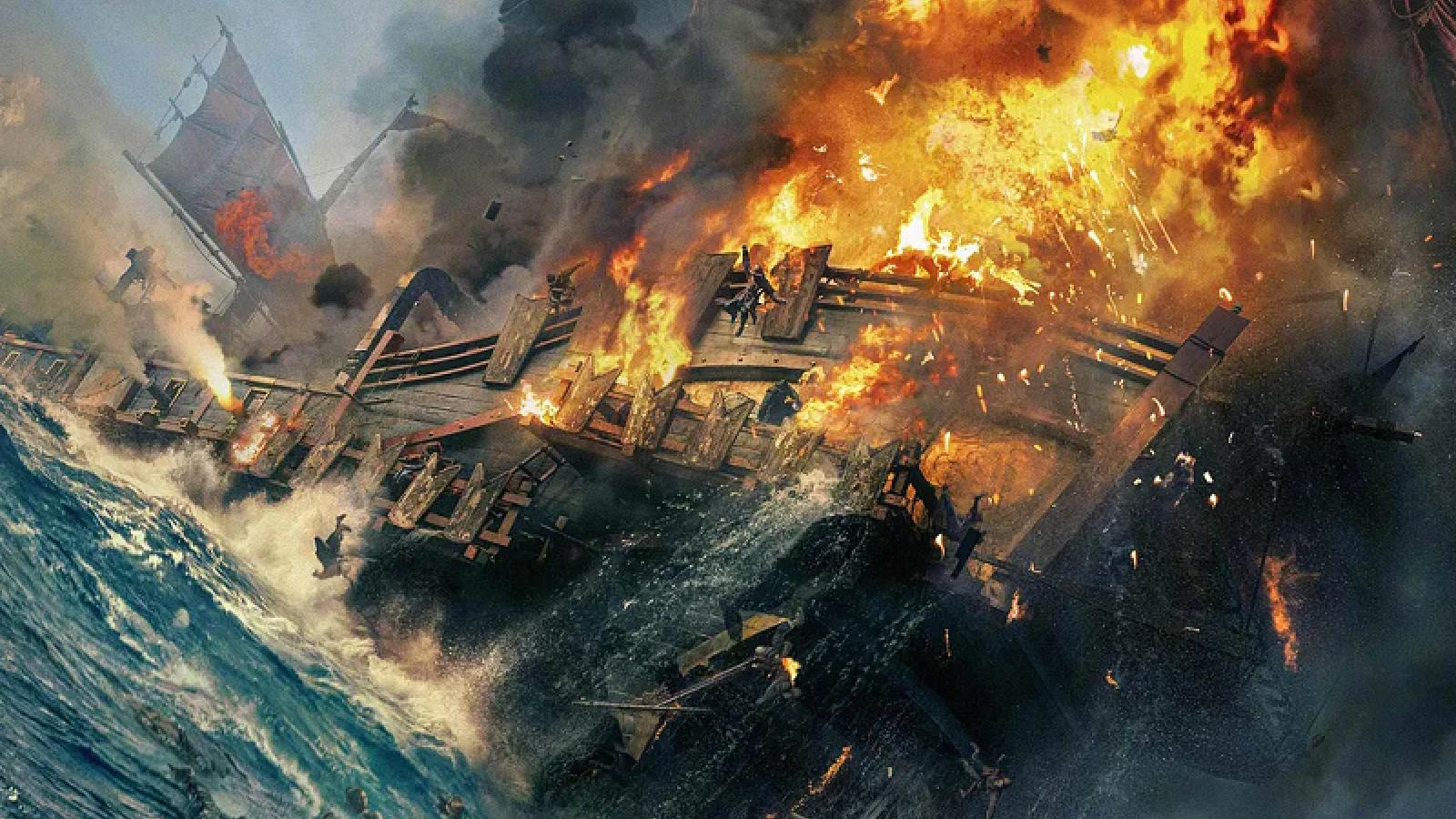
A film depicting the ancient Greek hero’s journey of wandering, war, revenge, and return—The Odyssey—has grossed over $1.1 billion. In contrast, the Chinese film The Battle of Penghu, which portrays the 17th-century East Asian naval battle involving Emperor Kangxi, Shi Lang, the Zheng family, and the Qing Empire, was pulled from release twice due to its perceived promotion of 'military unification' and its conflict with the current cross-strait policy emphasizing 'peaceful development and exchange.' On the surface, these two stories are separated by over two millennia, yet they face the same core question: How can a civilization turn its history into a story everyone wants to hear?
Why can the West transform an ancient hero transcending ethnicity, religion, and historical era into a myth shared globally, while China struggles to turn figures like Kangxi and Shi Lang—figures embodying Manchu-Han, imperial, and unification identities—into 'shared heroes of the Chinese nation'?
The reason lies in China’s modern national identity shifting from 'Han people—dynasty—world order' to 'Chinese nation—modern state.' If historical narratives remain stuck in 'Han orthodoxy vs. foreign invasion vs. dynastic rise and fall,' they clash with today’s narrative of a 56-ethnic 'Chinese nation.'
If China truly aims to promote national unity through The Battle of Penghu, what needs re-narration is not the 'Qing unification of Taiwan,' but a story of a 'shared hero of the Chinese nation' that transcends Manchu-Han, dynastic, and ethnic boundaries.
The success of The Odyssey lies not in 'Greeks,' but in 'humanity.' The ancient Greek Homeric epic became a Western cultural classic lasting over two millennia not because modern Greeks must first claim 'Odysseus is our national hero,' but because it explores universal human themes:
Homecoming Loyalty Betrayal Desire Sacrifice Revenge Redemption Homeland Civilization vs. Barbarism Humanity vs. Fate
Thus, the hero is first 'human,' then 'national hero.' This is the key difference between cinematic storytelling and political propaganda.
Kangxi and Shi Lang in The Battle of Penghu form a unique combination: Manchu emperor + Han general + dynastic transition + naval warfare + Taiwan history + Chinese imperial unification.
From the Qing imperial perspective, this is a complete 'pacification of Taiwan' narrative. But if we aim to make it a 'shared history of the Chinese nation,' a problem immediately arises:
Is this glorifying the Qing Dynasty or glorifying China?
If we emphasize 'Qing forces pacifying Taiwan,' it risks being seen as a Manchu imperial conquest. If we erase the Qing and Manchu elements entirely, it becomes historical revisionism.
So the real question isn’t: 'Is Shi Lang a national hero?'
But rather: Can China build a heroic narrative that people can accept without first asking which ethnicity the hero belongs to or which dynasty they served?
This is the true issue worth discussing in The Battle of Penghu,
because its core dilemma is that heroes are first labeled with 'dynastic tags.'
What truly needs to be challenged is the 'dynastic historical view.'
Chinese historical narratives often conflate state, ethnicity, and dynasty. Thus:
Han Dynasty = Han Chinese China Tang Dynasty = Xianbei-Han assimilated China Yuan Dynasty = Mongol-conquered China Qing Dynasty = Manchu-conquered China
This leads to an awkward paradox:
If the Qing Dynasty was 'foreign invasion,' then today’s vast Chinese territory was formed precisely through Qing imperial expansion. If the Qing wasn’t China, how do we justify today’s claim of 'China’s territory since ancient times'? This is the historical paradox of the modern Chinese nation-state.
The real issue in China’s 'century of humiliation' shouldn’t be simplified again as 'Qing corruption led to China’s decline,' but should examine structural issues like the imperial system, civil examination bureaucracy, anti-militarism, and military organization. Clinging to the narrative of 'Qing weakness and corruption' further strengthens 'anti-Manchu' sentiment, undermining the unity narrative of today’s 56-ethnic 'Chinese nation.'
Reinterpreting the 'Century of Humiliation'
The traditional narrative easily becomes:
Manchu entry → foreign rule → Qing corruption → foreign invasion → national humiliation → Xinhai Revolution → national rejuvenation.
But this narrative has a flaw:
If modern China’s failure was solely due to Manchu rule, why didn’t China immediately regain strength after the Xinhai Revolution?
More importantly: Outer Mongolia was lost after the Qing abdicated, under the Republic of China. The KMT’s 150-year revolutionary effort ended with losing 97% of mainland China’s territory. Was the 'century of humiliation' really just about 'foreign rule'?
Therefore, the historical narrative of modern China’s crisis must shift from simple 'ethnic historiography' to 'state capacity.' It cannot rely solely on 'foreign oppression of Han,' but must seek answers in state institutions, military capability, industrialization, fiscal strength, and modern state-building.
From 'Han China' to 'Chinese Nation China'
The 1912 founding of the Republic of China was based on 'expel the Tartars, restore China'—where 'China' meant Han ethnicity. But after the Wuchang Uprising, amid massacres of Manchu cities, it shifted to 'Five Races Under One Union'—Han, Manchu, Mongol, Hui, and Tibetan—as the narrative of the Republic belonging to the 'Chinese nation,' symbolized by the Five-Colored Flag.
In 1928, after the KMT’s Northern Expedition succeeded, the Blue Sky with a White Sun flag replaced it, marking a regression in ethnic narrative toward party-led nationalism. However, Japan’s full-scale invasion forced all ethnic groups to temporarily set aside internal conflicts for common defense.
The CCP’s success in integrating ethnic groups after 1949 lay in shifting the question of 'who belongs to China' from bloodline and ethnicity to 'who participated in China’s liberation and modern state-building.' Yet this successful political integration framework has not been fully translated into historical narrative language.
Therefore, if we still interpret Chinese history through:
Han vs. Manchu Han vs. Mongol Huaxia vs. Barbarians
we create an internal contradiction: Was Shi Lang a traitor?
If today’s Chinese political community is the 56-ethnic 'Chinese nation,' then betrayal should be to this community, not the Han people. In other words, instead of asking 'Was Shi Lang a traitor to the Han?', we should ask 'Did Shi Lang’s actions advance or hinder the formation of the Chinese nation?'—the latter being the question a modern state should pose.
Reinterpreting The Battle of Penghu
The Battle of Penghu was delayed twice. If it is to be re-released, what it truly needs to transcend is not the Qing Dynasty, but the 'dynastic hero' framework.
Shi Lang need not only be 'the Qing general who reclaimed Taiwan for Kangxi.'
He can be reimagined as a Chinese military figure at the crossroads of imperial transformation, maritime competition, and East Asian order upheaval.
And The Battle of Penghu need not only tell the story of Qing forces defeating the Zhengs and unifying China.
It could be remade as a great collision in the 17th-century East Asian maritime world, featuring:
Ming Zheng Qing Empire Dutch Japan Maritime merchants Pirates Southeast Asian sea trade Taiwan’s indigenous peoples Fujian coastal residents
Thus, The Battle of Penghu transforms from 'Qing unification of Taiwan' into 'China’s historical turning point toward becoming a maritime and modern nation.' Though this turning point ultimately failed to turn the Qing from a land-based to a maritime empire, it was precisely the early Qing emperors’ land-based conquests that laid the territorial foundation for modern China.
What can The Odyssey truly teach The Battle of Penghu?
In late July 2026, Chinese podcast host and political philosopher Zhong Shu interviewed Christopher Nolan in Beijing about the film The Odyssey. His statement, 'Filmmakers are modern bards,' resonated internationally—not because it treated The Odyssey as an ancient Greek war story, but because it asked how cinema can retell a civilization’s myths, decline, fate, and humanity.
In the interview, Zhong posed a question worth emulating for The Battle of Penghu:
If Homer was the bard of Greece’s rising civilization, is Nolan, standing at civilization’s twilight, also a modern bard retelling heroic stories?
Their conversation ranged from the Bronze Age collapse to Oppenheimer’s civilization-destroying bomb, extending to the Greek concept of 'xenia'—hospitality to strangers (to avoid Zeus’s wrath when he appears in disguise)—a shared rule that sustains civilization but whose violation may cause its collapse. They further explored war, hubris, repentance, and the hero’s responsibility. This may be the true lesson for The Battle of Penghu:
Historical films should not merely reenact who won or lost a battle, but like modern bards, use the hero’s choices, mistakes, and fate to ask how a civilization rises, falls, and why we still believe this history is worth telling the next generation.
The true lesson The Odyssey offers The Battle of Penghu may not be how to film a more spectacular naval battle, but how to transform a controversial history into an epic of a civilizational community facing a test of fate. Where are the bards of the Chinese nation?
Therefore, The Battle of Penghu need not only depict 'Kangxi’s wisdom, Shi Lang’s bravery, and the final unification of Taiwan,' but could portray a group of people swept by historical tides, searching for their place amid empire, ocean, war, and civilizational transformation. Shi Lang, in particular, could become a figure with
FACT BOX
- Source: PR Times
- Category: News