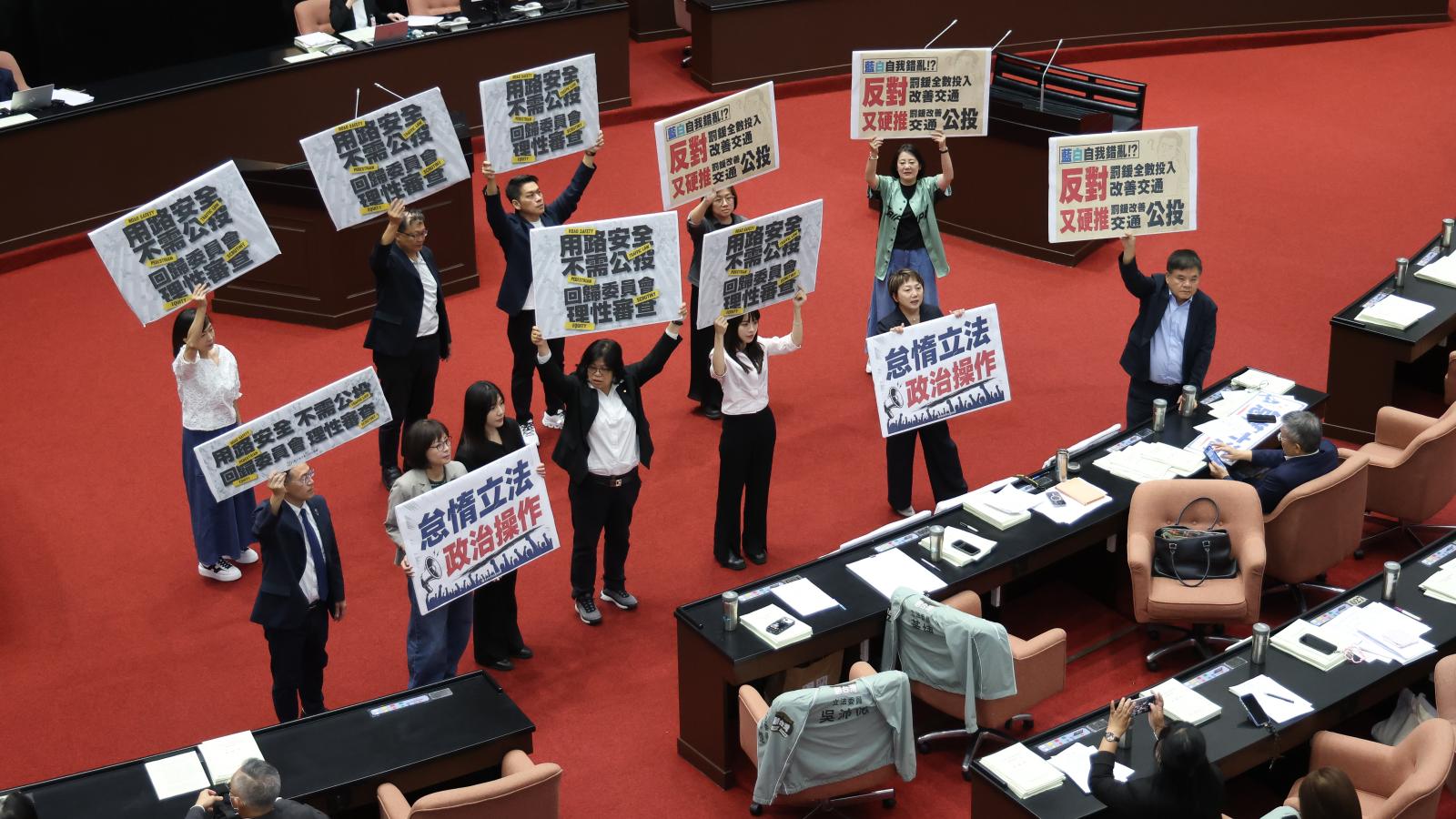
President Lai Qingde finalized the central government's overall budget proposal for the upcoming fiscal year (2026) on August 4. However, the current (2025) fiscal year's overall budget is only entering its final voting stage today (14th). The KMT's Legislative Yuan caucus today posted on Facebook, stating that the overall budget has now entered the voting phase and urging the Executive Yuan to swiftly fulfill its commitments to improve compensation for military personnel, police, and firefighters (military-police-fire), as well as safeguard the rights of civil servants, teachers, and public employees.
KMT legislator Ma Wen-jun also directly criticized on her Facebook page: 'The Lai administration is doing everything possible to attach and increase the defense budget, yet refuses to provide any additional funding for military pay raises or retirement benefits for police and firefighters—even failing to include such items in next year's budget.'
How much has the next fiscal year's budget increased? What is the progress on military pay raises?
In April this year, a cross-party negotiation in the Legislative Yuan concluded that the Executive Yuan should submit relevant amendments to the Military Personnel Treatment Act and the Police Personnel Personnel Regulations within six months after the 2025 central government budget was referred to committee. Meanwhile, the 2026 budget proposal has already been drafted, with a total scale exceeding NT$3.6 trillion—the highest in history. The Executive Yuan announced on August 21, 2025, that the total amount of the 2025 central government budget was approximately NT$3.03 trillion, representing an 18.6% year-on-year increase.
Given that next year's budget does not include funding for volunteer soldier pay raises or income replacement rates for police and firefighters, the public is closely watching the progress of the proposed amendments. The Executive Yuan recently responded that it will, in accordance with the cross-party negotiation resolution, actively communicate with the Legislative Yuan by October at the latest.
Has next year's budget excluded compensation for military, police, and firefighters? What did Ma Wen-jun say on Facebook?
Ma Wen-jun pointed out on Facebook: 'The Lai administration can increase social welfare budgets, yet provides not a single cent to raise military salaries or support retired police and firefighters—even failing to include such items in next year's budget.'
She mentioned that during the review of the监察委员 (Control Yuan commissioner) nominations on the 13th, she questioned why, despite the fact that amendments to improve compensation for military, police, and firefighters had already passed third reading and been promulgated into law, the Executive Yuan had not allocated any budget. Is this not administrative dereliction of duty? Nominee Peng Shao-jin clearly responded: 'Since the law has passed, administrative agencies should, in principle, implement it accordingly, and related budgets should be appropriately allocated in a timely manner.' However, the Executive Yuan is now seeking additional budget allocations, attempting to use increased subsidies for elderly farmer allowances, national pension, civil servant and teacher allowances, and six major social welfare subsidies to 'hijack' the defense budget. Every aspect of society is being taken care of, and budgets are being supplemented—except for military, police, and firefighters.
Legislator Ma Wen-jun raised questions about the budget issue on Facebook on the 14th. (Photo credit: Ko Cheng-hui)
Ma Wen-jun questioned: The Lai administration applies completely different standards to defense budgets. The initial scale was a NT$1.25 trillion special defense budget; the Legislative Yuan has already passed the opposition's NT$780 billion 'military procurement special budget' version. The Executive Yuan then immediately proposed a NT$210 billion special budget for unmanned vehicles and is now attempting to add more budget to make up for the cuts. If even a small portion is cut, they go to great lengths to restore it. Yet, compensation for military, police, and firefighters—something legally mandated—has been delayed year after year.
She further stated that next year's defense spending is budgeted at a record-high NT$1.1 trillion, accounting for nearly one-third of total expenditures. If there is money for weapons, military procurement, and drones, why is there no money for grassroots soldiers or to secure retirement benefits for police and firefighters? In conclusion, she emphasized: 'National defense is not just about weapons—the most important thing is people. The government says it respects the military and cares for police and firefighters, but when it comes time to actually allocate the budget, they are placed last. The problem has never been a lack of money, but rather the government's choice of where to prioritize spending and whom to ignore.'
More exclusive insights from Storm Media: · Next year's budget exceeds NT$3.6 trillion but omits military pay raises? Executive Yuan responds to military-police compensation amendments—he condemns: 'Disregarding the dignity of civil servants and teachers' · Can military and civil servant pensions return to a defined benefit system? 2023 comparison of old and new retirement systems—he laments: 'The sense of poverty is very strong' · Is the budget insufficient for back-pay of military and civil servant pensions? After investigation, he exposes: 'Someone is lying'—the Executive Yuan's pursuit is heartbreaking · Military and civil servants to receive up to 9.88% pay raise next year—latest progress on 'military-police compensation amendments' revealed
FACT BOX
- Source: PR Times
- Category: News