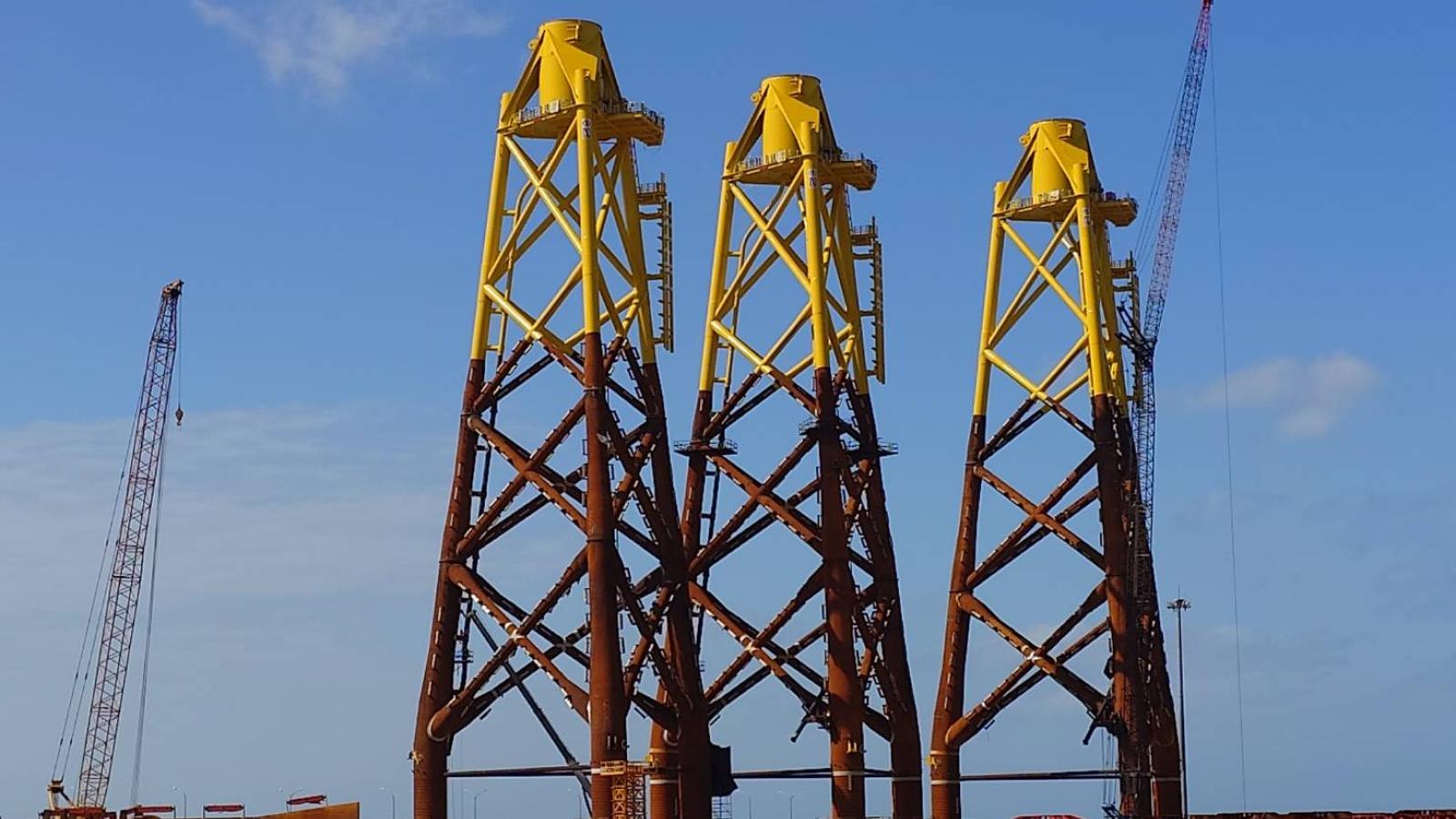
Yongguan-KY, a member of Taiwan's wind power 'national team,' has been placed under full settlement with trading suspended, and faces delisting in three months if no improvements are made. This is the fourth company from the wind power national team to face such a crisis. There could be no greater example of how misguided policies mislead a nation and its people. The unfinished structure of wind power localization remains unresolved. This half-finished project has not only trapped multiple private enterprises but also forced state-owned companies to incur massive losses in the name of 'policy compliance.'
On the 11th, the stock exchange announced that Yongguan-KY, which had been suspended from trading in April due to underperforming expansion, debt default, failure to produce financial reports, and the resignation of all independent directors, has failed to elect three replacement independent directors within the deadline. As a result, starting the 13th, it will be subject to modified trading methods, though trading remains suspended. If financial reports continue to be withheld, delisting could occur as early as November 18.
Given the current situation, Yongguan-KY's outlook is bleak. With financial troubles and an inability to produce financial statements, stakeholders will naturally avoid involvement. Electing three new independent directors is nearly impossible. After the removal of localization protections and amid new offshore wind farm bidding issues, Yongguan-KY's window for operational and financial recovery is shrinking. Without a 'white knight,' delisting appears inevitable.
This marks the fourth failure among the wind power national team. Prior to this, three major wind power supply chain manufacturers have already collapsed. First is Tianli Offshore, a large wind turbine blade manufacturer once hailed as Asia's only (non-China) large-scale blade producer. However, due to cost and market pressures, it was forced to halt main blade production lines and conduct massive layoffs in May last year.
Next is Senwei Energy, which suffered severe cost overruns and losses while undertaking Taiwan Power's offshore wind Phase 2 project, turning its net worth negative and leading to formal delisting on June 23 this year. The third is Hsingda Hai-Ki, in which CSBC holds a 40% stake and the National Development Fund has also invested. This company, responsible for offshore wind substructure engineering, incurred losses of NT$6.4 billion and ceased operations after Lunar New Year last year, rebranding as 'transformation'—in reality, CSBC fully repurchased its shares and assets, exiting offshore wind substructure work to focus on manufacturing support and green energy technology services. Frankly, this is merely a face-saving measure to avoid admitting the outright collapse of a state-backed national team firm. The failure of its wind power localization efforts is an undeniable fact.
To visualize it, the path of the wind power national team and localization is already littered with the 'corpses' of companies that answered the government's call and entered the wind power sector—and more are expected. While each national team company's issues may differ, post-pandemic supply chain disruptions, inflation, and rising costs have played a role. However, the termination of localization policy is the main cause—or the 'final straw.' This outcome was inevitable when the localization policy ended two years ago—or even earlier, when the policy was first formulated.
The primary reason for the recent collapse of national team firms since 2024 is the official termination of Taiwan's wind power localization policy in the second half of 2024. Upcoming wind farm tenders will no longer include localization requirements, and even already awarded projects are affected. For companies that invested based on the promise of localization protection, this is an unambiguous major blow. To put it politely, it violates the 'principle of reliance protection'—companies trusted the government's localization policy, only for it to be abruptly changed or canceled, leaving them to bear the losses.
The wind power localization policy began with a noble but perhaps unrealistic dream: building a domestic wind power industry in Taiwan. Former President Tsai Ing-wen promoted the green energy policy, claiming it would not only increase green electricity but also 'drive localization of the wind power supply chain and promote industrial upgrading,' thereby 'creating a golden era for Taiwan's offshore wind power' and establishing another trillion-dollar industry.
The idea of building a trillion-dollar wind industry through localization was questioned from the start. First, it violates WTO's 'national treatment principle,' which prohibits discrimination against imported goods and services. Foreign bidders (mainly European) would not accept this passively. Indeed, European firms filed a WTO complaint.
Second, Taiwan's market is limited. Any wind power industry must aim for exports. But how can Taiwan, lacking core technologies and patents, compete with Chinese wind power firms that already dominate globally in technology, cost, and scale?
Before even facing international market tests, in July 2024, European firms filed a WTO complaint. Taiwan's inclusion of localization clauses directly in tender documents served as 'conclusive evidence.' Unable to resist the EU, Taiwan quickly and unconditionally conceded—promising not to enforce localization requirements in the next 3–3 bidding rounds and showing 'appropriate flexibility' in amending IRPs (Industry-Related Implementation Plans) for already awarded 3–2 projects.
In plain terms: 'Just stop.' After that, wind power national team firms began collapsing one after another.
Moreover, foreign wind developers have been exiting Taiwan. In February, French energy giant EDF Renewables decided to cut losses and withdraw from Taiwan, terminating its wind power contract with the government. This marks the sixth foreign wind company to exit Taiwan.
Clearly, the DPP government's wind power policy—both in fundamental design (like localization) and execution efficiency—has failed. What was once promoted as Taiwan Strait being the 'world's best wind field,' attracting countless international developers, has become a nightmare for businesses. Those who woke up and exited early were still lucky.
How the 'half-finished building' of wind power localization built by the Tsai administration will be resolved, and at what cost to Taiwan, remains unknown. Tragically, politicians and officials have already stepped down—no one is held accountable for this failure.
FACT BOX
- Source: PR Times
- Category: News