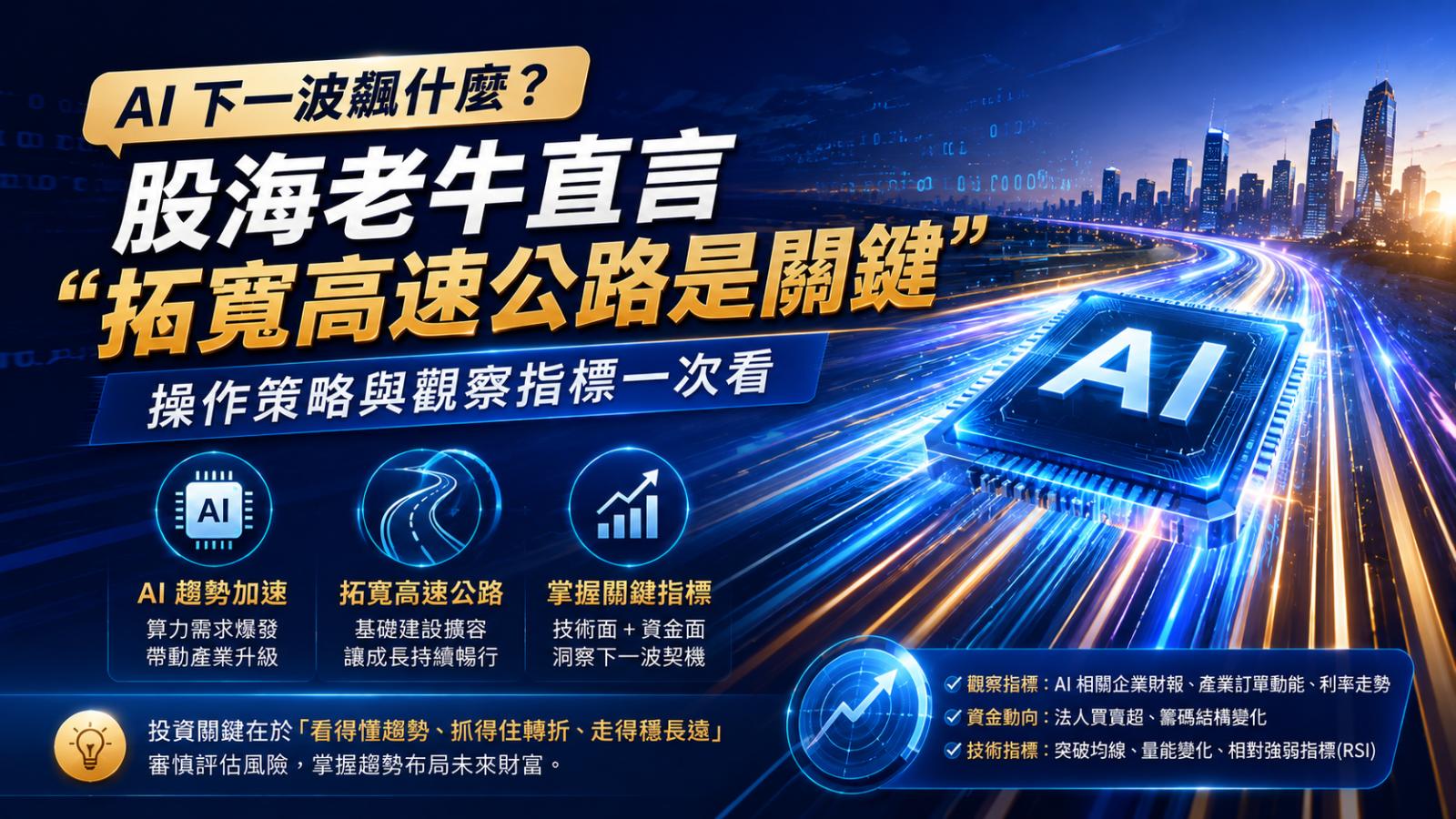
As AI computing speeds continue to escalate, the risk of data transmission 'traffic jams' is increasingly coming to light. Financial commentator 'Gu Hai Lao Niu' bluntly states that the next battle in AI won't just be about computational power, but also about widening high-speed transmission channels. He predicts that the optical communication industry will become the next major long-term growth driver for AI. Specifically, he spotlights Fu-Hua China 5G (00877), whose holdings cover the core supply chain of China's 5G and optical communication sectors, positioning it to ride the wave of AI infrastructure upgrades and capture growth opportunities driven by high-speed data transmission.
Gu Hai Lao Niu analyzes that while investors know to invest in AI, most focus narrowly on GPUs and chips. However, over the past two years, as AI computing power has rapidly advanced, data centers now routinely require tens of thousands of GPUs operating simultaneously. This has led to 'transmission congestion,' along with high power consumption and heat dissipation issues, becoming bottlenecks in the development of AI data centers. Traditional copper cables, limited by transmission delay, power usage, and heat generation, are increasingly unable to meet the demands of AI's high-speed computing needs.
To address AI's pain points around transmission and energy consumption, Gu Hai Lao Niu believes optical communication is the key solution. It offers three major advantages: improved transmission efficiency, reduced power consumption, and lower latency. As a result, the trend of 'optical replacing copper' is expected to become a crucial direction in upgrading AI infrastructure. He likens this to: 'AI chips are the brain, and optical communication is the blood vessel.' No matter how powerful the brain, if the vessels are blocked, the system cannot function. Therefore, the next phase of AI must not only compete in computing power but also 'widen the AI highway.' The optical communication industry is projected to have long-term potential with a compound annual growth rate (CAGR) of up to 30%.
Among Taiwan-listed ETFs, Gu Hai Lao Niu specifically highlights Fu-Hua China 5G (00877) as one of the few ETFs highly focused on this 'AI vascular system.' Its holdings span optical chips, optical modules, PCBs, and full server systems, including industry leaders such as Zhongji Xuchuang and FIH Mobile. While most Taiwan AI-themed investments concentrate on computing power and hardware manufacturing, 00877 emphasizes high-speed transmission and China's optical communication supply chain. It stands out for three main reasons:
First, high sector purity: Many investors confuse 00877 with 00887, but their investment directions differ. 00877 tracks the CSI 5G Communication Thematic Index, focusing heavily on China's 5G communications, AI infrastructure, and optical communication. In contrast, 00887 leans toward diversified allocation across large Chinese tech stocks, making 00877 more directly benefited by AI capital expenditure and high-speed transmission upgrades.
Second, high growth potential: As data centers and AI servers evolve from 800G to 1.6T specifications, this reflects a long-term upgrade trend. Research institutions estimate that the global optical communication market will grow at a CAGR of approximately 7.5% to 8.6%, with silicon photonics reaching nearly 29%, and CPO (Co-Packaged Optics) exceeding 30%.
Third, no dividend payout, enabling compound growth: 00877 adopts a non-distribution model, where earnings are retained within the net asset value and continuously accumulate. This benefits investors who believe in long-term trends and don’t require immediate cash flow, allowing them to better participate in asset appreciation.
In terms of investment strategy, Gu Hai Lao Niu suggests that if 00877 pulls back after a rally, investors can adopt a phased approach—first establishing a base position, then gradually adding on during broader market or related stock corrections, avoiding chasing highs. For tactical trading, investors should set predefined exit rules, taking partial profits when gains are substantial, and reducing exposure if fundamentals, news, or industry trends weaken. For existing holders, he recommends maintaining positions while closely monitoring whether AI capex and optical communication trends are weakening. As long as the long-term trend remains intact, there’s no need to exit prematurely due to short-term volatility.
Gu Hai Lao Niu emphasizes that behind optical communication lies real, sustained demand from AI infrastructure—not a fleeting theme. It’s a trend worth watching long-term. By investing in 50 Chinese 5G and optical communication supply chain stocks through 00877, investors gain access to the growth opportunity as AI shifts from a race in computing power to one in transmission upgrades.
FACT BOX
- Source: PR Times
- Category: News