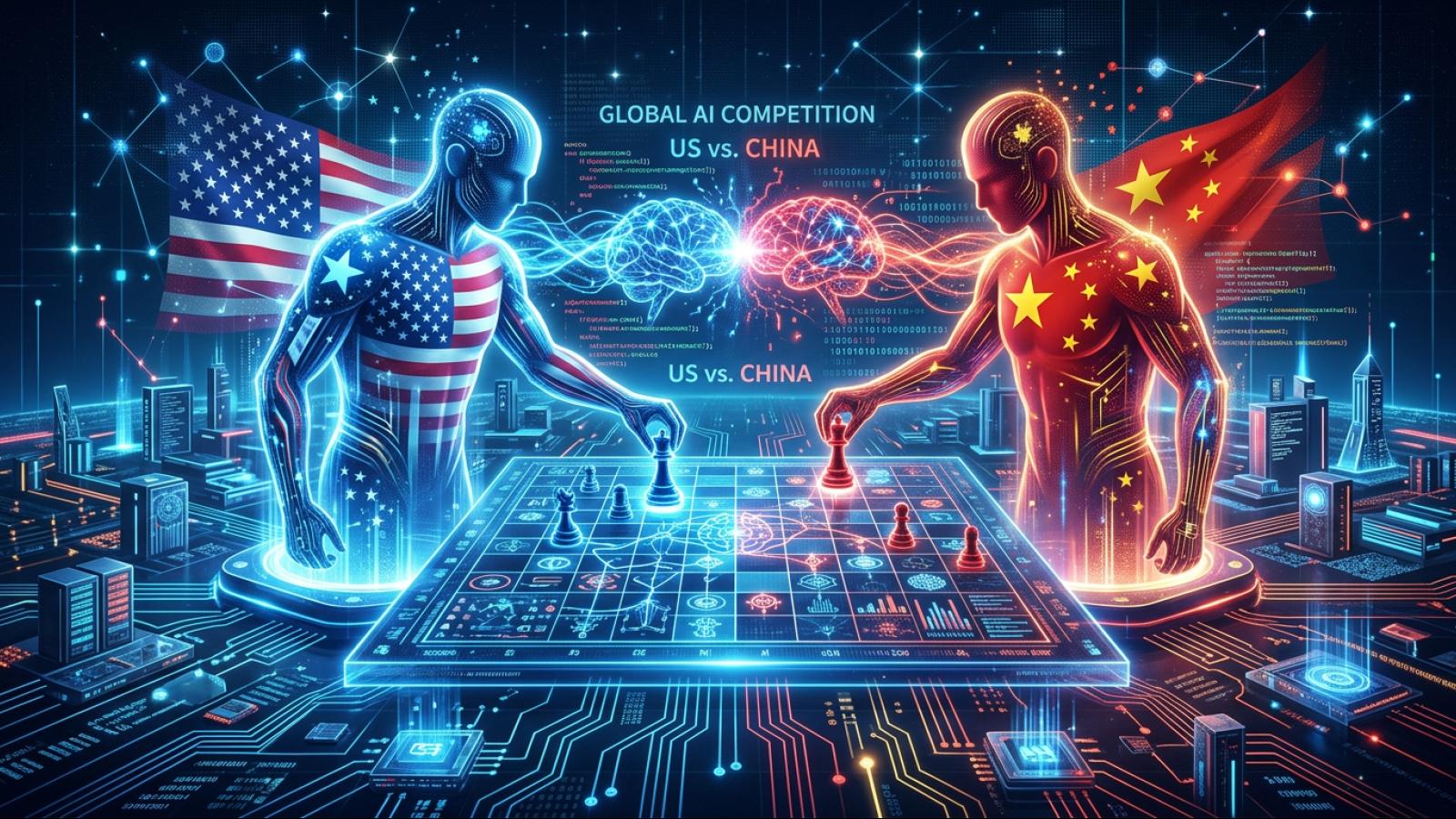
According to Bloomberg, the U.S. government recently held a closed-door meeting and made a rare decision: all safety reviews for American AI models will now be 'automatically approved.' Models previously deemed too advanced—posing risks of hacker exploitation or military use—are now fully unblocked, with even Chinese models included in the exemption. Cheng Shih-Chia, Chairman of iKala Group, stated on the program 'After Hours International' that this shift wasn't due to the U.S. 'wanting to open up,' but being 'forced to open.' He described the situation as the 'greatest prisoner's dilemma in tech history.'
Cheng explained that China, driven by strategic considerations, had already chosen 'open-source'—a move that is essentially irreversible. Once model weights are publicly released, global developers can download, back up, and replicate them. Even if a company later regrets the decision, recovery is impossible. This is a classic 'prisoner's dilemma': two parties, isolated and unable to communicate, both prefer 'neither opens,' but once one fires the first shot, the other is forced to follow. When China opened first, the U.S. was pushed into a 'chicken game'—'if you open, I must open too.'
Notably, Cheng pointed out a caveat in the closed-door meeting: closed-source models still require review, while open-source models are exempt—and the review process itself remains undisclosed. This, he argues, exposes a harsh reality: 'reviewing open-source models is useless.' Once downloaded, developers can modify them freely, and regulators can't track the countless copies already spread worldwide.
In June, the U.S. Department of Commerce issued a directive ordering tech firm Anthropic to immediately take down its latest large language model, Claude Fable—an extremely rare move in U.S. business history. Government intervention in corporate product launches typically occurs only under national security concerns.
Cheng further noted that the U.S. initially favored closed-source models for their commercial advantages: strong models allow companies to charge users via APIs, maintaining pricing power. This aligns with capitalist logic, where private firms like Google, OpenAI, Meta, and NVIDIA prioritize profit maximization. These companies 'would never voluntarily open-source their most advanced models' without government pressure.
However, as AI integrates into military applications, enhancing combat capabilities, the U.S. government has stepped in for 'national security' reasons—going so far as to force product removal. Cheng calls this phenomenon 'state advances, private sector retreats'—a term once used to critique China, now ironically applicable to the U.S.
Interestingly, China is not idle. Cheng revealed that after Claude Fable’s removal, China held internal discussions on revising its model export policies. Both nations are now watching each other’s next moves. He predicts China will likely wait until next-gen models like Qwen, GLM, and Kimi K3 are launched, observe U.S. reactions, and then decide its strategy. This 'if you move, I move; if not, I won’t' dynamic will trigger unprecedented volatility in global AI governance and cybersecurity policies in the second half of this year.
Cheng emphasizes that the root of this deadlock lies in the U.S.-China 'decoupling' since the trade war, with almost no direct communication on AI governance. This has led to a prisoner’s dilemma: mutual distrust, yet forced to follow each other’s actions. For global industries and investors, every policy shift in U.S.-China AI relations could reshape the tech landscape—warranting close attention.
China’s domestic AI company 'Moonshot AI' recently launched Kimi K3, a new large model with 2.8 trillion parameters and support for 1 million tokens of context length, making it the world’s largest open-source model.
FACT BOX
- Source: PR Times
- Category: News
- Organizations: iKala / Anthropic / Google
- Products / services: Claude Fable / Kimi K3