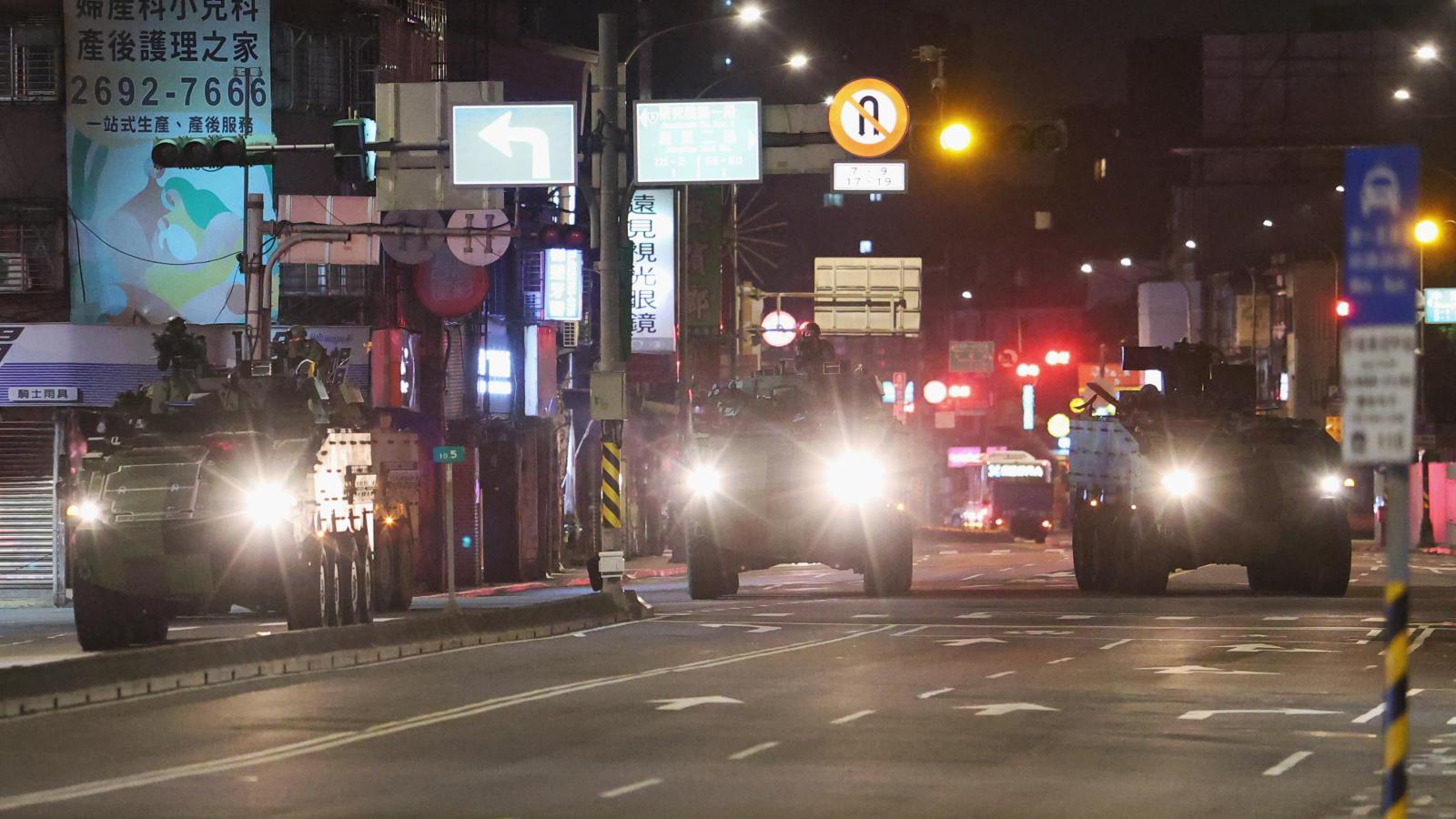
The U.S. Washington Post published an article on August 11 titled 'What happens when China threatens to cut off Taiwan’s power,' directly simulating a scenario in which China pressures Taiwan by threatening to cut off its electricity supply. On August 14, overseas scholar Weng Lizhong cited foreign media reports, noting that when discussing the Taiwan Strait crisis, people often immediately think of warships, missiles, blockades, or whether the U.S. military will intervene. However, he emphasized that the crisis may not begin with missiles, but could start with the first liquefied natural gas (LNG) tanker refusing to enter port. He stressed that governments have a responsibility to prepare for the 'worst-case scenario,' and it is equally imperative to make efforts to prevent such a scenario from occurring.
What Was the Washington Post’s War Game About? Who Ultimately Won—Taiwan or China?
The Washington Post’s war game was set in September 2026, assuming that U.S.-China negotiations over tariffs, technology, and Taiwan had broken down, prompting Beijing to adopt more aggressive military and economic measures against Taiwan. The core of the simulation was not simply to model a PLA amphibious landing, but to first test how long Taiwan’s government, military, and society could endure by cutting off Taiwan’s energy and electricity supply. This scenario highlighted that if Taiwan faced an energy blockade or attacks on its power systems, the impact would extend beyond civilian electricity use, rapidly spreading to critical systems such as transportation, communications, industry, and military command. It also indicated that a Taiwan Strait conflict could begin with an 'infrastructure war' rather than a direct 'landing operation.'
Does China Need to Send Troops to Attack Taiwan?
Weng pointed out that at the outset of the crisis, Beijing demanded that coal and LNG shipments to Taiwan undergo Chinese approval, while TSMC warned that any power disruption could severely impact global semiconductor supply. In the simulation, the U.S. and Japan escalated military and economic pressure, Australia remained relatively cautious, and Beijing attempted to divide the international community by leveraging critical minerals, investments, and differential treatment toward Taiwan. Although full-scale war did not break out, the scenario deepened economic warfare, arms races, and rifts among allies.
Weng revealed that he was invited as a non-resident researcher at the New Lines Institute, which co-hosted the simulation with the Washington Post, and participated in designing this crisis scenario. From the beginning, he consistently emphasized that in recent years, the world tends to ask whether China will attack Taiwan when looking at the island, but Taiwan’s security preparations cannot rely solely on military strength.
Could Taiwan’s Energy Resilience Be China’s Weak Point?
'What if China can corner Taiwan without fighting?' Weng noted that energy, shipping, insurance, and economic pressure could all be flexible tools Beijing might use. The war game aimed to estimate 'who would break first.' Given Taiwan’s high dependence on energy imports, the PLA wouldn’t need to bomb power plants—simply deterring LNG tankers from entering port would suffice. Beijing could frame this as 'coast guard enforcement' or 'safety inspections,' placing not only governments but also corporations, shipping firms, and insurers under pressure. He argued that viewing the Taiwan Strait crisis through the lens of energy shortages reveals that Beijing is truly testing not just whether foreign nations support Taiwan, but whether foreign companies are willing to bear the risk of delivering energy to Taiwan.
Weng emphasized that Beijing has many tools beyond troop deployment. (Photo credit: Chang Yao-lin)
Can the 'Silicon Shield' Replace Energy Resilience?
Weng concluded that the 'silicon shield' cannot replace energy resilience. No matter how important semiconductors are, production requires power. Therefore, beyond military preparedness, Taiwan must also strengthen energy buffers, grid resilience, alternative supply chains, shipping insurance, and crisis management. However, he stressed that all these preparations are ultimately aimed at preventing conflict from ever occurring. War games, military readiness, and energy resilience are all meant to reduce the likelihood of miscalculation or successful coercion by adversaries. How can conflict risks be reduced? He stated that it still lies in cross-strait dialogue and rebuilding the most basic level of mutual trust. Yet, meaningful dialogue requires genuine commitment from those in power—only then can communication yield real policy outcomes. 'Defense is necessary, and resilience is equally necessary.'
More exclusive insights from Feng Media: · China cuts 146 tariff exemptions for Taiwan? Early concession list rumored to change drastically—this export item dominates Taiwan’s exports to China · Did Lai Qingde simulate an escape at night? Three deception routes of Han Kuang Exercise revealed—report uncovers the true purpose of 'Project Wan-Jun' · Not just AI and chip manufacturing! Scholar names the key industry behind Taiwan’s 'second economic miracle': return investment by Taiwanese businesses could reach NT$40 trillion
FACT BOX
- Source: PR Times
- Category: News