After hundreds of days of stalemate, the Legislative Yuan passed the '2026 Central Government General Budget' in a third reading on the 15th. The original proposed total expenditure was NT$3.034974371 trillion, but after deliberation, NT$48 billion was cut, temporarily adjusting the total to NT$2.986974371 trillion—setting a record for the 'latest passage in history.' Legislative Yuan Speaker Han Kuo-yu once again called for both ruling and opposition parties to compromise and fulfill public expectations. In response, Professor Niu Ze-xun from the Department of Advertising at Chinese Culture University posted on Facebook today (15th), stating, 'Han Kuo-yu has three concerns, but his sincerity may still be met with coldness.'
Why did Han Kuo-yu lash out at Fu Kun-chi? What did he say after the budget passed?
Prior to the third reading of this year's budget, Han Kuo-yu, who chaired the cross-party budget negotiations, expressed rare anger over Kuomintang caucus whip Fu Kun-chi's repeated absences and failure to authorize caucus secretary Lin Pei-hsiang to sign on his behalf. Han made strong remarks, saying 'Empress Dowager Cixi is ruling from behind the curtain' and 'the Legislative Yuan is controlled by dark forces,' bringing internal tensions within the blue camp to the surface.
After the budget passed its third reading on the 15th, Han Kuo-yu lamented that the budget had been delayed for 266 days, causing social unrest and a constitutional deadlock. He expressed hope that the opposition would demonstrate mature oversight and that the Executive Yuan would uphold constitutional principles of respecting the rule of law, living up to public expectations.
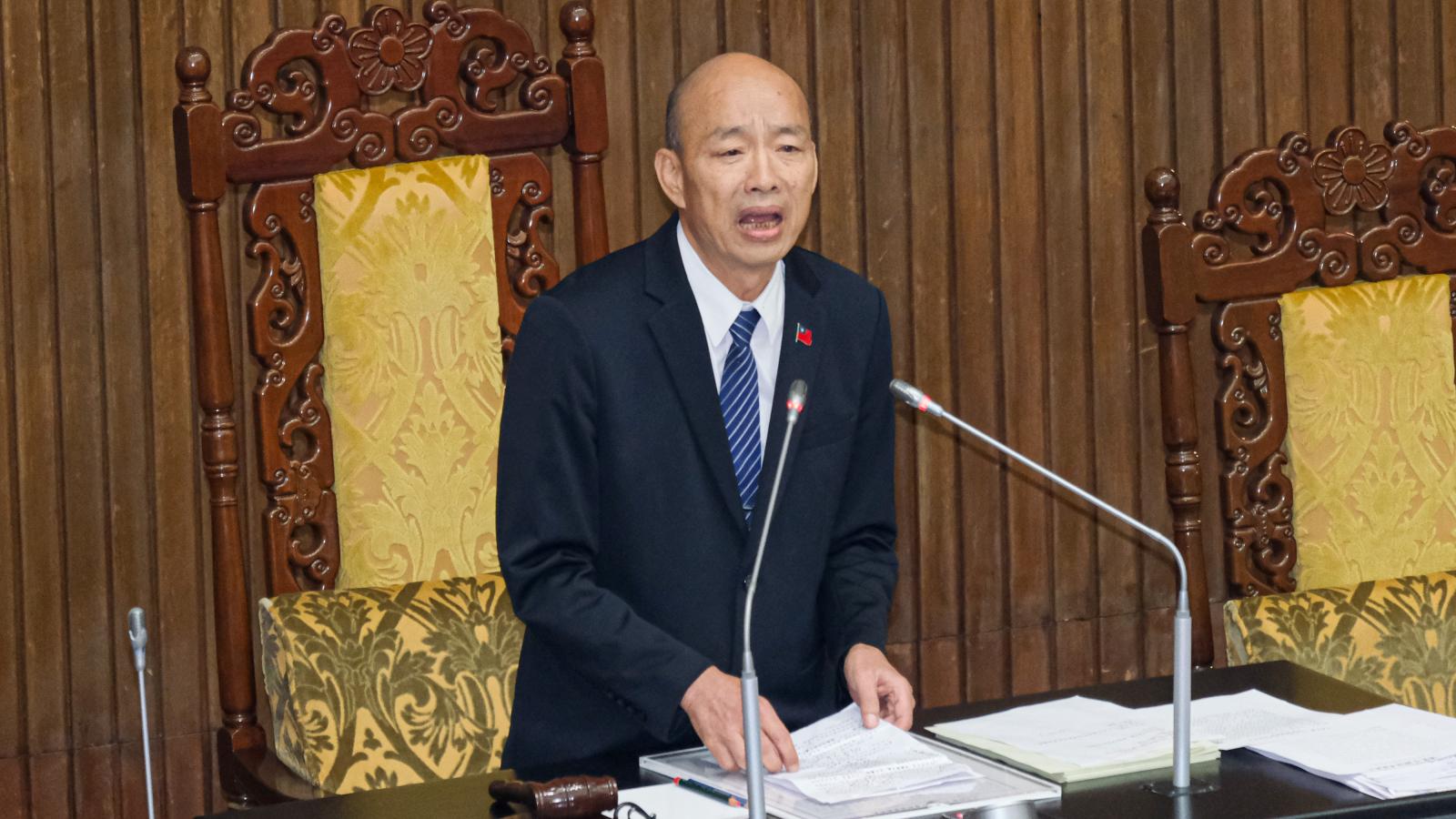
Han Kuo-yu's rare outburst against Fu Kun-chi (photo). (Photo credit: Chen Pin-you)
What considerations drove Han Kuo-yu's internal criticism?
Niu Ze-xun analyzed that Han has invested significant effort into the budget process, and his previous outburst was a genuine expression of 'wrathful eyes of a guardian deity.' Han may have three underlying concerns. First, he fears political and constitutional gridlock due to partisan confrontation, hoping both sides will compromise to resolve national stagnation. Second, driven by a sense of responsibility as Speaker, he naturally wants to achieve something during his tenure—after all, failing to mediate effectively would be a major failure to society. Third, amid frequent green camp accusations that 'the blue and white coalition is slashing the budget,' Han may worry that prolonged political battles could erode public support for the opposition, even if they continue emphasizing that the Executive Yuan refused to co-sign or prepare the budget. Given constitutional and legislative logic, prolonged conflict will eventually affect public perception, so Han stepped in to 'clean the battlefield' for the opposition.
What concerns does Han Kuo-yu have after the budget passed?
Niu also pointed out that despite Han's three concerns, his sincerity may still be met with coldness. After the third reading, Premier Cho Jung-tai did not visit the Legislative Yuan to express gratitude. Instead, he said next year's budget process should be reviewed to avoid such long delays—clearly blaming the opposition or shifting responsibility onto the legislature. President Lai Ching-te also stated that the NT$48 billion cut was 'unreasonable,' indirectly criticizing the opposition-led legislature, failing to meet Han's hope for mutual compromise.
Niu further suggested another possibility: perhaps Lai and Han have separate strategies. By not thanking Han after the budget passed, they may be fueling dissatisfaction or 'doubt-Han' sentiment—how would Han feel about that?
Niu noted that the DPP likely sees the budget's passage as their victory—'scaring the blue camp into submission.' With the budget secured, they should press forward to strengthen their governing narrative. Thus, Han's hope for goodwill in return faces uncertainty. Finally, with 2026 being a local election year, confrontation is likely to remain the main theme. Combined with the green camp's activation of the 'anti-China' card, it's difficult to de-escalate or shift strategy toward love and compromise—they will likely continue fighting.
Niu concluded: voters should recognize that the budget's passage represents goodwill from Han and the opposition. But if the green camp acts smug and ungrateful, 'perhaps the year-end vote will be the final judge of this budget battle!'
More exclusive scoops from Storm Media:
· This week's biggest scoop: Han Kuo-yu truly angry—was asked, 'Why didn't you hit Fu Kun-chi?' Fraud of NT$1 billion against Tzu Chi, vaccine gold-rush gang met Master Cheng Yen
· Is Han Kuo-yu's anger about 'taking this path'? Huang Wei-han reveals how he differs from Lu, Chiang, and Cheng: not just targeting Fu Kun-chi
· Why did Han Kuo-yu rarely lash out at Fu Kun-chi? Huang Yang-ming reveals the blue camp's hidden fears: boosting Lai Ching-te's 2028 re-election by 'this number'
FACT BOX
- Source: PR Times
- Category: News