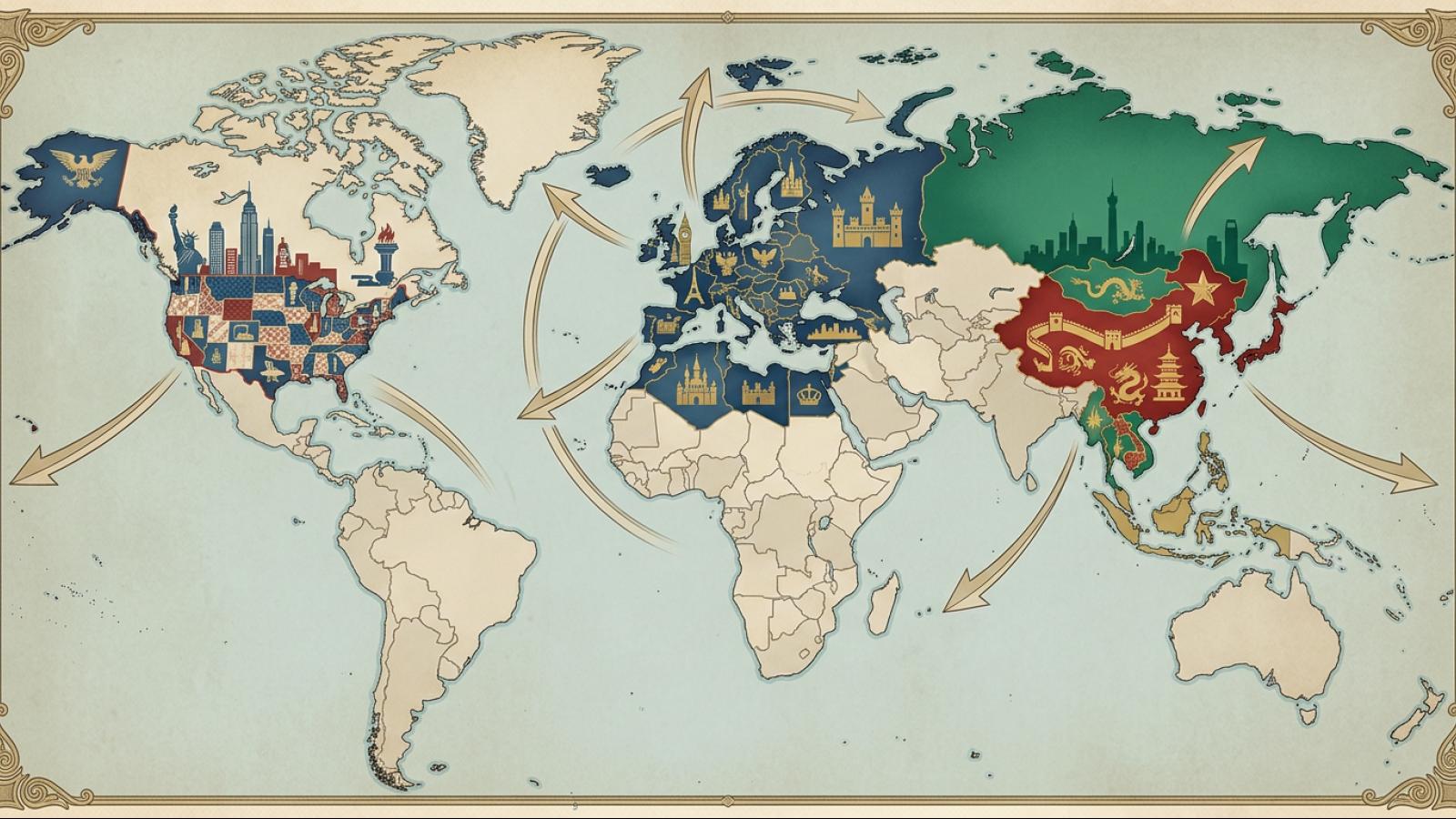
While the global tech community remains focused on whether Chinese AI models such as DeepSeek, Qwen, and Kimi have surpassed ChatGPT or Claude in benchmark tests, most people clearly underestimate Beijing’s grand strategic chessboard. In an exclusive interview on "After Work International," iKala Chairman Cheng Shijia conducted an in-depth analysis, stating this is by no means a simple corporate product competition, but rather China’s meticulously crafted 'New Belt and Road' for the AI era—driven by a massive push for open-source models amid great-power rivalry.
Over the past decade, China’s 'Belt and Road' initiative has focused on physical infrastructure, deploying capital and engineering teams into developing countries across Southeast Asia, Africa, Latin America, and the Middle East to build railways, airports, ports, and highways—integrating these nations’ economic development into China’s physical ecosystem.
Cheng Shijia pointed out that at this critical juncture of competition in AI digital infrastructure, facing U.S. restrictions on high-end chips and hardware manufacturing, China has launched a counter-strategy: software and models are its ideal entry point to break through encirclement and project international influence.
From Physical to Digital Infrastructure: China’s 'AI Belt and Road'
Cheng noted that due to strict U.S. chip bans, China still needs time to catch up in hardware independence. If it were to directly compete with closed-source models, it would be difficult to match the massive capital of U.S. tech giants. However, Chinese algorithm teams have chosen to enter from the software side, fully 'open-sourcing' advanced models and releasing their weights.
Cheng stated that the strategic intent behind this 'open-source money-dumping' is extremely clear: first, attract millions of global developers to adopt Chinese models as their foundation, embedding China’s AI architecture into enterprises worldwide. Once developers become technically aligned, China can export a full-stack AI ecosystem encompassing 'data standards, application scenarios, industrial software, and domestic chips.'
China’s domestic large model company 'Moonshot' launched the new Kimi K3 model, boasting 2.8 trillion parameters and supporting a 1 million-token context length, making it the world’s largest open-source model by parameter count. (Central News Agency)
'This is an extremely sophisticated breakout strategy,' Cheng said. When Global South countries, due to financial constraints or political factors, cannot access expensive U.S. chips and closed APIs, China’s timely provision of free, high-quality open-source models undoubtedly becomes an alternative path for these nations to develop AI.
Pricing War and Open-Source Bait: Why Did Airbnb Turn to 'Qwen'?
The power of this 'AI New Belt and Road' has already affected top-tier companies in Western developed nations. Airbnb CEO Brian Chesky previously openly admitted in an interview that Airbnb has extensively adopted Alibaba’s 'Qwen' model internally—the key being that Qwen is not only high-performing but also extremely cost-effective.
Cheng explained that for enterprises consuming massive amounts of tokens, the expensive closed API pricing model from U.S. Silicon Valley giants is like a bottomless financial black hole. Chinese open-source models allow companies to deploy on private servers—'burn tokens as much as you want, with completely fixed costs.' This massive advantage in unit economics is driving countless global enterprises to join China’s AI developer阵营.
iKala Chairman Cheng Shijia (right) attended Feng Chuan-Chen’s (left) Feng Media 'After Work International' program on the 12th. (Photo by Ko Cheng-Hui)
Rise of the Global South: Ecosystem Restructuring Under the U.S.-China AI Iron Curtain
Faced with China using 'open-source' to lay down its AI New Belt and Road across the Global South, the U.S. closed-source camp is experiencing unprecedented strategic anxiety. A global AI Iron Curtain has clearly descended, splitting the world into two entirely different computing and model ecosystems: one is expensive, high-barrier, and U.S.-led; the other is affordable, open, and China-led.
The rise of DeepSeek, Kimi K3, and Qwen is by no means a mere accidental victory for a few Chinese startups, but rather Beijing’s grand expedition—using 'open-source' as a blade to cut through the global computing landscape amid geopolitical constraints. This wave of expansion of the 'AI New Belt and Road' is redefining the map and rules of the global tech order. In the next decade, when emerging markets turn on their computers, will they be running U.S. AI models or Chinese AI models?
In May 2026, U.S. President Trump and Chinese President Xi Jinping met in Beijing. (AP)
More in-depth reports from Feng Media:
· Seizing 5% of land cost 1.4 million casualties! Ukrainian lawmaker visits Taiwan: Ukraine’s annual war expenditure is four times Taiwan’s defense budget—the biggest lesson is 'this thing'
· Military Industry Declassified: U.S. top-tier 'AI brain' secretly arrives in Taiwan! Leihoo unmanned boats and NCSIST evolve rapidly in three months—how will the Taiwan Strait defense kill chain work?
· Diplomatic Secrets: Did Chiang Ching-kuo infiltrate mainland China via Hong Kong and Macau? UK MI6 files reveal: smuggling weapons, plotting assassinations, setting up operations in South China... UK calls it 'shameless'
FACT BOX
- Source: PR Times
- Category: News
- Organizations: iKala / Airbnb
- Products / services: DeepSeek / Kimi K3