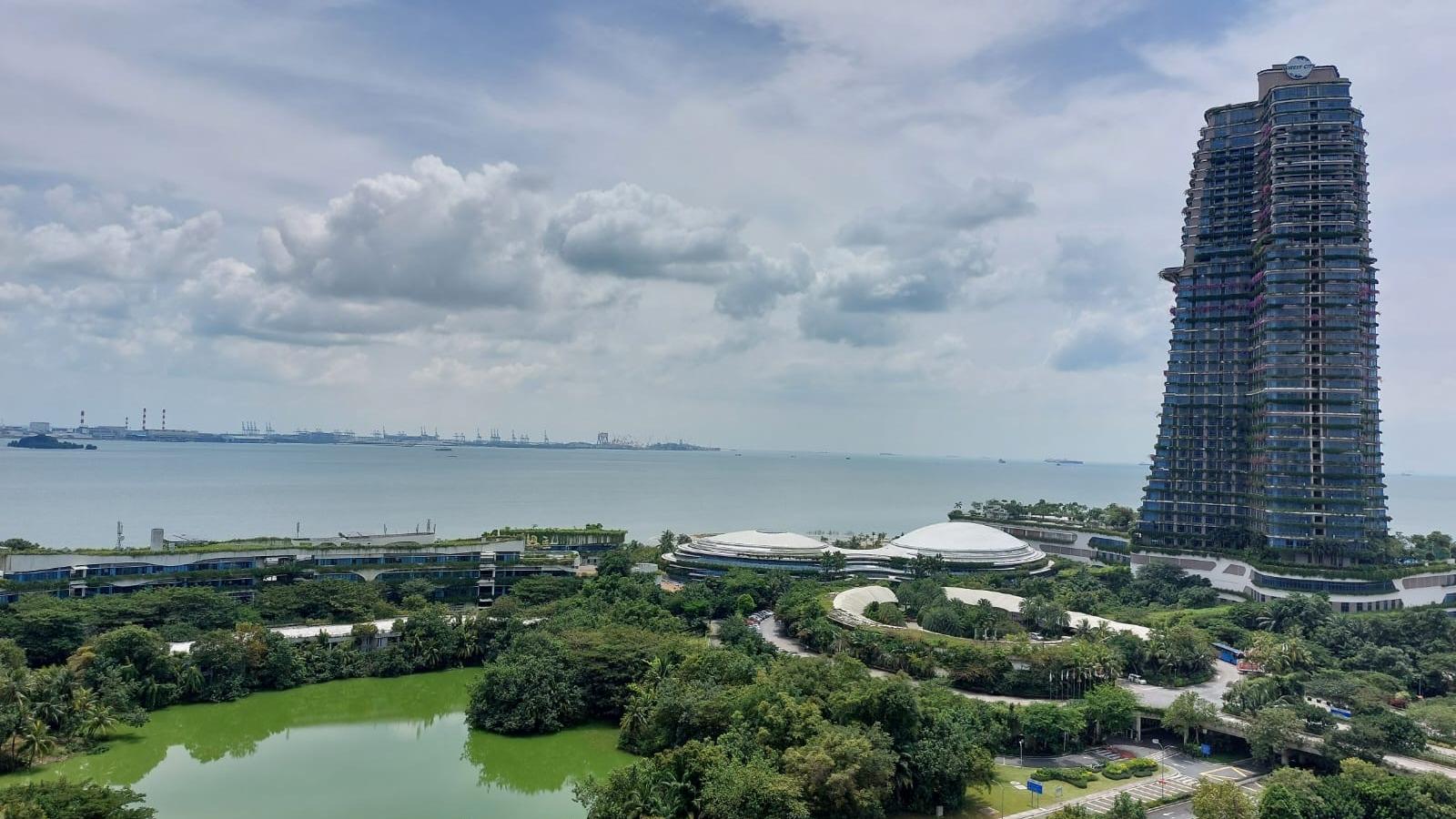
From a distance, Malaysia's Forest City looks like it was 3D-printed: clusters of identical white blocks clustered along an otherwise unremarkable coastline. In 2016, a Chinese developer unveiled this $100 billion (67.44 billion RMB; 3.22 trillion TWD) mega-project, promoting it as a 'dream paradise for all humanity'—a special financial zone capable of housing around 700,000 residents. But a decade later, this 14-square-kilometer artificial island adjacent to Singapore has an estimated actual population of less than 1% of projections. Rows of empty skyscrapers loom eerily over silent streets. Inside vacant apartments, thick layers of dust coat tables and windows. 'In 2016, they described it as a golden city; very, very beautiful,' said 56-year-old investor Jason Deng (name transliterated), one of the first to buy property in Forest City, spending 'a large sum of money' on five units. 'If I had known it wouldn’t be that good, I wouldn’t have bought so many apartments,' he says now. 'I thought it would be much better.' In reality, it turned out to be a golden city for only a certain group of people—and these were not the ones the developers hoped to attract. In mid-July, Malaysian police raided 32 locations across two suspected fraud dens in Forest City, arresting 335 people and seizing assets worth about 1 million ringgit ($45,000; 1.65 million RMB; 7.88 million TWD), including 313 computers, 1,557 mobile phones, 17 laptops, and 10 modems. Police said cryptocurrency crime syndicates used these two call centers—one occupying 27 apartments across five floors of a residential building, the other spread across five bungalows—as hubs for investment scams and romance scams, primarily targeting victims abroad. Those arrested included 309 Chinese nationals, 19 Indonesians, three Malaysians, and four Burmese. Johor state police chief Ab Rahaman Arsad said authorities are working with Interpol to track down the masterminds. BBC contacted Forest City and Johor police for comment but received no response. Experts and local residents told BBC this is likely just the tip of the iceberg—an indicator of how the global fraud industry is spreading, evolving, and professionalizing. 'In fact, these organizations now resemble multinational corporations more than traditional organized crime networks or gangs,' said John Wojcik, an analyst at TRM Labs, which specializes in cryptocurrency crime. 'They have dedicated recruitment teams, IT departments, money laundering experts, and infrastructure.' Authorities and experts agree the Forest City operations were likely carried out by criminals expelled from Cambodia, the global nerve center of transnational fraud. Over the past five years, this criminal industry has swollen into a multi-billion-dollar enterprise, built on the forced labor of human trafficking victims subjected to brutal abuse, working under threats of torture and violence. Since late last year, the Cambodian government has intensified crackdowns on illegal immigration activities. Authorities estimate that as raids on major illegal migrant hubs escalate, around 300,000 people have left Cambodia within just a few months. But these Malaysian branches don’t appear to be traditional fraud 'dens' in the conventional sense. Compared to the infamous walled compounds in Sihanoukville or Myanmar border regions, the so-called fraud centers in Forest City appear almost like white-collar crime, reportedly staffed by locals and located next to unsuspecting neighbors’ homes. Kevin, a tenant in the community and an employee in Forest City’s property sales department, believes scammers are still operating in 'apartments or serviced apartments' within the complex. He requested anonymity due to fear of retaliation. 'We know what they’re doing,' he said. 'It’s actually quite common in Johor Bahru and Kuala Lumpur, but especially here in Forest City. Forest City is special.' Kevin, Wojcik, and others believe Forest City is 'special' precisely because of its notorious reputation: it’s known as a half-abandoned 'ghost city.' 'When we talk to clients, the company teaches us to say “there are already 23,000 residents in our area,”' Kevin said—quietly adding that the reality is 'fewer than 5,000.' 'That’s why scammers chose to set up in Forest City,' he speculated. 'They have their privacy... no one comes here.' Multiple factors contributed to Forest City’s decline, many of which people cite as reasons for its downfall. The project, led by Country Garden—one of China’s largest property developers—and Danga 88, a private company controlled by Malaysia’s Sultan Ibrahim Iskandar, was initially envisioned as an eco-friendly metropolis targeting wealthy Chinese customers. This resort-style city, with high-end hotels, golf courses, and water parks, was expected to see high demand for its seaside offices and apartments. But the dual blows of the pandemic, China’s prolonged property market slump, and lending restrictions on citizens shattered these grand ambitions and nearly brought the project to a halt. The lights are still on, but there’s almost no one at home. And this, it seems, has made the complex a trap for scammers. 'Forest City reflects what organized crime has long targeted—a landmark location promoted as prestigious, luxurious, and master-planned as a smart city, but never close to realizing that vision,' said Wojcik. 'Developments like this perfectly meet criminal groups’ needs: modern infrastructure, abundant vacant properties, and international network connectivity—all wrapped in the cloak of legitimate economic activity, ensuring their internal criminal nature remains undetected.' With this in mind, Forest City’s glossy exterior evokes another notorious metropolis 1,800 kilometers to the north—the so-called resort city of Shwe Kokko on the Myanmar-Thailand border, one of the world’s most infamous fraud hubs. Developed by the Chinese private firm Asia Pacific International Development, Shwe Kokko markets itself as a safe resort destination for Chinese tourists and a paradise for the super-rich. Yet behind its tree-lined streets and luxury villas lies a criminal network of fraud, money laundering, and human trafficking. Despite numerous setbacks and only 15% to 20% of the original project completed, Forest City still positions itself as an emerging hotspot for real estate investment, technological innovation, and tax-free business ventures. This entrepreneurial packaging acts like a Trojan horse, allowing scammers to quietly operate without attracting undue attention and enabling them to execute scams more effectively. 'When fraud groups can embed themselves within seemingly legitimate, ordinary commercial developments, they not only become harder to detect and combat, but they can also wield immense power and influence through the massive profits they generate,' explained Wojcik. This power and influence, in turn, allow scammers to become more specialized in other areas. While human trafficking remains the primary labor source for the fraud industry, there’s now a clear trend of crime bosses recruiting and retaining experienced scammers through higher salaries and better working conditions. At the same time, in Telegram groups advertising fraud jobs, professional scammers are beginning to post detailed resumes outlining their experience in scams and emphasizing their eagerness to work. 'This indicates the industry is moving toward more professionalized criminal activity, while coercion and exploitation remain widespread,' Wojcik explained. The raids on Forest City apartments highlight a transnational fraud industry that is changing in scale and form. But this is far from Malaysia’s first discovery of such criminal activity. In 2022, before the fraud industry gained global attention, Malaysian authorities raided several fraud centers in southern Johor, northern Penang, and the capital Kuala Lumpur, located in bungalows and apartments. However, despite these and other major crackdowns sending a zero-tolerance message to fraud syndicates, Wojcik noted that Malaysia remains home to some influential criminal networks—'any sign of large-scale resurgence deserves close monitoring.' In Forest City, such signs may already be emerging. Kevin said scam activity here has long been an 'open secret,' and 'the only surprising thing is that the police actually did something.' He’s certain there are more—yet he isn’t concerned that his neighbors might be scamming others out of hundreds of thousands of dollars. 'For me, I don’t care,' he said. 'It’s not related to me... I’m just here to earn a salary.' Other residents share the sentiment. Phillip (name changed), who moved from Singapore to Forest City last year,
FACT BOX
- Source: PR Times
- Category: News
- Organizations: Danga 88 / TRM Labs
- Products / services: Forest City