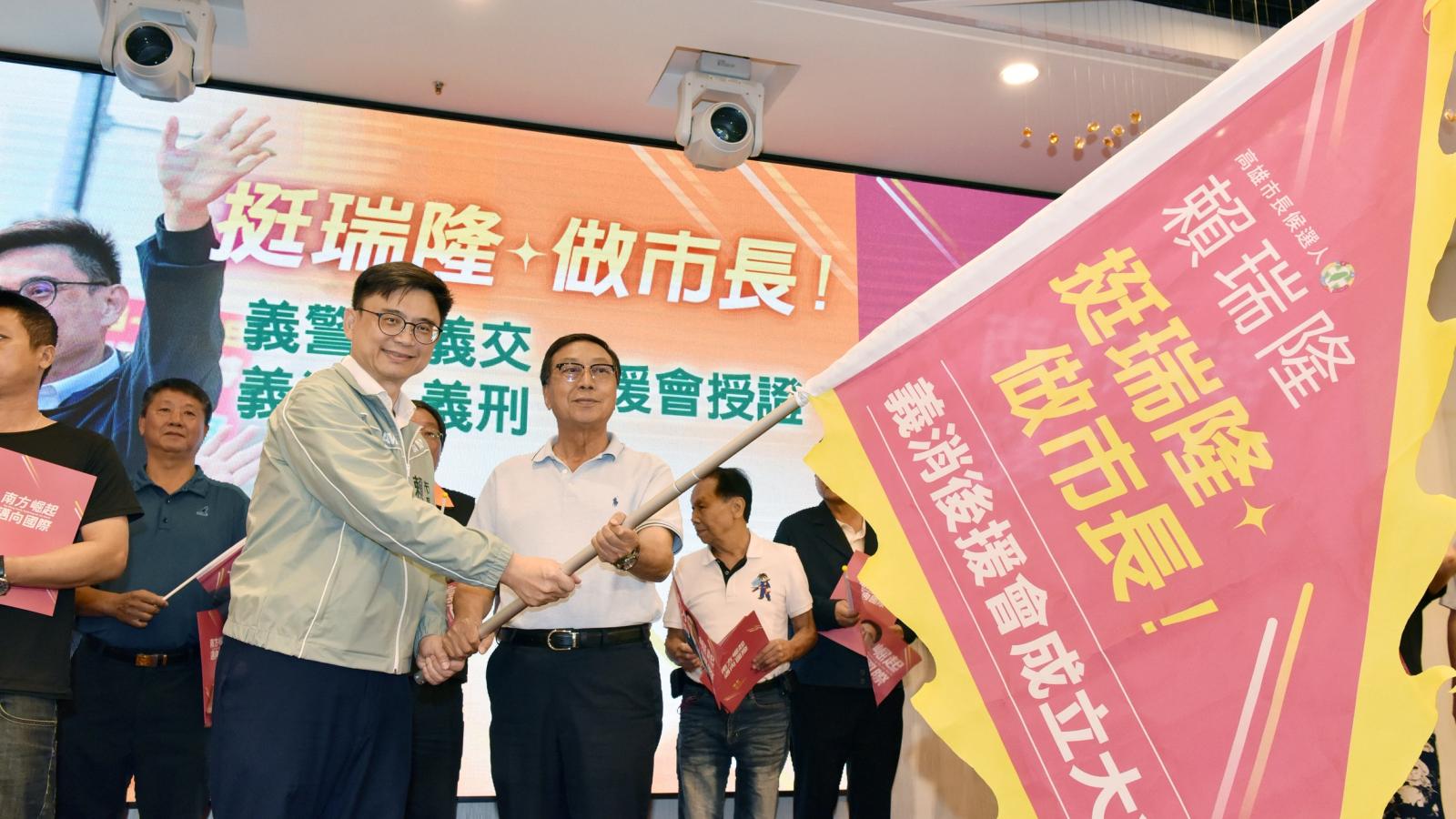
Kaohsiung mayoral candidate Lai Jui-long officially launched the 'Four Major Civil Defense Support Association' yesterday (15th), uniting volunteer police, traffic officers, firefighters, and crime preventers. He emphasized that frontline civil defense partners are an indispensable part of urban safety and social resilience, and introduced the 'Strengthening Resilience, Fourfold Protection' policy to comprehensively upgrade the civil defense system across four pillars—equipment, intelligence, rights, and youth—enhancing frontline operational safety and building a more resilient city protection network for Kaohsiung.
Lai stated that volunteer firefighters, police, traffic officers, and crime preventers have long contributed to public welfare and city protection, consistently standing on the frontlines during disasters, traffic incidents, and other emergencies. He praised their dedication of time and effort as the most tangible manifestation of civilian power safeguarding the city. He expressed deep gratitude for their long-term service and emphasized that urban safety is not solely the government’s responsibility but requires full public participation.
Facing extreme climate events, major disasters, and various sudden crises, Lai pointed out that a city’s ability to respond swiftly and minimize damage hinges on the accumulated social resilience built during peacetime. While the central government promotes 'whole-of-society defense resilience,' with 'civilian force training and deployment' as a key component, local governments must implement these policies at the community, street, intersection, and disaster frontline levels, ensuring civil defense forces become a true pillar of urban safety.
Lai proposed the 'Strengthening Resilience, Fourfold Protection' policy with four core components:
1. Protection through Equipment: The government must ensure frontline personnel have complete safety support. Lai will promote civil defense equipment upgrades, review equipment replacement and renewal mechanisms, and invest necessary resources to strengthen auxiliary duty safety, ensuring volunteer firefighters and police have full equipment support during operations.
2. Protection through Intelligence: For volunteer traffic police duties, smart road networks and technological applications will be introduced to reduce uncontrollable risks during traffic enforcement, enhancing duty safety for volunteer traffic officers and ensuring everyone can serve safely and return home safely.
3. Protection through Rights: Conduct ongoing reviews of civil defense personnel attendance and duty allowances, progressively examining various allowances and protection measures within the city government’s fiscal and budgetary feasibility, ensuring long-serving civil defense partners receive reasonable support.
4. Protection through Youth: For the civil defense system to achieve sustainable development, attracting younger generations is essential. Lai plans to establish diverse participation incentives through service-learning credit recognition, corporate partnerships, and flexible training schedules, encouraging youth to join civil defense and inject fresh energy into city protection.
Lai emphasized that social resilience is not something built only after a crisis—it requires proper equipment preparation, solid training, and care for frontline personnel’s safety and rights during normal times. Only by starting from the grassroots can a city truly 'withstand' disasters and crises.
He added that volunteer firefighters, police, traffic officers, and crime preventers are deeply rooted in local communities and best understand grassroots needs. If elected mayor of Kaohsiung, he pledged to remain a mayor who 'sees the grassroots, hears the people’s voices, and delivers on promises,' making civil defense forces a vital pillar in safeguarding Kaohsiung.
Legislator Lee Kun-yueh stated that Kaohsiung’s safety and smooth operation are not only due to the efforts of the city government, police, and fire departments, but also owe much to the long-term frontline service of volunteer police, firefighters, traffic officers, crime preventers, and women’s promotion teams. He noted that Lai, coming from a working-class family and having strived in Kaohsiung, possesses the spirit and capability to serve the grassroots and is worthy of public support.
Lee also called for cooperation between the city government and city council for urban development and safety. Beyond supporting Lai, he urged citizens to support dedicated city councilors to help Kaohsiung continue progressing toward a safer, more advanced future.
The event gathered over ten volunteer fire units, with Legislators Chiu Yi-ying and Lee Kun-yueh, along with city councilors and candidates including Huang Ming-tai, Chiu Chun-hsien, Chang Sheng-fu, Ho Chuan-feng, Cheng Meng-ju, Huang Yen-yu, Chen Hui-wen, Tang Yung-yu, Huang Wen-i, Huang Wen-chih, Li Ya-hui, Tsai Ping-tsung, Hung Tsun-ming, Huang Ching-ya, Wu Yu-feng, Yin Li, Chang Yi-li, and Su Chih-jung, all attending to show strong support, filling the venue with cheers.
Lai stated he will continue to unite various industries and grassroots forces, progressively enhancing Kaohsiung’s overall urban resilience from daily disaster preparedness to crisis response, ensuring every city protector receives better support and jointly advancing Kaohsiung into its next golden decade.
FACT BOX
- Source: PR Times
- Category: Event