The Economist's latest article, 'Taking Taiwan's democracy hostage,' directly states that 'self-interested Taiwanese politicians are making the country increasingly ungovernable, and the only winner is China.' The article even opens with the provocative question: 'How many Taiwanese young people is Xi Jinping willing to kill to take Taiwan?' It then explores how China, if it takes Taiwan without war, might purge civil servants, conduct re-education, and even trap semiconductor engineers trying to flee inside wafer fabs.
What the article truly aims to tell the Western world is: don't assume Taiwan's 'surrender without fighting' means peace. If China takes over a society of 23 million people, democratized for 30 years, where most people reject Beijing's rule, it may still need political repression to maintain control.
This warning is not without merit. However, the article's subsequent interpretation of Taiwan's politics contains several questionable points.
The real fight isn't about drones—it's about who builds them
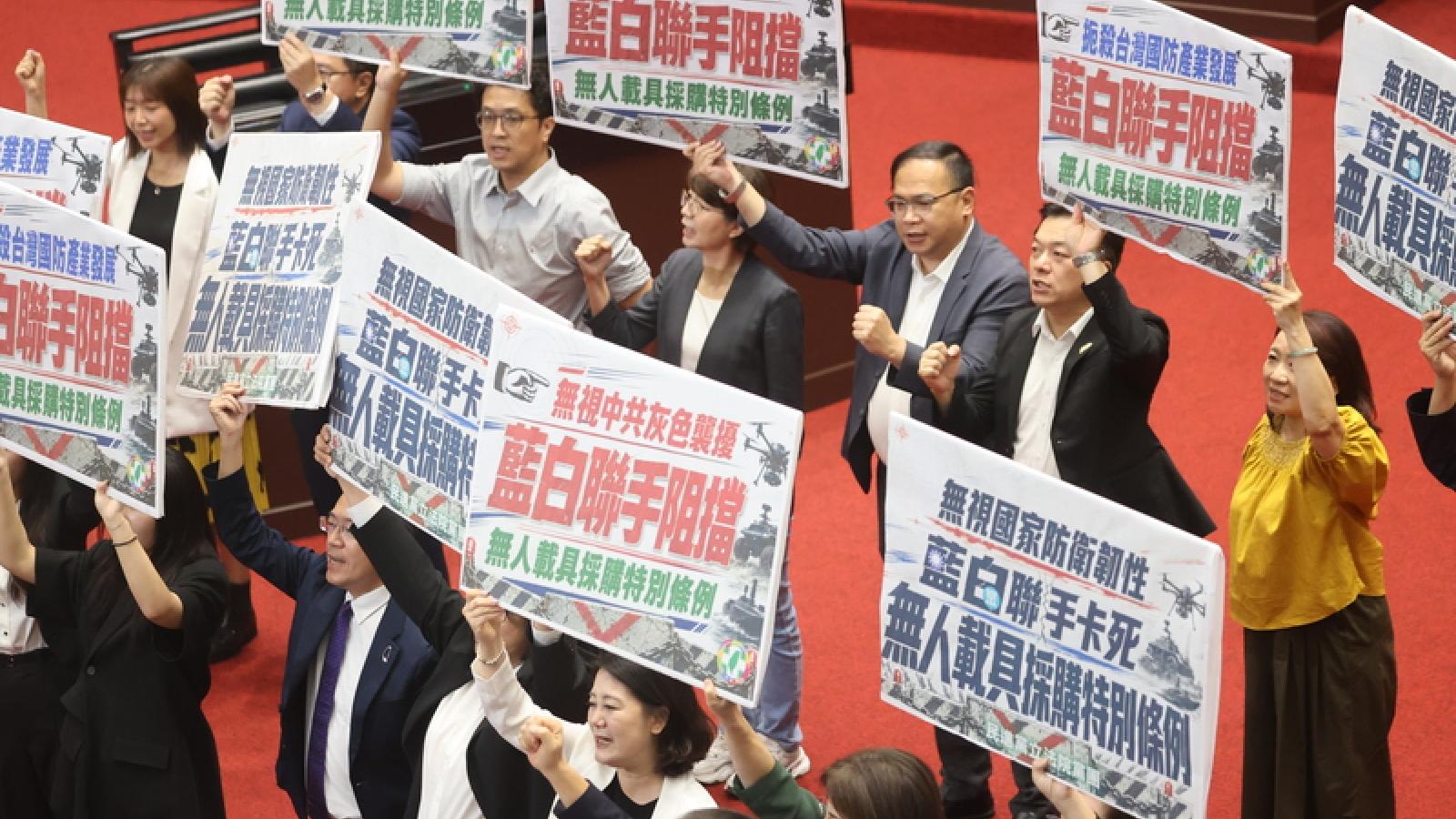
The most typical example is the 210 billion NTD drone program.
The Economist criticizes the opposition for blocking the procurement of 210,000 aerial and maritime drones, even describing it as a 'dramatic act of self-harm.' According to its logic, with China's threat looming, Taiwan needs drones, and the opposition blocking the budget weakens Taiwan's defense.
But this isn't the full story.
The opposition's Blue-White alliance hasn't opposed drone development; in fact, they've proposed a six-year, 240 billion NTD plan—higher than the Executive Yuan's 210 billion. The real dispute lies in how the budget is compiled (DPP wants a special budget; Blue-White prefers annual appropriations), how the legislature supervises it, and most importantly—who ultimately executes this 210 billion NTD program?
The defense drone budget has become a focal point of political struggle between ruling and opposition parties. Shown here are various drones, including COBRA 312 0 and Taiwan's version of the Switchblade. (Mingwang Technology)
Drones aren't just a defense policy—they're a massive industrial policy. A government investment of over 210 billion NTD could reshape Taiwan's next military-industrial landscape. Under DPP rule, drone ecosystems are emerging in Chiayi and Tainan; the Blue camp wants to bring Taichung's existing precision machinery, machine tools, motors, and component supply chains into the mix.
In other words, the Blue-Green rivalry isn't necessarily about 'whether to build drones,' but 'who builds the drones' and which industrial ecosystem will be nurtured by future government defense procurement.
The Economist simplifies this complex political-economic struggle—spanning defense, industry, local interests, and party competition—into 'the KMT blocks drones, so China wins,' clearly distancing itself from Taiwan's political reality.
210 billion NTD is no small sum—when did legislative oversight become democratic sabotage?
A bigger issue is that 210 billion NTD is not a trivial amount. In a democracy, legislative oversight of government budgets is a given.
In the U.S., the executive and Congress routinely fight over budgets to the point of federal government shutdowns. Congress can cut the president's budget, amend defense spending, or even shut down the government—yet no one claims 'American democracy is being held hostage.'
So why, in Taiwan, does blocking a budget labeled 'defense' immediately get interpreted as weakening Taiwan and helping China?
Of course, the opposition must also be scrutinized. If they claim to support defense but indefinitely delay essential military projects without reasonable justification, they should be held politically accountable. But whether oversight is reasonable or obstruction excessive should be judged case by case—not have legislative oversight's legitimacy canceled just because a policy involves China.
Otherwise, if 210 billion can't be blocked, what about the next 500 billion or 1 trillion? Should the legislature just approve everything the executive says is 'national security'?
Was Tsai Ing-wen better at negotiation? Overlooking full-party governance
Another questionable claim in The Economist is that Lai Qingde is stubborn and unlike Tsai Ing-wen, unwilling to negotiate with moderate KMT members.
The problem is that Tsai and Lai face fundamentally different legislatures.
When Tsai took office in 2016, the DPP won 68 seats; in her 2020 re-election, they still held 61 seats—majorities in both terms. As long as internal party opinions were aligned, major bills and budgets didn't need KMT's approval.
Lai, however, has only 51 seats, facing a legislature where the KMT holds 52 and the TPP 8—no single party has a majority.
This result was democratically elected by Taiwan's people in 2024—it's not democratic failure: voters gave the presidency to the DPP but didn't give the legislature's majority to them.
When Tsai was president, the ruling DPP also held a legislative majority. (Photo by Yen Lin-yu)
After eight years of DPP rule, scandals in vaccine and green energy policies led the public to deeply realize: 'We can let the DPP govern, but someone must check them.'
So the real issue isn't 'why has Taiwan suddenly become so hard to govern,' but whether the executive and legislature can relearn how to negotiate after losing full-party governance.
What The Economist missed: How the 'Great Recall' tore apart ruling and opposition
More notably, The Economist describes today's ruling-opposition conflict but almost skips a crucial piece of history—2025's 'Great Recall.'
After the 2024 election, the DPP lost its legislative majority, and the Blue-White alliance pushed a series of political moves: legislative reform, budget cuts, and freezes. By 2025, political conflict escalated into a full-scale recall movement targeting KMT district legislators.
At the time, DPP caucus leader Ko Wen-je publicly predicted all 31 KMT legislators could be recalled, framing the movement as a counterattack against 'Blue-White-Red cooperation.'
The final outcome was completely opposite. On July 26, the first wave of 24 recall motions against KMT legislators all failed; on August 23, the remaining 7 were also rejected. None of the 31 KMT legislators were recalled.
The political aftershock of this movement cannot be separated from today's ruling-opposition deadlock.
From the KMT and TPP's perspective, in 2024 voters already denied the DPP a legislative majority through elections. Yet in 2025, a political movement tried to change the legislative composition through mass recalls. Throughout the recall process, 'collaborators with China' became a recurring mobilization slogan.
The Great Recall ultimately failed to change the legislature's structure but drastically increased mutual distrust between ruling and opposition.
Legislator Ko Wen-je claimed to be a key figure in launching the 'Great Recall.' (Photo by Ko Cheng-hui)
Thus, today's Blue-White hardline obstruction of the Lai administration can be criticized. But blaming all responsibility on 'irresponsible opposition parties' without asking why ruling-opposition relations deteriorated so severely only sees the second half of the political conflict.
The Great Recall didn't resolve the 2024 divided government but pushed the three-party politics—which should have learned negotiation—further into zero-sum confrontation.
This is one of The Economist's biggest gaps in understanding Taiwan's current political landscape.
Why did The Economist publish this now?
Yet even with its misunderstandings of Taiwan's politics, we can't ignore the significance of The Economist publishing this article now.
Because The Economist's readers aren't Taiwanese voters, but elites in Washington, London, Brussels, and global political, business, and foreign policy circles. What's truly notable is the line: 'Taiwan's political system is a deterrent'—Taiwan's political system itself is a form of deterrence.
This reveals a shift in Western expectations of Taiwan. The U.S. once cared how many F-16s, missiles, and weapons Taiwan bought. Now it cares more: if war breaks out in the Taiwan Strait, can Taiwan's own political system rapidly mobilize budgets, industries, energy, communications, reservists, and civil defense?
In other words, the West is no longer just testing Taiwan's military capability, but its 'political reliability': can ruling and opposition parties form a minimum defense consensus? Can major military investments last a decade? Will policies reverse after party rotation?
Taiwan cannot fully avoid these questions. But here lies the problem.
To defend democracy, should we reduce democracy?
The Economist's logic, if followed through, easily becomes: China's threat rises → Taiwan must strengthen defense → legislature blocks defense budget → deterrence weakens → China's chance of taking Taiwan increases.
This could form a dangerous equation: opposing the government's defense policy = weakening Taiwan = helping China.
If 'anti-China' becomes the supreme standard of policy legitimacy, defense budgets can't be blocked, cross-strait policies can't be questioned, national security bills can't be opposed—because every objection can end with 'Beijing will be happiest.'
This creates an absurd democratic paradox: to defend democracy, we begin demanding less democracy.
China's National People's Congress may decide major policies more efficiently than Taiwan's legislature. But what truly distinguishes Taiwan from China isn't the government's ability to make quick decisions, but that government decisions can be opposed, budgets can be cut, policies can be questioned, and people can even vote the ruling party out in the next election.
These systems may sometimes be noisy, inefficient, even annoying—but this is precisely the value of democracy.
Taiwan must indeed prove it has the ability to preserve
FACT BOX
- Source: PR Times
- Category: News