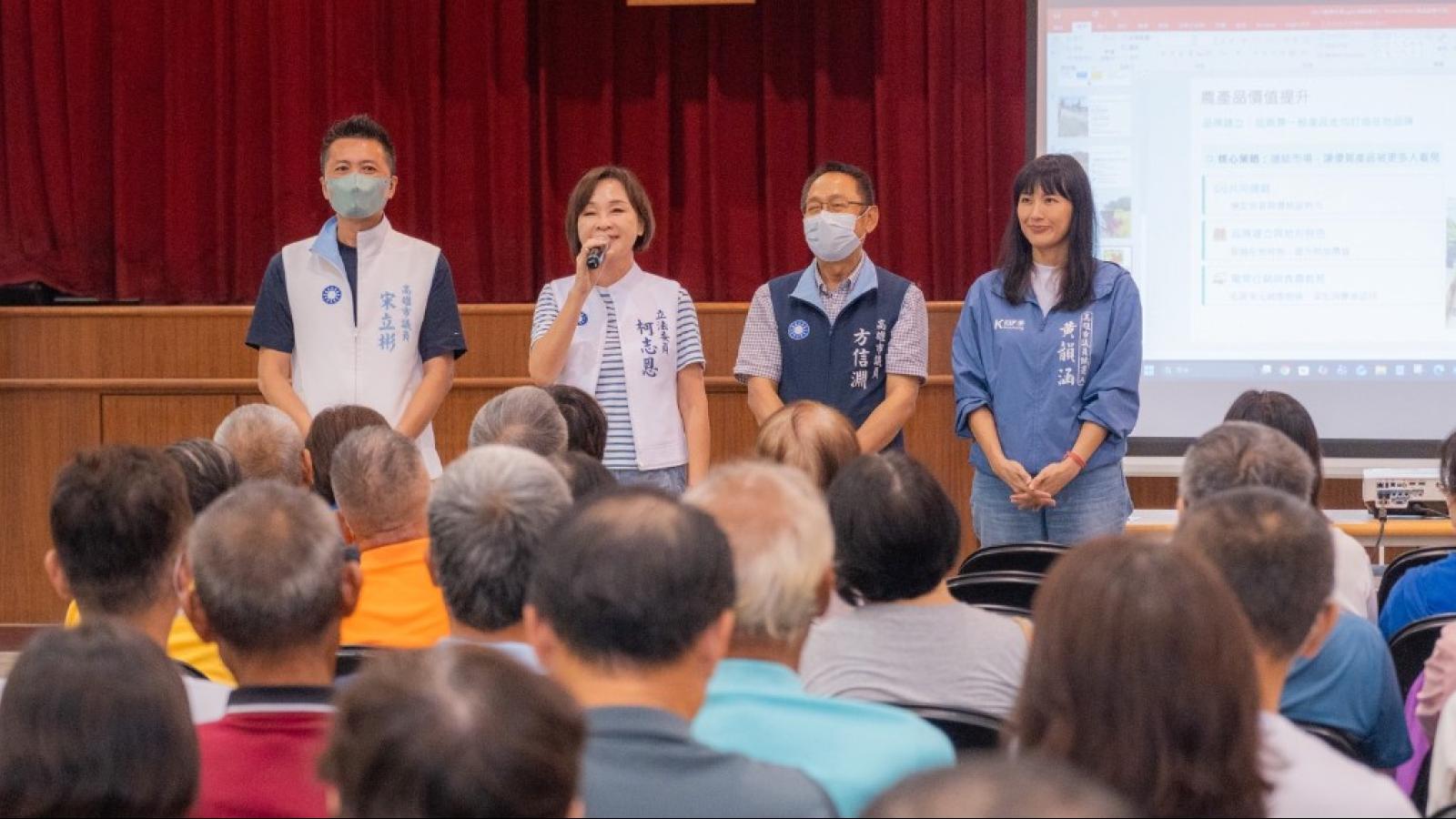
KMT Kaohsiung mayoral candidate Ko Chih-en continued her grassroots outreach yesterday (15th), walking from Gangshan Farmers' Association to Yancheng Wenshu Temple. In the morning, she engaged in face-to-face dialogue with farmers, proposing her 'Five-Strong Agriculture Strategy'—covering production, branding, distribution, consumption, and local development—to establish an integrated agricultural supply chain for Kaohsiung's produce. In the evening, she hosted a temple-front concert in Yancheng, sharing personal memories and advocating for old town revitalization, traffic improvements, youth return, and educational internationalization. She emphasized the need to create new development pathways for Kaohsiung, from rural to urban, from industry to daily life.
Ko stated that the most important aspect of grassroots visits is listening to frontline voices. Farmers care not only about 'growing well' but also about 'selling well.' Therefore, she proposed the 'Five-Strong Agriculture Strategy.' First, 'Strong Production': introducing smart agriculture, supporting young farmers' return, and enhancing irrigation and drainage infrastructure to improve resilience against extreme weather. Second, 'Strong Branding': deepening the 'Kaohsiung Preferred' brand, integrating local specialties like Gangshan longan honey, and elevating product value through quality, packaging, and origin storytelling.
Third, 'Strong Distribution': facilitating partnerships between farmers' associations and supermarkets, hypermarkets, e-commerce platforms, and corporate procurement to expand domestic and international market access for Kaohsiung's agricultural products. Fourth, 'Strong Consumption': promoting local agricultural products in school nutrition lunches and exploring expanded use of senior citizen cards at farmers' markets and local business districts to keep spending within the community. Fifth, 'Strong Local Development': integrating agriculture with tourism and culture, linking agricultural products with local landscapes and特色 events to turn agriculture into an engine for attracting visitors and boosting local economies.
Ko emphasized that agricultural policy must focus not only on output but also on farmers' income and quality of life. Going forward, she will continue advocating for farmers in various representative bodies and push for increased welfare allowances for elderly farmers, ensuring lifelong contributors receive better support and younger farmers can cultivate and sell with confidence.
From Childhood 'Dreamland' to Old Town Revitalization: Ko Proposes the Yancheng 'Time Corridor'
In the evening, Ko held a temple-front concert at Wenshu Temple in Yancheng District, attended by around 500 supporters. Ko recalled growing up in Pingtung and visiting Daxin Department Store in Yancheng with her mother as a child, riding Taiwan's first elevator. The once-thriving Yancheng had always been her 'dreamland.' Today, Yancheng faces challenges such as population decline, aging, and old town transformation. Ko believes revitalizing foot traffic and vitality in old towns is an unavoidable issue in Kaohsiung's urban governance.
Ko pointed out that Yancheng's population peaked at around 60,000 in the 1960s but has now dwindled to just over 20,000. While the streetscape and historical culture remain, the bustling crowds are gone. She proposed integrating cultural and tourism resources across Yancheng, Hamasen, and Pier-2 to create a 'Time Corridor,' incorporating industrial heritage like the hardware street into overall planning, transforming old town culture from mere historical memory into energy for tourism and industrial development.
Regarding urban renewal, Ko proposed subsidies for improving aging neighborhoods, walls, and environments to enhance overall city aesthetics. On transportation, she advocated placing large parking facilities outside the old town core, complemented by shuttle buses and shared bicycles to address parking and traffic flow, balancing tourism development with residents' daily lives.
She also stressed that old town revitalization cannot rely solely on tourism but must bring young people back. She plans to create spaces for youth entrepreneurship and cultural development, encouraging independent bookstores, music performances, and startups to settle in Kaohsiung, enabling young people to live, work, and start families there. In education, she will promote AI and international education to narrow the gap between urban and rural areas, giving Kaohsiung's children broader global perspectives.
Ko stated that while the challenges facing Kaohsiung—from rural areas to old towns—are different, the core lies in creating better development opportunities and living environments. She emphasized that Kaohsiung needs change and party alternation. She will continue visiting communities, listening to citizens' voices, and gradually presenting comprehensive policies—from agricultural supply chains to local revitalization and urban governance—so that Kaohsiung not only finds industrial pathways and urban futures but also allows the next generation to see a hopeful Kaohsiung.
FACT BOX
- Source: PR Times
- Category: News