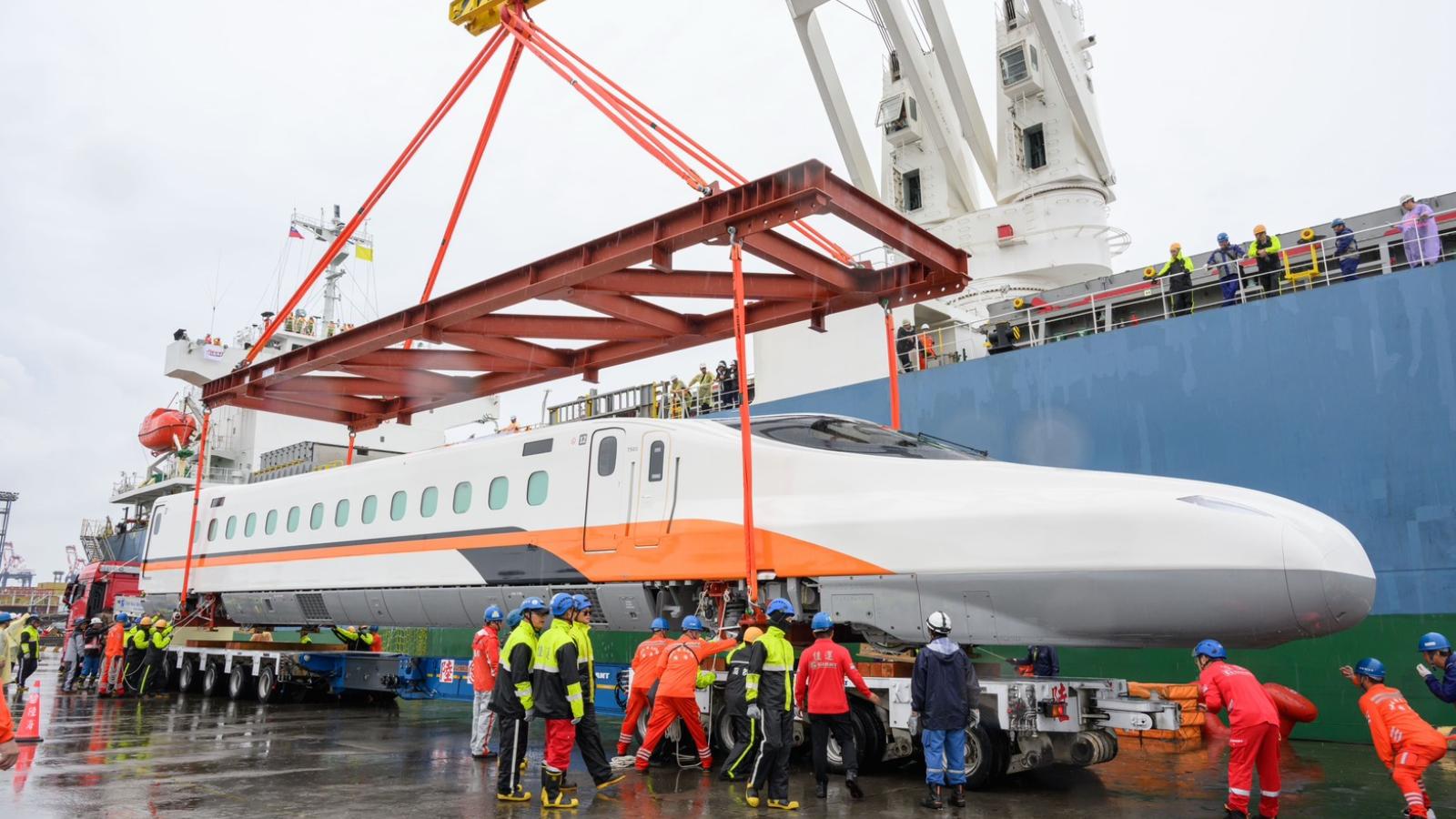
The first set of Taiwan High Speed Rail's (THSR) next-generation N700ST train officially arrived at Kaohsiung Port yesterday (15th), marking the first time in 22 years that a new high-speed train has been welcomed at Pier 74 of Kaohsiung Port. At the arrival ceremony, THSR Chairman Frank Hsu appealed to the Ministry of Transportation and Communications, announcing that after the new trains enter service on July 1 next year, the company will review its ticket pricing for the first time in 20 years—a structure unchanged since its 2007 launch. The goal is to establish a diversified and flexible fare system, with new pricing potentially implemented by September 2028, when all 12 N700ST sets are fully operational.
THSR has procured 12 sets of the N700ST trains from Japan. The first set consists of 12 carriages, which left the Japanese factory on July 30. Originally scheduled to depart on August 6, the shipment was delayed due to Typhoon Baitang and finally set sail on the evening of August 11. The voyage was further slowed by southwest monsoon, heavy rain, and high waves, causing the cargo vessel to reduce speed. The train ultimately arrived at Kaohsiung Port at 3 a.m. today and successfully docked by 6 a.m.
A 'N700ST New Train Arrival Ceremony' was held at Pier 74 of Kaohsiung Port, where Minister of Transportation and Communications Chen Shih-kai, Kaohsiung Mayor Chen Chi-mai, and THSR Chairman Frank Hsu jointly witnessed the new train being slowly lifted and unloaded from the cargo ship’s hold, officially marking the arrival of the next-generation train in Taiwan.
Chairman Hsu reflected on the arrival of the 700T trains 22 years ago at the same pier, recalling that at the time, there were even doubts about whether 'HSR would become scrap iron.' Twenty-two years later, the social atmosphere has completely changed. From an average daily ridership of 46,000 at its 2007 launch, THSR now expects to surpass 230,000 daily riders this year. HSR has evolved from a mere transportation tool into a driver of urban development along its corridor.
'HSR has transformed mobility into migration, and in the future, it will aim for livability,' said Hsu. He noted that the introduction of the N700ST will bring three major challenges. First, the simultaneous operation of both 700T and N700ST models will pose a significant challenge to over 2,000 HSR staff responsible for logistics, maintenance, and overnight servicing, with stabilization expected to take about two years.
The second challenge is financial sustainability. Hsu emphasized that HSR has become an indispensable 'artery of Taiwan,' and a healthy financial structure is essential for continuously improving service quality. Therefore, after introducing the new trains and enhancing ride comfort, the company will further review current fares.
At the ceremony, Chairman Hsu directly appealed to the Ministry of Transportation, stating that current fares have remained unchanged for 20 years. Starting July 1 next year, when the new trains go live, a fare review will be initiated—'but the premise is to first ensure passengers ride comfortably, then discuss pricing.' Internally, THSR has already begun drafting fare adjustment plans. The future direction will not be a simple fare hike but will focus on a 'diversified and flexible' pricing structure, designing different ticket types and discounts based on trip purpose, distance (short vs. long), direct vs. local trains, and more. Early-bird tickets may become more flexible, and discounts for families and tourists are also under consideration.
Currently, the standard-class fare between Taipei and Kaohsiung is NT$1,490, a price maintained since HSR’s launch. HSR briefly raised fares in 2013 due to financial restructuring but reverted to the original pricing by the end of 2015 after the opening of Miaoli, Changhua, and Yunlin stations.
Hsu stated that once all 12 N700ST sets are fully deployed, the company will also initiate plans to phase out and replace the existing 34 sets of 700T trains. If the fare adjustment proposal is submitted on July 1 next year, it will still need to go through board and MOTC approval processes, with new fares potentially implemented by September 2028, when all 12 new trains are fully operational.
Regarding the fare adjustment, Minister Chen Shih-kai expressed a positive attitude but set three conditions: maintaining transportation safety, increasing capacity and ridership, and ensuring passengers are truly 'satisfied with their ride.'
Chen stated that the Ministry is currently promoting 'HSR 2.0,' covering stations, ticketing, customer service, and smart services. Once the new trains are gradually deployed, the overall service quality must reach the '2.0 standard' before fare adjustments are discussed.
As for the future development of HSR, Chen proposed three requirements: maintaining transportation safety, increasing capacity and ridership, and ensuring passengers are truly 'satisfied with their ride.'
After the first N700ST set arrives, it will take about two days to complete unloading. It will then be transported by road to the Yanchao Depot over three late-night shifts, under traffic control and escort. Upon arrival, the train will undergo assembly, static testing, and safety inspections, with assembly and static testing expected to be completed by November this year.
Following this, dynamic testing will begin, including 69 detailed items such as traction, braking, and service facilities, conducted in three phases. The entire dynamic testing process is expected to be completed by the end of April 2027. The remaining 11 new train sets will arrive in Taiwan sequentially between 2026 and 2028, with all 12 sets expected to be fully operational by September 2028.
For Taiwan High Speed Rail, the arrival of the N700ST is not just about a new train—it marks a critical turning point in launching a comprehensive upgrade after 20 years of operation. From increasing capacity and improving ride quality to phasing out the 700T fleet and adjusting fares, HSR’s next phase will focus on balancing 'providing a better ride experience' with 'ensuring financial sustainability.'
FACT BOX
- Source: PR Times
- Category: New Product