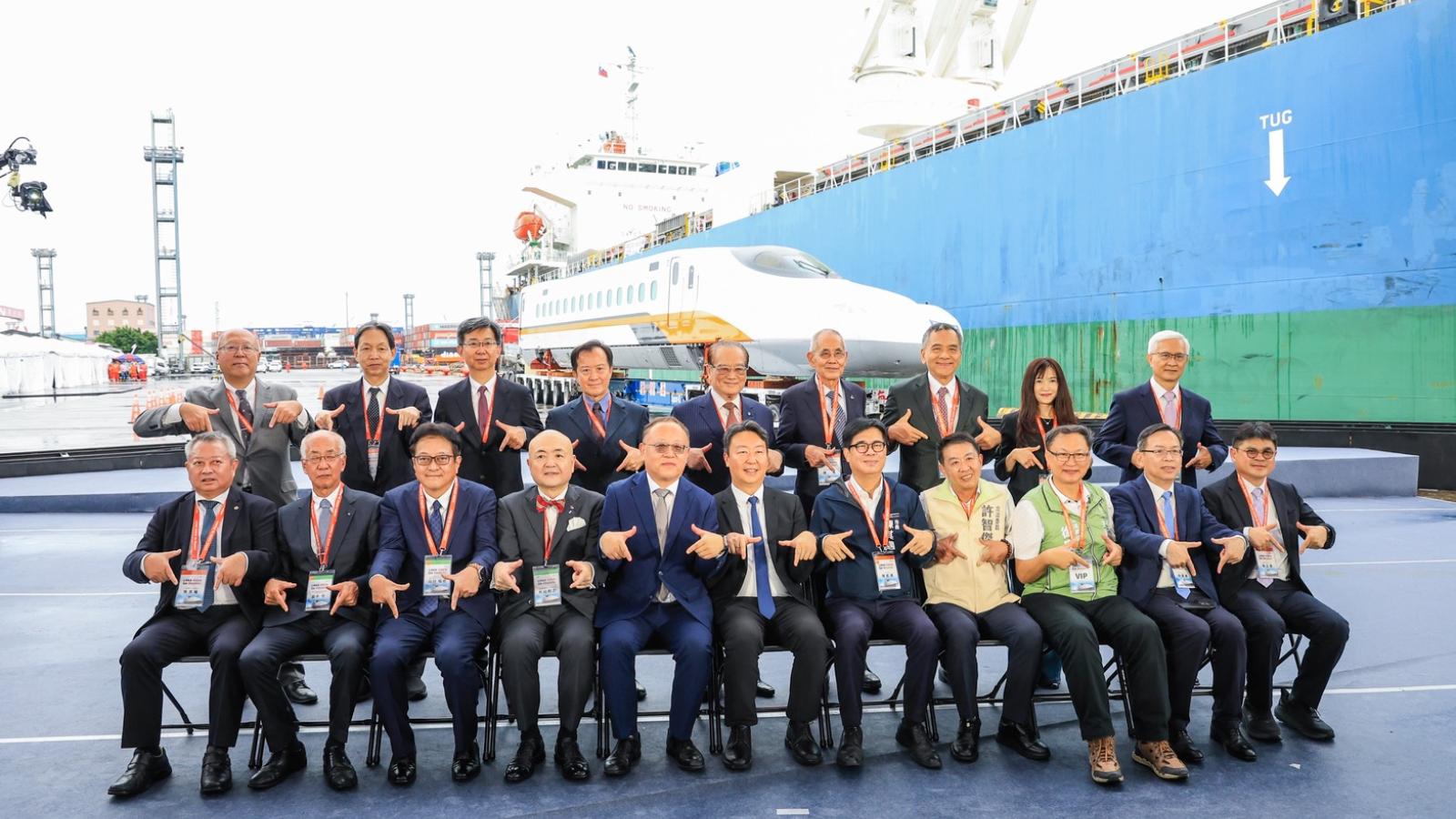
The first N700ST new-generation high-speed train of Taiwan High Speed Rail arrived at Kaohsiung Port from Japan yesterday (15th), with a welcoming ceremony held at Pier 74. This event symbolizes Taiwan High Speed Rail's entry into a new era and highlights Kaohsiung Port’s vital role in connecting maritime and land transportation and supporting major national infrastructure projects.
Kaohsiung Mayor Chen Chi-mai, Minister of Transportation and Communications Chen Shih-kai, THSR Chairman Shih Che, and legislators Hsu Chih-chieh and Hsu Fu-kuei attended the ceremony, jointly witnessing the historic moment of the first 12-car unloading of the N700ST train.
At the ceremony, the brand-new N700ST train was slowly lifted from the cargo ship’s hold and successfully placed onto a terminal trailer, marking the start of a two-day unloading operation. The subsequent train sets will be transported in batches during late-night hours to the Yanchao General Maintenance Depot for assembly, testing, and safety inspections. The first train is scheduled to enter service in July 2027, with all 12 train sets expected to be fully operational by the end of 2028.
Mayor Chen expressed his welcome on behalf of the Kaohsiung City Government and thanked Taiwan High Speed Rail for its long-term support in the city’s development. He emphasized that high-speed rail is not just a transportation tool but a catalyst for changes in population flow, industries, and urban development. He cited the growth of cities along the HSR line as evidence of urban transformation driven by the rail network.
Chen highlighted Kaohsiung’s recent focus on concert-driven economic growth, noting that THSR has supported major events by adding extra services and facilitating passenger transport, serving as a crucial backbone for city tourism and large-scale events. To welcome the arrival of the N700ST, Kaohsiung launched a citywide campaign, lighting up iconic locations—including the Kaohsiung Music Center, Love River, Central Park, Formosa Boulevard MRT Station, and CSC Headquarters—with the train’s signature orange lights for 14 consecutive days, showcasing the city’s enthusiasm for the new era of high-speed rail.
Reflecting on the development of HSR, Chen acknowledged past debates and controversies surrounding its construction but emphasized that after more than 20 years of operation, the HSR has successfully created a one-day living circle between northern and southern Taiwan, driving rail-based economic development and industrial transformation in manufacturing and services. He urged that if THSR plans to establish an operational headquarters or expand its operations in the future, Kaohsiung should be prioritized, with full municipal support.
Pier 74 Welcomes HSR Trains Again: Kaohsiung Port Witnesses the Evolution of Taiwan’s High-Speed Rail
The decision to unload the N700ST at Kaohsiung Port’s Pier 74 holds significant historical resonance with the development of Taiwan’s high-speed rail. According to Taiwan International Ports Corporation, Pier 74 previously welcomed the first batch of 700T-series HSR trains in May 2004, assisting in unloading and onward transportation, laying the foundation for the HSR project.
Years later, the same pier once again receives the next-generation N700ST train, symbolizing Kaohsiung Port’s continued support for major national infrastructure and marking Taiwan’s high-speed rail journey from construction and operation to vehicle upgrades.
Taiwan International Ports Corporation noted that Pier 74 is a deep-water heavy-lift wharf, 314 meters long with a water depth of 12.5 meters, and a rear yard area of approximately 12,600 square meters. With a load-bearing capacity of 3 tons per square meter, it is equipped to handle oversized and specialized cargo. Thanks to its advanced port facilities and extensive experience in heavy cargo handling, Kaohsiung Port has repeatedly supported major national projects, including the unloading of HSR trains.
On Taiwan-Japan exchanges, Mayor Chen noted the deep friendship forged through mutual support during major disasters such as the 921 earthquake, Typhoon Morakot, Kumamoto earthquake, and the 2011 Great East Japan Earthquake. The arrival of the N700ST from Japan represents not only an upgrade in transportation infrastructure but also a deepening of industrial cooperation and exchange between Taiwan and Japan.
Quoting Japanese literary master Yasunari Kawabata’s famous line from “Snow Country” — “After passing through a long tunnel, there was snow country” — Chen described the N700ST’s journey across the long sea route to southern Taiwan, expressing hope for smooth future operations and greater convenience for Taiwan’s transportation.
Minister Chen Shih-kai stated that after more than 20 years of operation, HSR has profoundly transformed Taiwan’s urban and industrial development. As a frequent user himself, he expressed gratitude to the HSR team for maintaining safe, punctual, and high-quality service. He urged that with the addition of new trains, safety must remain the top priority, while strengthening professional training and talent development for maintenance staff, enhancing overall capacity, and continuously improving station operations, ticketing, and passenger service quality.
Chairman Shih Che emphasized that the train’s arrival, despite challenges from earthquakes, typhoons, and harsh sea conditions, was successfully completed under the principle of safety first. He noted that HSR is not just about “mobility” but has gradually changed people’s lifestyles — evolving from “mobility” to “resettlement” and further toward “livability.” Facing the maintenance and logistical challenges of operating both new and old train models, THSR will continue advancing “HSR 2.0,” refining train operations, station facilities, and service quality to achieve sustainable operations.
Taiwan International Ports Corporation stated that ports are not merely gateways for cargo and logistics nodes but essential infrastructure supporting national transportation, industrial development, and public transportation. Moving forward, the corporation will continue strengthening port infrastructure and heavy-lift capabilities, integrating rail, road, and air transport systems to build a safer, more efficient, and resilient maritime-land-air transportation network, ensuring Kaohsiung Port continues to serve as a national gateway and a vital transportation hub.
FACT BOX
- Source: PR Times
- Category: Event