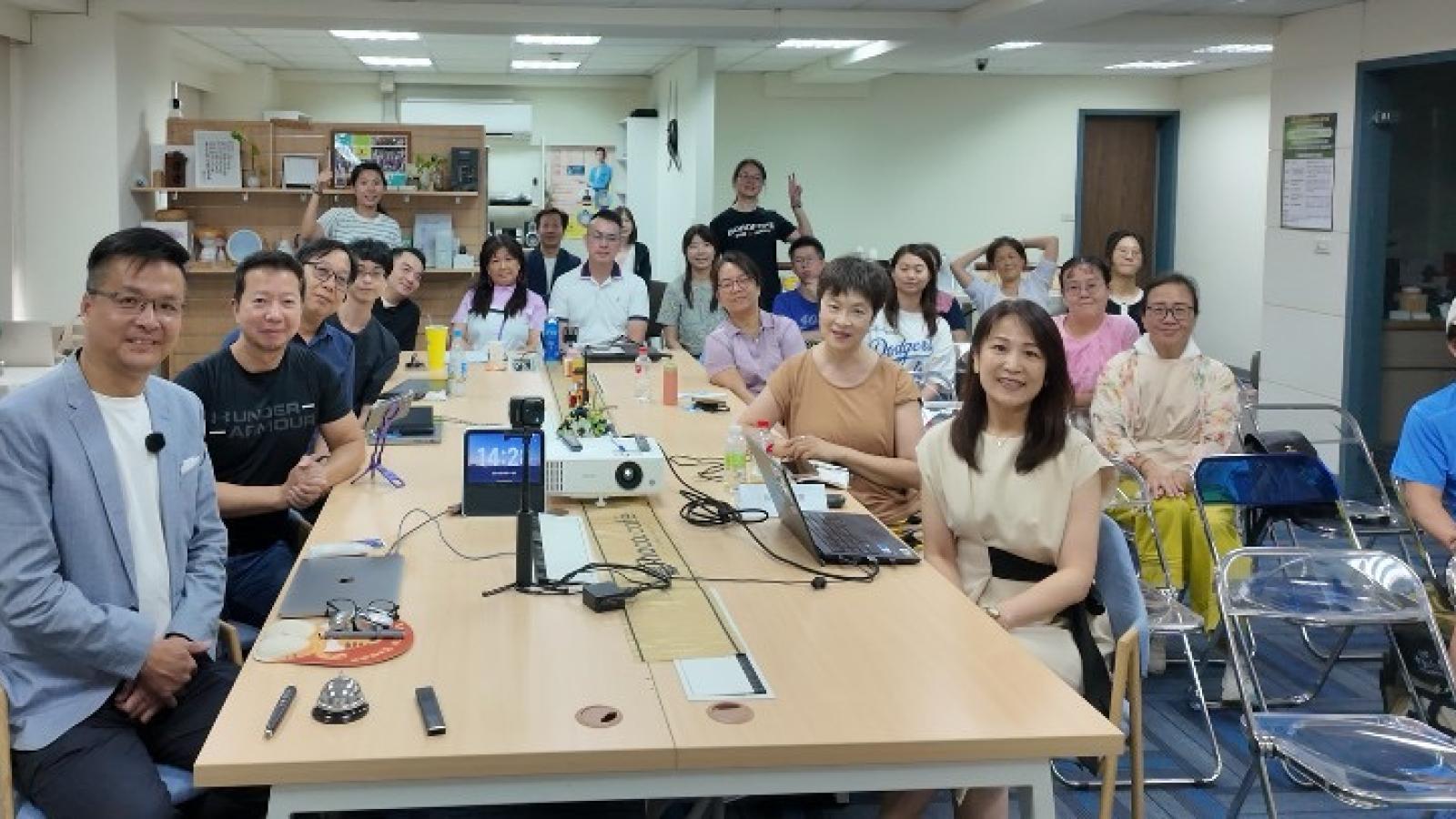
Will AI really take away jobs, or can it become humanity’s strongest assistant? As generative AI rapidly evolves, collaborating with AI has shifted from a bonus skill to a fundamental workplace competency. The "AiWan AI Reading Group" held a forum today, June 16, at hoco.cafe in Zhubei City, gathering experts from education, industry, urban governance, and AI practice. Together, they explored topics ranging from enterprise transformation and smart cities to personal assistants and future business opportunities, guiding participants to envision the new world of AI.
The AiWan AI Reading Group forum took place in Zhubei, uniting industry, government, and academic experts with attendees to gain early insights into the latest AI application trends. (Photo courtesy of AiWan AI Reading Group)
AI is no longer just a tool for tech professionals—the Zhubei-based co-learning community is breaking down learning barriers.
Launched in March this year by founding chairperson Band Brother Guo Hongbin, the AiWan AI Reading Group holds regular monthly gatherings centered on co-learning, sharing, communication, and collaboration. It focuses on six key areas: entrepreneurship, education, productivity, business, creativity, and futurism, aiming to help people of all ages and professional backgrounds find their own way to apply AI.
Hosted by Yang Chun-tzu, former Director of Hsinchu County Education Bureau and adjunct assistant professor at National Tsing Hua University, the forum began with perspectives on education and talent development, guiding four speakers in cross-domain dialogues. This transformed what might seem like complex AI technologies into practical skills immediately applicable to work and daily life.
Implementing AI in enterprises isn’t just about buying tools—clearly articulating needs is the real key to success.
Lin Tzu-teng shared insights from his experience in enterprise digital transformation, emphasizing that successful AI integration depends less on how powerful the model is and more on whether users can clearly define what they want the AI to accomplish. He stated that if AI can further integrate calendars, emails, LINE messages, documents, and quotation processes, it can evolve from a chat tool into a true digital partner capable of handling actual work.
Hsinchu County Councilor Wu Hsu-chih, who holds a Ph.D. in Information Science from National Yang Ming Chiao Tung University, presented his vision of a "warm-hearted smart city," stressing that people remain at the core of smart cities. Technology should not merely pursue more devices and data but must respond to citizens’ everyday needs, making public services more timely, efficient, and life-centered.
Everyone can have their own AI assistant—work patterns and life efficiency are being completely transformed.
Chang Yen-tang, founder of Blue Duck (launchdock.app), demonstrated practical AI mini-tools and categorized AI assistant capabilities into three stages: visibility, understanding how to do it, and execution. He believes the biggest bottleneck is often users’ inability to clearly describe tasks; once requirements are articulated clearly, AI is actually within reach for everyone.
Kent Liao Jen-da analyzed that as AI rapidly democratizes efficiency, future markets may split into two paths: ultimate efficiency and authentic human experiences. Businesses must not only consider how to use AI to boost efficiency but also rediscover irreplaceable human values to transform technology into entirely new business models.
Moving forward, the AiWan AI Reading Group will continue hosting forums, corporate visits, hands-on exchanges, and startup collaborations, connecting resources from government, industry, academia, and communities. The goal is to position Zhubei not just as a hub for technology industries but as a center for AI co-learning and innovative applications.
FACT BOX
- Source: PR Times
- Category: Event