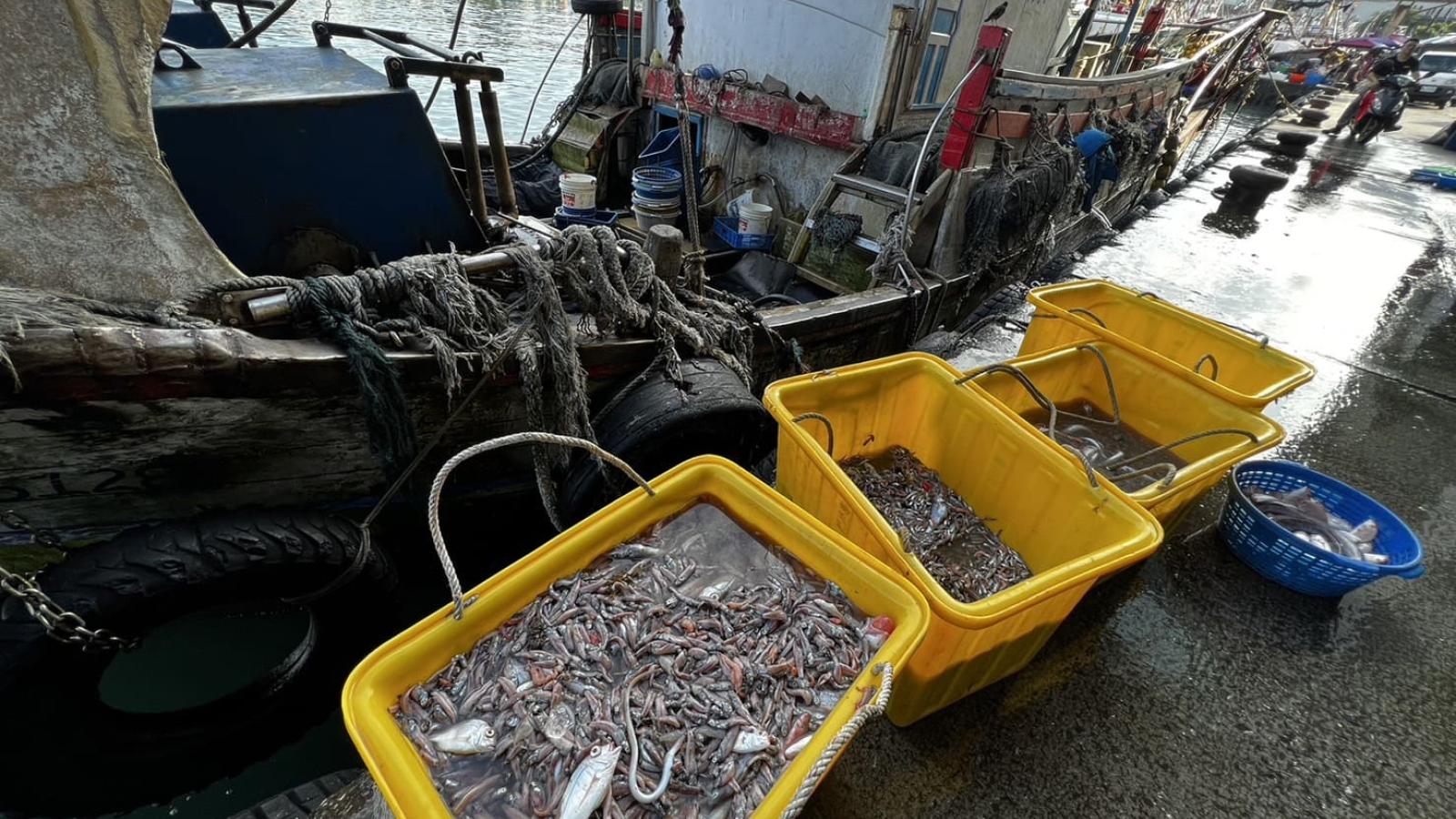
Consumers may have noticed that prices for certain fish species have risen recently. Intuitively, one might wonder whether fish are becoming scarcer—and this possibility is indeed very high. There are several reasons why fish populations are declining, one of which is improper fishing methods, with bottom trawling posing the greatest threat to marine ecosystems. If left unchecked, fewer fish will be caught, and they will become even more expensive.
Last week, the Council of Agriculture’s Fisheries Research Institute released a press statement announcing experimental trawling conducted in the Yilan Bay area. The study confirmed that doubling the mesh size to 4 centimeters allows smaller or slender fish to escape through the net, thereby reducing the accidental capture of non-target species and helping preserve fishery resources and marine ecology.
However, these research findings must be translated into formal administrative regulations by the Council of Agriculture to bring about tangible improvements. Moreover, bottom trawling also damages seabeds and increases carbon emissions. To protect marine ecosystems, fishing operators should be supported in transitioning to sustainable practices, ecologically sensitive areas should be designated as no-fishing zones, and seasonal fishing bans should be established—only then can the harm caused by bottom trawling be ended.
Bottom trawling sweeps across the seabed, capturing all fish regardless of size
Trawl fishing is categorized by water depth into surface, midwater, and bottom trawling. Among these, bottom trawling—which operates at depths reaching up to 500 meters—has the most severe impact on marine ecosystems. Two common types exist: one uses two large boards to open the net mouth and herd fish inside; the other equips the net with a beam and rollers that drag along the seafloor, capturing not only fish but also organisms living under reefs and sandy seabeds. Carbon stored in seabed sediments is released into seawater, exacerbating ocean acidification.
The bag nets commonly used in trawl fishing have mesh sizes of about 2 centimeters. These small gaps result in the indiscriminate capture of even small, economically insignificant fish and shrimp. This practice harms fishermen themselves, as young fish and shrimp never get the chance to grow, ultimately reducing future catches. Everyone understands the folly of 'draining the pond to catch fish,' yet the Council of Agriculture lacks foresight and avoids proactive management out of fear of upsetting the industry. Meanwhile, fishermen prioritize short-term convenience, jeopardizing their own futures.
Statistics from the New Taipei City Fisheries Office confirm that fish stocks are not only decreasing but also shrinking in size. Coastal fishery yields in New Taipei dropped from 5,919 metric tons in 2012 to 3,516 metric tons in 2024—a staggering 40% decline. Additionally, multiple species such as the humphead wrasse and white pomfret have also shown reductions in body size.
In response to these alarming trends, the New Taipei City Fisheries Office recently announced plans to connect scattered conservation zones in Wannan, Ruifang, and Gongliao—areas rich in coral ecosystems—into a continuous coastal conservation corridor along the Northeast Coast, enhancing ecological connectivity. Furthermore, high-precision harvesting methods like spearfishing and harpooning place significant pressure on specific coastal fish species. These activities will now be restricted, including the use of diving equipment, spearguns, and harpoons, under a tiered regulatory system.
Mesh size regulation, no-fishing zones, and seasonal bans are needed
Animal protection groups have repeatedly called for restrictions on bottom trawling. The most recent protest occurred in June 2023 outside Taiwan’s Executive Yuan, triggered when fishermen from Nanfangao, Yilan, caught an 800-kilogram goblin shark using bottom trawling—one carrying six unborn pups. Such deep-sea giants should never be captured. Yet despite widespread public condemnation, three years later, neither the Council of Agriculture nor the Executive Yuan has taken any meaningful action.
The Taiwan Animal Society points out that many ocean-conscious nations have already begun phasing out trawl fishing, while others have established bottom trawling exclusion zones. Hong Kong, Palau, and Indonesia have completely banned bottom trawling. In 2014, a legislator proposed a full ban on bottom trawling, but it was shelved after protests from fishermen.
As a result, the Council of Agriculture continues to enforce extremely lax regulations: prohibiting trawlers from operating within 3 nautical miles of shore. However, this rule is easily violated and difficult to monitor. For example, fishermen often claim they were merely cleaning their nets rather than fishing. Although rules now prohibit net deployment and retrieval near shore, unless caught in the act, proving violations remains challenging.
Today’s oceans face numerous threats. What will the future hold? How can we act now to safeguard marine resources for generations to come? Animal protection groups suggest systematically dismantling ocean threats—one step being the phased retirement of bottom trawling operators, alongside measures like those in New Taipei City, establishing no-fishing zones and seasonal closures. Banning bottom trawling in areas of high biodiversity and juvenile fish nurseries is essential to relieve pressure on marine ecosystems.
*The author is an independent journalist.
FACT BOX
- Source: PR Times
- Category: News