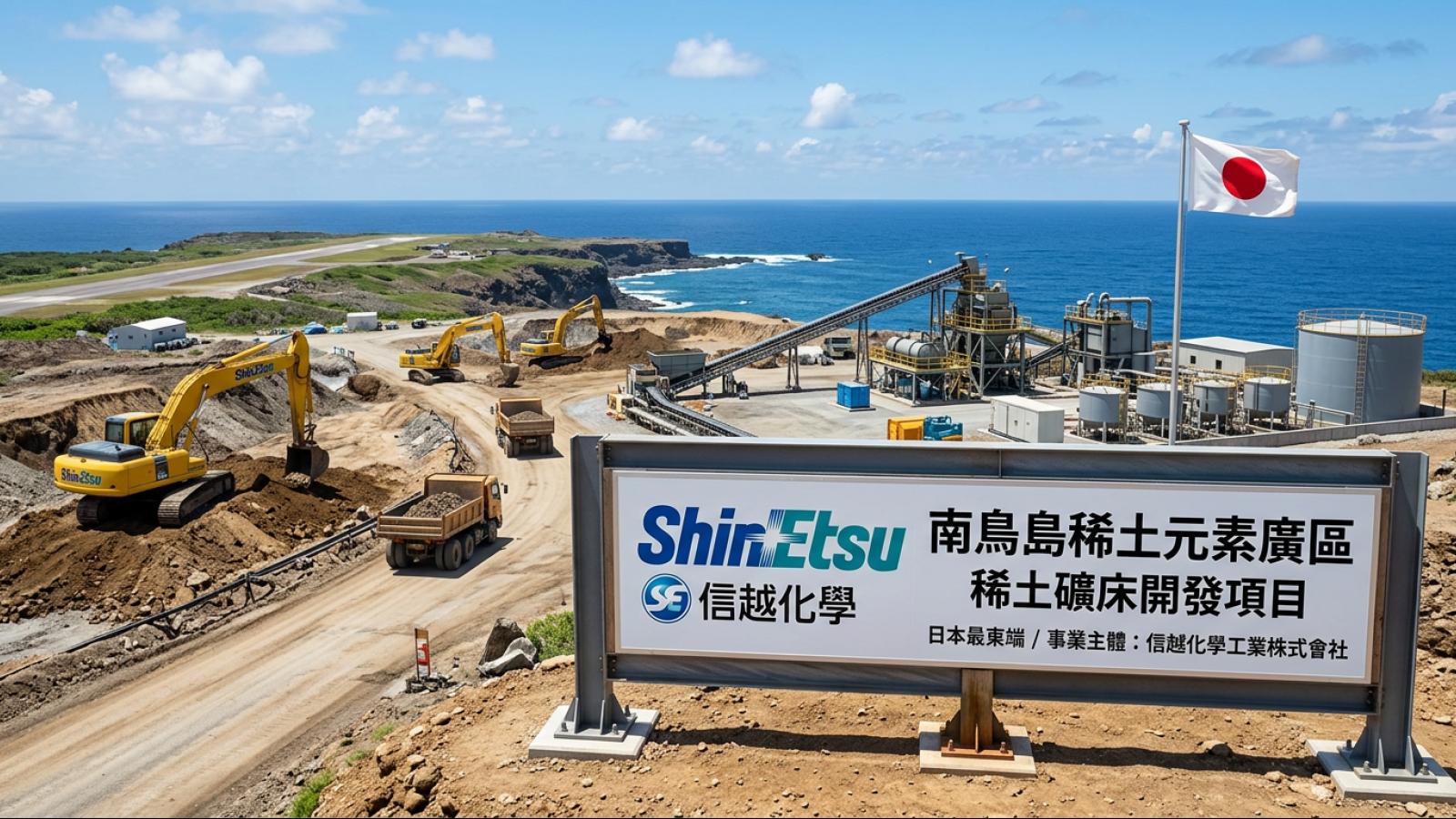
On February 3, 2026, Japan's Ministry of Economy, Trade and Industry (METI) announced that the government would use fiscal budget funds to invest in the industrial development of rare earth mud near Minamitorishima Island, providing subsidies for mining and smelting projects. Then, on June 11, the Japanese government announced a partnership with chemical giant Shin-Etsu Chemical to build a new rare earth refining plant in Echizen City, Fukui Prefecture. The total investment is 35 billion yen, with the government and Shin-Etsu each contributing 17.5 billion yen. The goal is to establish domestic industrial capacity in critical heavy rare earth refining, completely eliminating the pressure of dependence on China. Minamitorishima Island, photo from the internet (provided by author) In fact, since 2010, Japan and China have been engaged in a rare earth war triggered by territorial disputes over the Senkaku Islands. Unfortunately, after 16 years, Japan has still not managed to break free from the rare earth curse despite exhausting all possible methods. This time, following the Kaohsiung mayor's statement that 'if Taiwan is in trouble, Japan is in trouble,' the Chinese Communist Party once again imposed an export ban on dual-use materials (including rare earths), severely impacting Japanese companies. In response, the Japanese government has finally decided to take strong action. But can this new policy reverse the situation, enable Japan to achieve rare earth self-sufficiency, and benefit the entire Western alliance? The world is watching closely. As is widely known, rare earth deposits are distributed globally and are not scarce. Their 'rarity' lies in extremely low concentrations and highly dispersed distribution. The 17 rare earth elements are closely bound together, requiring dozens of processes and hundreds of cycles of reactions to separate, extract, and purify them. In terms of separation, refining, metal reduction, alloy production, and magnet manufacturing, China leads the world. According to the International Energy Agency (IEA), despite global efforts in recent years to diversify supply, about 80% of the world's magnetic rare earth refined products may still rely on China by 2035. Minamitorishima Rare Earth Development Project Against this backdrop, the development of rare earths around Minamitorishima is just the most fundamental step in Japan's effort to build a complete rare earth industrial chain. The current model is 'government-led strategic resource development,' led by Japan's Cabinet Office and incorporated into the 'Cross-ministerial Strategic Innovation Promotion Program (SIP)' Phase 3 'Marine Security Platform' project. The core of actual technical execution is JAMSTEC (Japan Agency for Marine-Earth Science and Technology), a national research and development corporation under government control, with private companies participating in technology and equipment investment. Kato Taiho Unveils the Truth Behind Minamitorishima's Rare Earths The discovery of rare earths at Minamitorishima is just one small piece of a larger puzzle. On July 3, 2011, Professor Kato Taiho of the University of Tokyo published a research paper titled 'Deep-sea mud in the Pacific Ocean as a potential resource for rare-earth elements' in the authoritative earth science journal Nature Geoscience. This paper was not specifically about Minamitorishima; it primarily explored the distribution of deep-sea rare earth mud across the Pacific Ocean and was the first to propose the concept that 'deep-sea rare earth mud is a large new resource.' At the time, Professor Kato's research was not yet complete, but due to the rare earth war between China and Japan in 2010, he published the paper early to boost domestic morale and strengthen diplomatic negotiation leverage. Impact on Japanese Policy Kato's paper can be seen as the starting point of Japan's marine rare earth strategy, with far-reaching subsequent impacts. The Japanese government began surveying the waters around Minamitorishima, and JAMSTEC collaborated with the University of Tokyo on drilling, gradually establishing seabed mining and mud-lifting technologies. They also integrated research with drilling data from IODP (International Ocean Discovery Program), becoming a crucial scientific basis for Japan to rebuild its rare earth supply chain. Later, to meet national strategic needs, Kato's research team gradually narrowed their focus to the waters around Minamitorishima within Japan's Exclusive Economic Zone (EEZ). The results were astonishing. In 2013, the University of Tokyo announced research findings: the team discovered the world's highest concentration of rare earth mud in Minamitorishima's exclusive waters. The maximum REY (referring to Rare Earth Elements (REE) plus Yttrium (Y)) concentration reached 6,600 ppm, equivalent to 20–30 times that of China's ion-adsorption type rare earth ores, with high-grade layers located just a few meters below the seabed, indicating immense development potential. Then, in 2018, the research team estimated that the Minamitorishima waters contain approximately 16 million tons of REO (rare earth oxides), particularly rich in rarer and more strategically valuable heavy rare earth elements such as yttrium (Y), dysprosium (Dy), and terbium (Tb). For Japan, long lamented for its lack of resources, this seemed like finally receiving encouraging news. In July 2026, the Cabinet Office and JAMSTEC announced that the team had successfully collected about 50 tons of deep-sea mud from 5,600 to 6,000 meters offshore from Minamitorishima. Analysis showed that 'medium and heavy rare earth elements' (HREE) accounted for as high as 54%. The trial collection report also indicated that the mud contains no toxic or radioactive substances, and large-scale mining trials are planned for February 2027, with preliminary commercial production expected to begin in 2028, followed by full-scale mass production at an economically viable scale within three years. The Minamitorishima project has immense potential, but the challenges are equally formidable. After all, the success of the project depends not on whether there is enough or high-quality rare earth under the sea, but on whether technology, cost, and management can meet the requirements. The challenges include: 1. Deep-sea rare earth mining is a global first. As the pioneer, Japan must design an entire set of equipment from scratch, including mining machines, lifting pipes, deep-sea robots, and offshore platforms—all of which are currently still in the testing phase. Especially at a depth of 6 kilometers, the seabed must withstand 600 kilograms per square centimeter of water pressure (equivalent to 600 atmospheres). Japan must deploy top-tier exploration vessels like the 'Chikyu' and connect hundreds of ultra-high-strength pipes to pump up the mud, making the technical difficulty extremely high. 2. Geography could be a fatal flaw for the Minamitorishima project: Minamitorishima Island, with an area of only 1.52 square kilometers, administratively belongs to Ogasawara Village, Tokyo, but is 1,267 kilometers away from the Ogasawara Islands and over 1,900 kilometers from Tokyo. Within a 1,000-kilometer radius, there is nothing but open ocean, and the island is vulnerable to typhoons during summer and autumn. How can such a remote island support commercial-scale mining? Current estimates suggest that mining costs will be 20 times higher than land-based mining in China. The logistical challenges of transporting supplies and goods by sea and air will be unimaginable. According to current targets, Minamitorishima's rare earth mining output could reach 350 tons per day by 2027—a seemingly large amount, but still far from the break-even point of 3,500 tons per day. Even though rare earths have now risen from industrial raw materials to strategic materials critical to national security, requiring all-out efforts regardless of cost, if building a self-sufficient rare earth industry chain turns into a massive fiscal black hole, how should the gains and losses for national development be evaluated? This is debatable. 3. Environmental impact: Although current samples of deep-sea mud show no radioactivity, which is good news for developed countries long hesitant due to rare earth radiation concerns—significantly slowing down the 'de-China-ification' of rare earths—large-scale mining will still face international maritime regulations regarding seabed sediment disturbance and marine ecological impacts. Shin-Etsu: The Second Strategic Bet If Minamitorishima mining is a bold first step and experimental attempt by Japan to build a complete rare earth industrial chain, then the government's subsidy to Shin-Etsu Chemical to build a new rare earth refining plant is a steady move forward based on existing foundations. The former secures autonomous ore sources, while the latter strengthens the critical midstream technological segment of the industrial chain. By abandoning the previous ad hoc approach of 'overseas mining, partial offshore separation, and domestic focus on high-end products,' and investing heavily to connect the entire supply chain from start to finish, Japan aims to secure an unbeatable position. Why Shin-Etsu? Shin-Etsu Chemical has been deeply involved in the rare earth field for 60 years, possessing world-leading multi-stage solvent extraction and separation refining technologies. Its main products are divided into various 6N-grade (99.9999% purity) rare earth oxides used in semiconductor manufacturing, optoelectronics, and ceramic components, and rare earth permanent magnets (high-performance magnetic materials) used in electric vehicles and military equipment. Take 6N yttrium oxide, one of Shin-Etsu's core products, as an example. It is a key precision ceramic material used in plasma-resistant coatings in semiconductor process equipment. Especially in advanced wafer processes below 3 nanometers, any metal impurity can cause wafer scrap, making the importance of 6N yttrium oxide irreplaceable. Equally dominant globally is the samarium-cobalt magnet (SmCo Magnets), first developed and mass-produced in 1976 at Shin-Etsu's Takefu Plant, and the neodymium-iron-boron sintered magnet (Nd
FACT BOX
- Source: PR Times
- Category: News
- Organizations: JAMSTEC / IODP