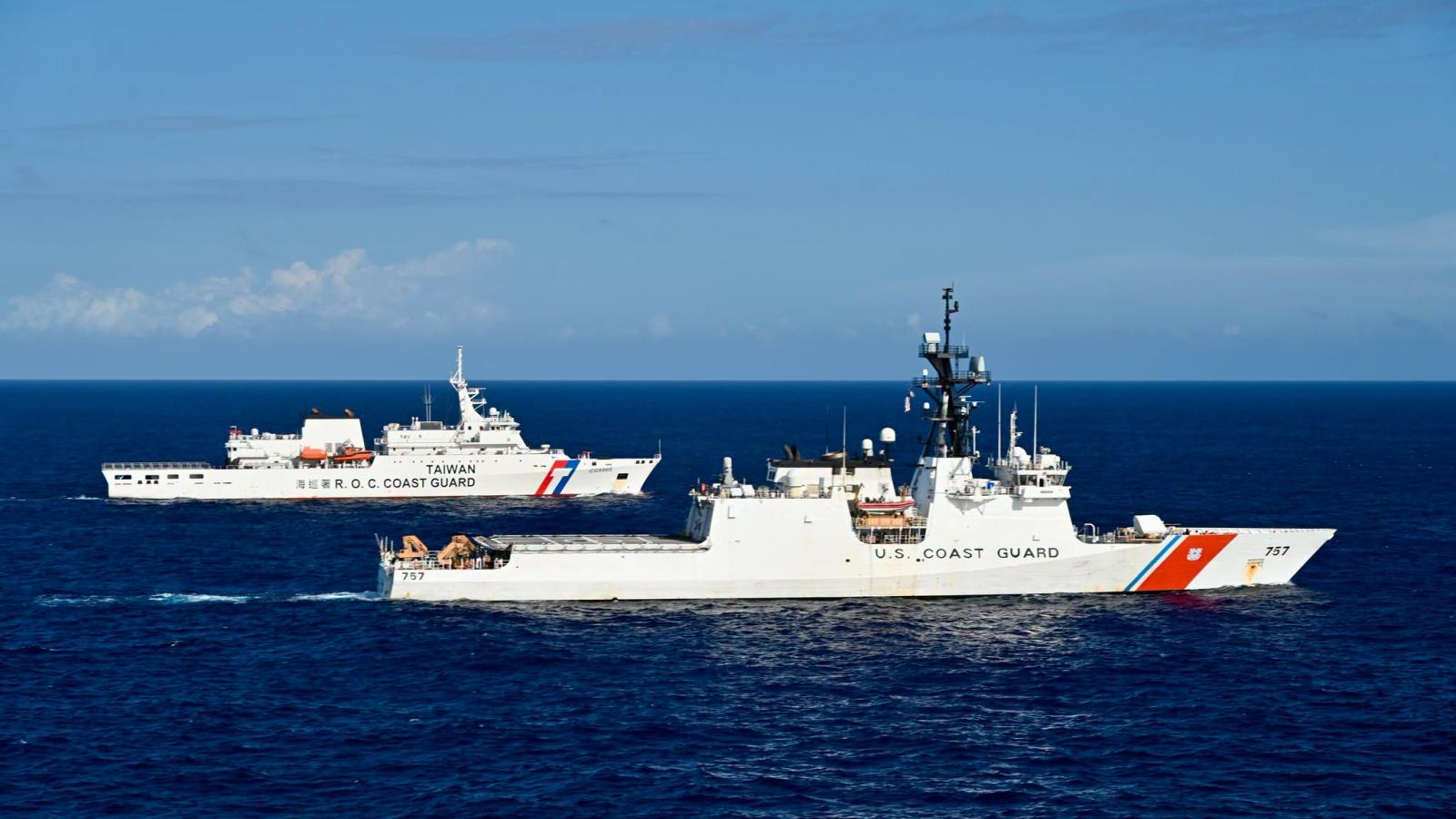
In late July, the American Institute in Taiwan (AIT) posted a photo on its Facebook page showing a U.S. Coast Guard patrol vessel operating alongside a patrol ship from Taiwan's Coast Guard Administration in an unspecified maritime area. The caption stated simply: "As typhoon season approaches, the U.S. Coast Guard and Taiwan's Coast Guard Administration are closely coordinating on multiple shared maritime objectives, including search and rescue, tropical storm preparedness, disaster relief, marine resource conservation, combating illegal fishing, and intercepting maritime drug smuggling."
This Facebook post not only became a major news story on the day of publication but has since accumulated over 10,000 likes—an unusually high engagement level for social media content from foreign missions in Taiwan. Typically, such institutional posts are bureaucratic and low-key, but this image carried strong visual impact and has been interpreted as a symbolic demonstration of deepening practical cooperation between the U.S. and Taiwan.
Underlying this development is China's increasing use of so-called 'gray-zone tactics'—actions that fall short of outright military conflict but aim to assert de facto control over disputed waters. Using fishing vessels and coast guard ships, China has engaged in repeated confrontations with neighboring countries' maritime forces in the South China Sea, East China Sea, and around Taiwan. In response, the United States has shifted toward leveraging civilian or quasi-military assets like the Coast Guard as a form of 'civilian deterrence'—a strategy designed to counter Chinese coercion without triggering direct military escalation.
This photo is widely seen as a manifestation of that strategy. Because the U.S. Coast Guard is classified as a civilian agency rather than a military force, its collaboration with Taiwan can be framed as 'non-military' and 'humanitarian,' allowing the U.S. to provide tangible deterrence while avoiding giving China a pretext for military retaliation. This represents a form of soft-power diplomacy aimed at upholding a 'rules-based maritime order'—a key pillar of U.S. Indo-Pacific strategy.
Moreover, this cooperation goes beyond symbolism. The U.S. Coast Guard possesses long-range operational capabilities, advanced surveillance systems, and extensive expertise in maritime law enforcement. Through joint training and intelligence sharing with Taiwan's Coast Guard, it contributes directly to enhancing Taiwan's operational readiness—particularly in addressing non-traditional security challenges such as illegal fishing and drug interdiction.
For Taiwan, this partnership carries significant strategic value. While it lacks a formal military alliance with the U.S., strengthening practical ties enhances deterrence against unilateral Chinese pressure. It also elevates Taiwan's visibility in the international community and could serve as a model for maritime cooperation with Pacific Island nations and Southeast Asian countries facing similar challenges.
However, China is likely to respond with strong condemnation, viewing such cooperation as 'external interference' in its internal affairs. The Chinese Foreign Ministry has consistently maintained that Taiwan is an inseparable part of China and has criticized any form of U.S.-Taiwan security collaboration—formal or informal—as crossing a 'red line.' Some Chinese state media outlets have already framed the photo as evidence of the U.S. using Taiwan as a pawn to destabilize the region.
Nonetheless, the U.S. intent is clear. The Biden administration has emphasized strengthening alliances and partnerships, upholding the rule of law, and investing in infrastructure and human capital as core elements of its Indo-Pacific Strategy. This Coast Guard cooperation exemplifies the 'partnership strengthening' and 'rule of law' pillars in practice—a calibrated, intermediate approach to countering gray-zone tactics without resorting to military confrontation.
This strategic shift is supported by growing consensus within U.S. policy circles that responding to China's gray-zone actions with military force risks dangerous escalation. Instead, civilian and legal tools are seen as more sustainable and effective. The 2022 U.S. National Defense Strategy explicitly calls for expanding the Coast Guard's role and presence in the Indo-Pacific, reflecting this evolving doctrine.
If such U.S.-Taiwan maritime cooperation becomes routine and institutionalized, its deterrent effect against Chinese coercion is likely to grow. It could also serve as a model for collaboration with other nations facing similar gray-zone pressures, such as Japan, the Philippines, and Vietnam. The U.S. is not seeking a formal containment alliance but rather a multilateral coalition based on shared rules and norms. In this context, the AIT photo functions as a powerful visual message of that strategic intent.
In conclusion, the AIT photo is more than a gesture of goodwill—it represents a significant turning point in U.S. strategic posture toward China. By shifting from military confrontation to civilian cooperation, the U.S. is deploying a 'quiet deterrence' strategy that could reshape the security landscape of the Indo-Pacific region in the years ahead.
FACT BOX
- Source: PR Times
- Category: News